
The British Cruiser Slotting Between The Harley Nightster And Indian Scout On Price And Torque
Walk past a Harley-Davidson dealership these days and there’s a decent chance the lights are off. Not everywhere, not yet, but often enough that longtime riders have started noticing the pattern. A brand that once defined an entire category of motorcycle is shrinking its own footprint, closing doors it spent decades opening. Meanwhile, something else has been happening on the other side of that gap, and it didn’t come from Milwaukee at all.
Why America’s Cruiser King Is Losing Its Grip

Harley-Davidson closed out 2025 with consolidated revenue down 14 percent to $4.47 billion, and the motorcycle division itself, the actual bike-building business rather than the finance arm propping it up, posted an operating loss of $29 million for the full year. Global retail sales fell 12 percent to just over 132,500 units. None of that reads like a company having a rough quarter. It reads like a company having a rough decade.
The dealer network is feeling it hardest. Of the roughly 650 Harley-Davidson dealerships across Canada and the United States, 73 have closed since August 2025 alone, and the closures keep coming into 2026. Harley’s stock has fallen a long way from its own all-time high of $75.87, reached in November 2006, when the company’s market capitalization touched roughly $19.6 billion. Today that figure sits around $2.6 to $2.7 billion, a fraction of what a Fortune 500 icon commanded at its peak. Even the electric LiveWire experiment, once positioned as the brand’s future, managed just 653 unit sales for all of 2025. That’s not a rounding error. That’s a brand in genuine trouble.
The Import Wave Nobody Saw Filling The Gap


Harley’s struggles didn’t happen in a vacuum, and the riders leaving the brand haven’t stopped riding. They’ve just started shopping elsewhere. Cheaper Chinese-built machines have flooded the entry-level end of the market by the millions of units annually, and established rivals from Japan and elsewhere have quietly picked up the market share Harley used to consider untouchable. What’s more interesting is who’s shown up at the mid-to-premium end of that same shift, the part of the market where a rider trading out of Milwaukee actually wants to land.
One of the more unexpected names crashing that party wears a badge most people associate with cafe racers and retro roadsters, not laid-back American-style cruisers. It’s a British manufacturer with zero history in this specific niche, and it didn’t try to out-muscle anybody on paper. It built something else instead, and priced it exactly where a Harley refugee with a specific budget in mind would actually be looking.
Triumph’s Bonneville Speedmaster Steps Into Harley’s Vacuum

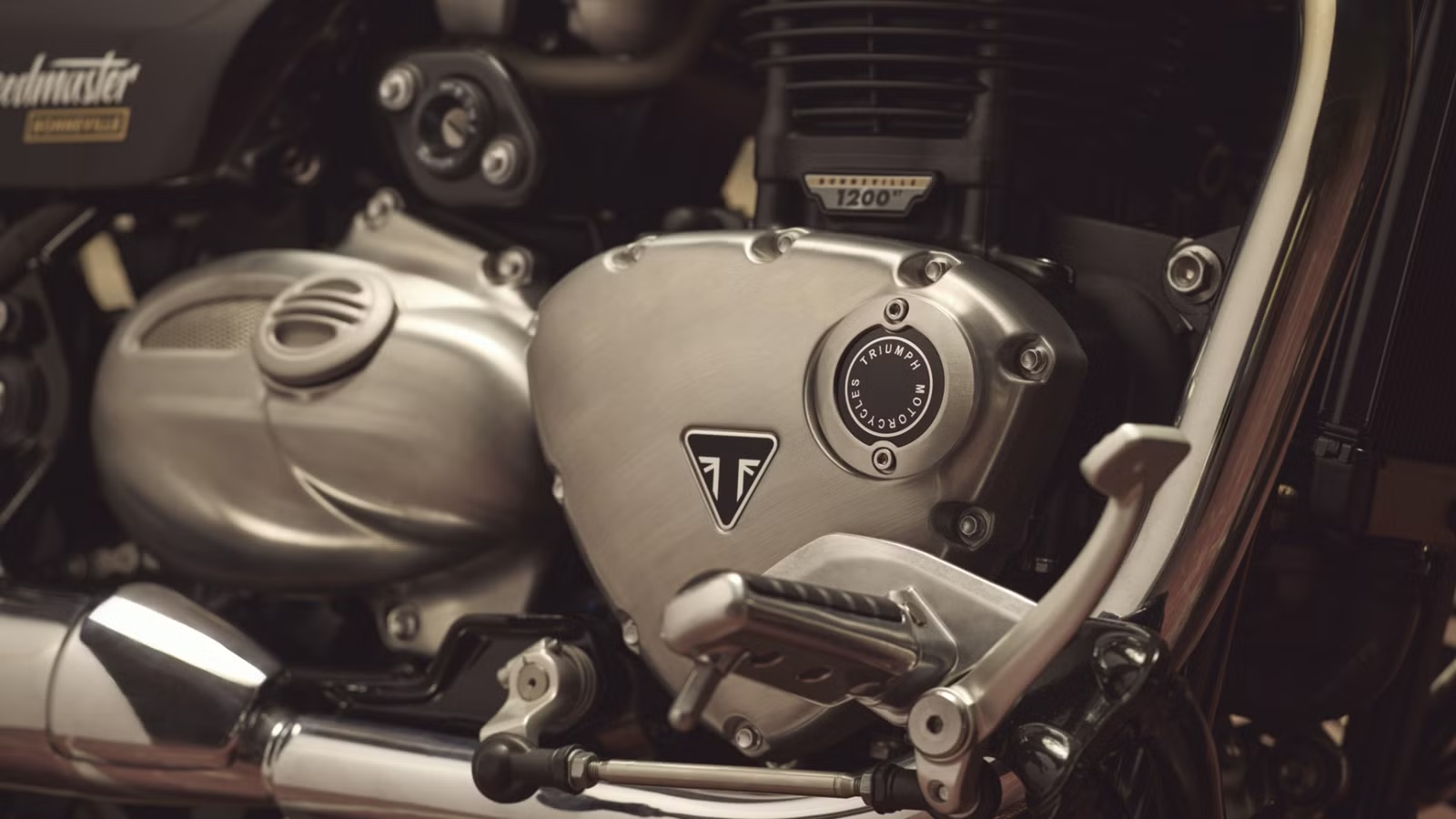
That bike is the 2026 Triumph Bonneville Speedmaster, and its numbers land right in the pocket its rivals left open. The liquid-cooled, 1,200cc parallel twin makes 77 horsepower and 78.1 lb-ft of torque, paired with a six-speed gearbox and a 270-degree crank tuned for low-end pull rather than a screaming top end. At $14,795, it costs nearly $5,000 more than Harley’s own entry-level Nightster at $9,999, and just under $2,000 less than the 1,250cc Indian Scout Classic at $16,699. Triumph didn’t stumble into that gap. It built a bike sized and priced to sit precisely inside it.
The horsepower figure looks modest sitting next to the Scout Classic’s 105 hp on a spec sheet, and that’s exactly the number a skeptical shopper will clock first. It’s also the wrong number to fixate on if you actually plan to ride the thing in traffic rather than admire it in a brochure.
Why 78 Lb-Ft Of Torque Beats A Bigger Horsepower Number

Peak horsepower on the Scout Classic arrives at 7,250 rpm. The Speedmaster’s torque peak lands at just 3,750 rpm, practically idle by comparison, which means the power that actually matters for rolling away from a stoplight or cruising through a canyon shows up the instant you crack the throttle rather than somewhere up near redline. Cruiser riders overwhelmingly live in that low-rpm band. A bigger horsepower number sounds better in an argument, but a fat torque curve down low is what actually makes a bike feel effortless to ride every single day, and that’s the case Triumph is quietly making without shouting about it.
What The 2026 Speedmaster Actually Upgrades

Triumph didn’t touch the engine or chassis for 2026, and that’s fine, because the updates that did land are the ones that matter for a cruiser buyer specifically. The fuel tank grew from 3.2 to 3.7 gallons, stretching real-world range past the 200-mile mark even with the bike’s modest fuel economy. The wire-spoke wheels stay, but new lightweight aluminum rims replace the old steel ones, cutting unsprung weight and sharpening how the bike responds to steering input. Both changes sound minor individually. Together they’re the difference between a bike you tolerate on a long ride and one you’d actually choose for it.
The bigger shift is electronic. A new inertial measurement unit brings cornering-aware ABS and lean-sensitive traction control to the Speedmaster for the first time, technology that was pure sportbike territory a decade ago and now comes standard on a cruiser wearing 1950s styling cues. Cruise control, a USB-C charging port, and a new LED headlight round out the list. None of it changes what the bike is. All of it changes how livable the bike is to actually own.
The Suspension Detail Traditional Cruisers Don’t Bother With

Most bobber-style cruisers fake the hardtail look by simply hiding the shock somewhere unflattering, or they skip the illusion entirely and let the rear end look exactly as suspended as it is. Triumph took a different route with what it calls a swing-cage rear end: a steel cage conceals a linkage-driven monoshock, preserving the clean, spring-free silhouette of a true hardtail while still delivering an actual, functioning suspension underneath. It’s a small piece of engineering most riders will never think about, right up until they hit a pothole on a bike that’s supposed to look like it can’t absorb one and discover that it just did.
What This Bike Signals About Harley’s Next Decade

One motorcycle from a British manufacturer isn’t going to sink an American institution on its own, and nobody serious is arguing that it will. What the Speedmaster represents is something more specific: proof that a rival can walk directly into Harley’s own pricing and displacement territory, undercut the segment leader on approachability, and still make a genuinely compelling case without needing to win a horsepower argument it was never going to win anyway.
Harley’s own numbers tell the more urgent half of this story. Dealers are closing, market value has cratered, and the company’s leadership has publicly called 2026 a reset year rather than a growth year. Every rider who walks past a shuttered Harley showroom and into a Triumph dealership instead is a data point in a trend that started years before this specific motorcycle existed. The Speedmaster didn’t create that vacuum. It just happened to show up with exactly the right price tag at exactly the right time to benefit from it.
Quick Answers About The 2026 Triumph Bonneville Speedmaster
A few of the most common questions riders ask about this bike, answered directly.
How much does the 2026 Triumph Bonneville Speedmaster cost?
The Speedmaster starts at $14,795 in the United States, identical to the pricing on its stablemate, the Bonneville Bobber.
What engine does the Speedmaster use, and how much power does it make?
It’s powered by a liquid-cooled, 1,200cc parallel twin producing 77 horsepower and 78.1 lb-ft of torque, paired with a six-speed gearbox.
What’s actually new on the 2026 model?
A larger 3.7-gallon fuel tank, lightweight aluminum wheel rims, an IMU-enabled electronics suite with cornering ABS and lean-sensitive traction control, standard cruise control, and a USB-C charging port.
Sources: TradingView, Triumph.

Related posts
Latest Post


No Comments