
5 Hemi Mopars Real Collectors Are Quietly Hunting Now
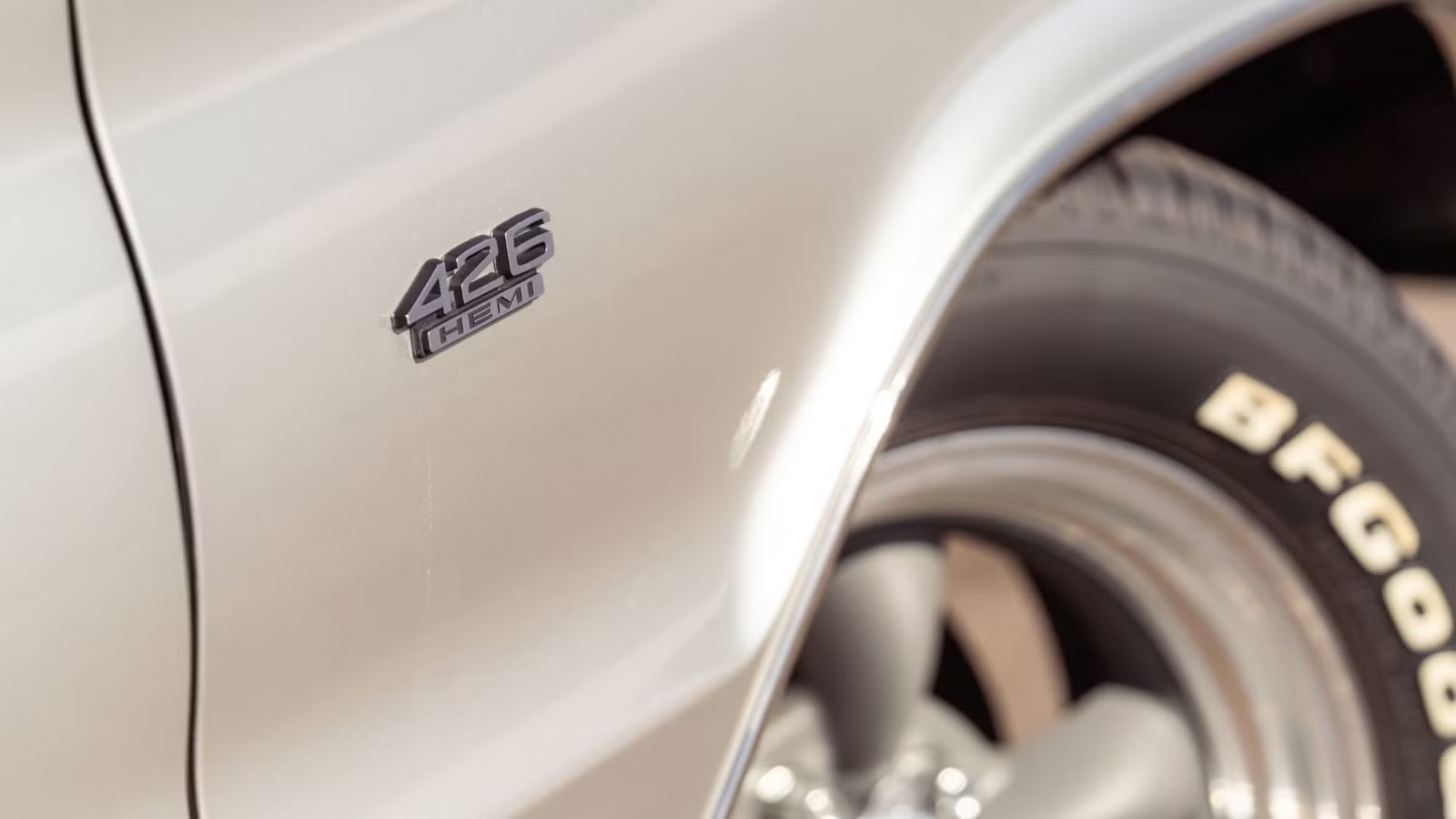
While it’s true that the Dodge Challenger R/T and ‘Cuda are some of the most sought-after muscle cars packing 426 HEMI V8 power that collectors throw money at, this potent 425-hp engine may have gotten around more than you think. The Street HEMI was an available option with tons of hot rides that are currently flooring it under the radar.

Also, the Elephant HEMI comes from the same engine family, only it was the variant designed as a race-only option for NASCAR. Because the street variant runs on standard pump gas, it was easy to drop in various models. Plus, it needed to fit into a certain number of production cars to be legal for racing.
While the ultra-rare Mopar classics get all the credit and glory, this engine can actually be found in affordable project cars. With the HEMI’s output of 425 hp and 490 lb-ft of torque, it provides thrilling raw power that drivers were after. Now collectors are hoping to find five models with the famous engine to scoop up before the word gets out.
5
1966 Coronet 500 Hemi
Value: $60,000 to over $150,000 Production: 136 Models

Back in 1966, Dodge made the 426 HEMI V8 engine available for the entire Coronet lineup, not only stripped-down race cars. It’s the earliest street-legal model to enter production with the legendary powerhouse. Sadly, it cost $908 to add the massive engine, which was insanely expensive at the time.
About 136 1996 Dodge Coronet 500 models were equipped with the powerhouse. Roughly 86 models are believed to be equipped with the four-speed manual transmission, and the other 50 cars got the three-speed TorqueFlite automatic. As few as 21 models with the convertible top may exist.
Also, the Coronet 500 trim stands out as the top-tier, sportiest option. It features vinyl bucket seats, a center console, and unique HEMI badging. The Coronet 500 HEMI was only in production in 1966 and 1967, as it was too expensive and demand was low. But the Coronet itself lasted in production from 1965 until 1976.
Only Two Were Made: Dodge’s Rarest Hemi Muscle Car Ever Built
It’s not a Challenger or a Charger. It’s the other Mopar muscle car that got the ball rolling. Today, this unicorn is worth millions.
4
1969 Plymouth Road Runner Hemi (standalone option)
Value: $122,000 to over $250,000 Production: 787 Models

Once again, adding the 426 HEMI V8 was pretty expensive. It cost about $800 to add to the 1969 Plymouth Road Runner. But it was a bit more popular to build, as 788 models were factory equipped with the massive engine. As few as 10 of the cars are believed to be convertibles, making that variant ultrarare.
Over 84,000 Road Runner models were produced that year, but the HEMI engine is only found in 1% of them. The engine is either paired with the four-speed manual or three-speed automatic Torqueflite transmission. Also, Plymouth introduced the 1969 HEMI Road Runner for racing enthusiasts who were ready to dominate the drag strip.
It was a stripped-down track-focused car, so it didn’t have creature comforts such as air conditioning. But it could be paired with special packages like the Track Pak and Super Track Pak to add components like a Dana 60 Sure-Grip rear axle, power front disc brakes, and heavy-duty cooling. The Plymouth Road Runner HEMI stand-alone option was available from 1968 until 1971. Then the Road Runner itself was in production from 1968 until 1975.
3
1971 GTX Hemi
Value: $120,000 to over $350,000 Production: 30 Models

The 1971 GTX Hemi is both extremely rare and misunderstood as a luxurious gentleman’s car. On that note, the GTX in 1971 Plymouth HEMI GTX stands for Grand Touring, and the X was a filler provided by Chrysler to designate an elevated level of luxury performance. The HEMI engine cost about $900 to add, and the muscle car market was collapsing at the time, leading to only 30 models ever being built.
Plus, 1971 was the last year the 426 HEMI engine was built. The GTX could be paired with a vacuum-operated ‘Air Grabber’ hood with pop-up graphics, a Go Wing rear spoiler, and machine-gun exhaust tips, giving it a unique style. The Super Track Pack added a heavy-duty Dana 60 rear axle, a Sure Grip limited-slip differential, and 4.10 or 3.54 gearing ratios.
The cabin features high-quality vinyl bucket seats, wood grain accents, and full analog gauges. Out of the 30 models which are considered to be royalty, only 11 models were made with the four-speed manual transmission. The rest have the four-speed automatic, and it was in production from 1967 until 1971.
10 Most Valuable 440 Six Pack Mopar Muscle Cars
These rare Mopar muscle cars with triple two-barrel carburetors are commanding six-figure prices at auction.
2
1968 Dart Hemi (Hurst LO23)
Value: $250,000 to over $350,000 Production: 80 Models

The 1968 Dodge Dart LO23, or Hurst HEMI Dart, is an iconic factory-built race car. Hurst Performance partnered with Dodge to build this drag racer, leading to only 80 models being produced. Also, it was made to rule NHRA Super Stock racing. The car needed to lose weight to meet NHRA regulations.
As a result, it was stripped of all non-racing essentials such as the rear seats, radios, and sound dampening materials. Plus, it features a fiberglass hood, fiberglass fenders, acid-dipped steel doors, and thin window glass that’s held up by straps. Because it was built for racing, Chrysler didn’t offer a factory warranty on it. The 1968 Dart Hemi (Hurst LO23) was shipped with a disclaimer stating they were only built for supervised acceleration trials.
The rear end features a Dana 60 rear axle and race-oriented 4.88 manual or 4.86 automatic gear ratios. The Dart HEMI was only made in 1969 because they were too expensive to build and weren’t street legal. However, the compact Dodge Dart was in production for 1960 until 1976 during its first initial run.
1
1970 Super Bee Hemi
Value: $200,000 to over $500,000 Production: 36 Models

The 1970 Super Bee was built on the B-body platform and represents the peak muscle of the 1970s. It was based on the mid-size Dodge Coronet platform and stands out with an eye-catching, aggressive front-end style. This muscle car has a bumblebee-wings twin-loop front bumper, a Ramcharger hood with a functional hood scoop, heavy-duty Dana 60 rear axle, and historic bumblebee stripping on the rear end.
The interior includes a power-bulge hood and stylish, athletic dashboard, and available high-back bucket seats. Too bad it cost about $848 to add the engine at the time. This accounted for one third of the car’s price. Plus, it pops with shades of high-impact rad colors such as Plum Crazy purple and Go Mango orange.
Because the1970 Dodge Super Bee Hemi was outrageously expensive, only 36 models were produced. Ultimately, high insurance premiums caused sales of this rare muscle car to remain low. But it also failed to compete against the more popular Plymouth Road Runner. While the Super Bee Hemi was in production from 1968 until 1971, only 22 to 125 models were produced each year.
Source: Hemmings, Hagerty

Related posts




Latest Post


No Comments