
Pontiac’s Last Concept Predicted The C8 Corvette Cockpit And Nobody Saw It
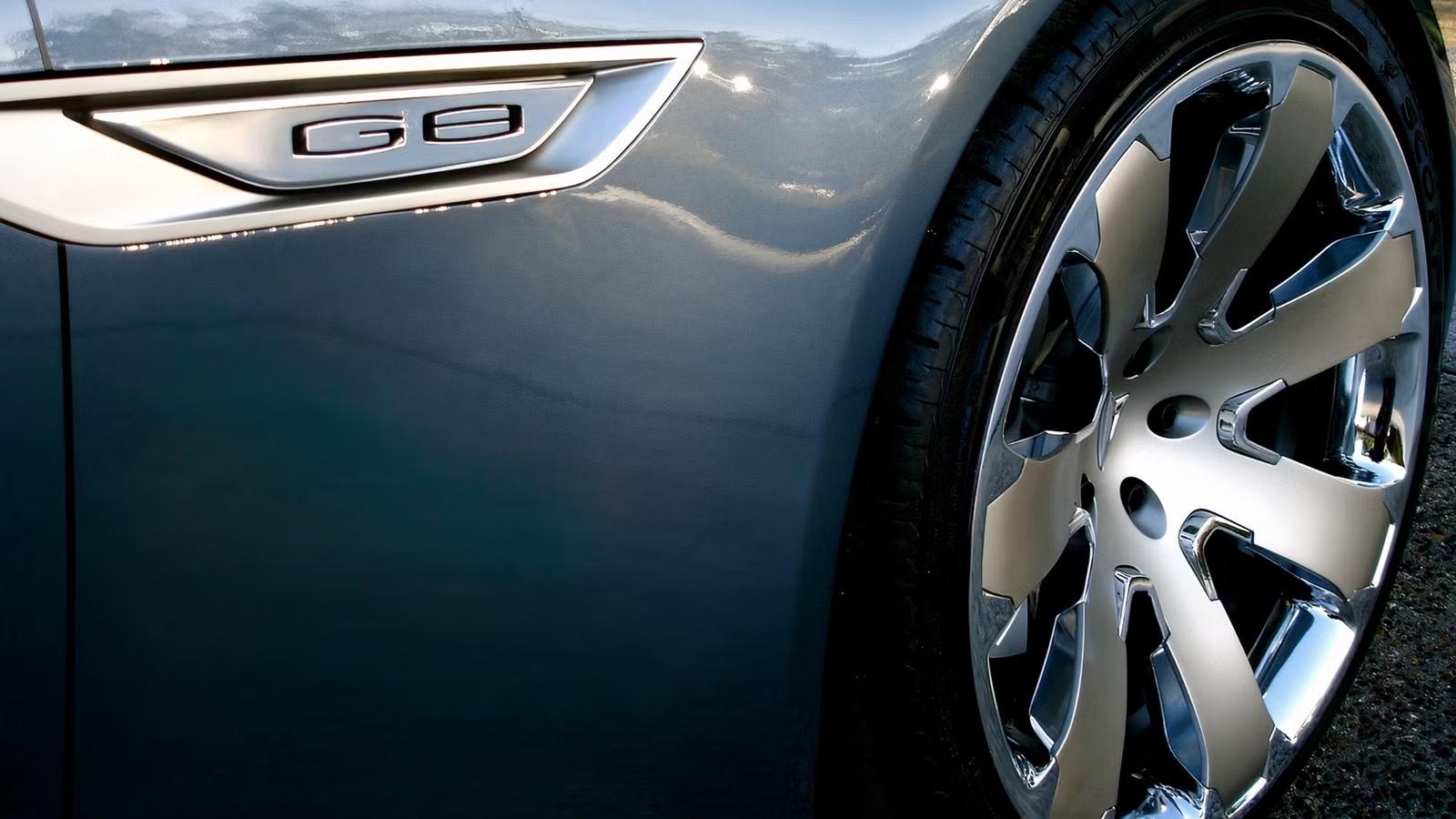
The year is 2008. The location is Southern California. More specifically, General Motors’ Advanced Studio near Los Angeles. There are the usual trappings of any design studio of that era — foam and clay design models of a particular concept sit on desks and other surfaces in the space. Pictures of said concept are stacked on workspaces.

This is pretty normal in any automaker’s design center, except for one thing — this concept wouldn’t be seen by the public for another 16 years. Not only that, but this design reached reality with a different brand from the same company, while the brand that came up with the concept would be relegated to the history books just two years later.
More than a sketch: How far the concept went
Concept cars start as sketches, and eventually they are represented physically by clay models. There are steps in between, such as using a computer to create a more fleshed-out rendering. Available photographs show that the car, a concept version of the Pontiac G8, was more than just a sketch. There was possible production intent. And, indeed, the car did make production, but not in the way Pontiac intended.

The fact that the designers took time to produce clay models suggests that they did intend it to be a production vehicle. Not every car that gets the clay treatment gets to production, of course, but having a clay model made is a sign that there is an intent to, if not build the car, at least see if producing it is feasible.
Clay models give designers a three-dimensional look at shape, including minor design touches, that can be harder to see on paper. So if a car company has a clay model, there’s some thought of possibly building the car.
A distinctly Pontiac answer to an Australian sedan

As we know, Pontiac did build a G8 sedan, based on the Australian Holden Commodore. What Pontiac dealers were selling in 2008 had differences from the concept models sitting in the GM studio in Southern California. It had a pillar-less hardtop body, frameless doors, a recessed rear-glass hatchback, and vertical headlights.
Some of these design cues came from other GM brands, such as Cadillac. Pontiac’s own Solstice roadster also influenced the concept’s design. It ended up being a more dramatic, sculpted look for a rear-drive sedan with muscle-car power. Unlike the Holden, which didn’t have as distinctive an identity.
There does remain one unanswered question: was this concept meant to replace the production G8, or was it meant to be the successor? Or was it just a more general design study?
We’ll never know for sure, since Pontiac didn’t survive GM’s bankruptcy reorganization during the Great Recession.
The cockpit was looking ahead, too

It wasn’t just the exterior that was meant to draw attention. Inside, there were four bucket seats, and the overall shape of the cabin was driver-focused.
The inside had a wraparound shape that was driver-oriented, and when the Chevrolet Corvette C8 was launched years later, that car’s interior “wall” seemed derived from this concept.
“Seemed” is a key word — we don’t know for a fact if Chevy designers used the G8 concept as inspiration. It could be a coincidence. Either way, even if it was not intentional, there’s no denying the similarities. And perhaps that’s not shocking. Both cars have driver-focused cockpits because both are performance-focused.
The production G8: A short-lived performance benchmark

As most of our readers likely remember, the production Pontiac G8, based on the Holden Commodore, was a sport sedan sold in the American market for the 2008 and 2009 model years. Three engines were offered: A 3.6-liter V6, a 6.0-liter V8 in the GT, and a 6.2-liter LS3 V8 in the GXP. Nearly 40,000 were made—38,290, to be exact—with 1,829 being GXP trims. Eight hundred and forty-six GXPs had a six-speed manual transmission, and all GXPs made 415 hp and 415 lb-ft of torque.
The missing pieces of Pontiac’s next chapter

There’s one G8 concept that was shown to the public; the G8 ST sport truck. The small, sporty pickup had Chevy El Camino vibes. Your author even got to see and touch one at a media event—there was fanfare around the ST, which was based on Holden’s Ute. A Sportwagon station wagon was also a concept idea.
The ST was planned to launch in 2010 if the brand had survived, but instead it was canceled as Pontiac faced budget cuts and reviewed its lineup ahead of its eventual failure. Former GM boss Bob Lutz later said that if Pontiac had lived, it could’ve been a niche brand offering rear-wheel-drive performance cars based on GM’s Alpha platform, competing directly with Dodge. In that case, Pontiac would’ve had a tighter, more coherent focus.
That’s just Lutz’s vision — as far as outsiders can tell, there was no lineup of future cars set for production.
The future that stayed in the archive

Pontiac’s death due to GM’s reorganization left a lot of dreams unfulfilled, including performance-car dreams.
The clay models are evidence that Pontiac had grand plans for an even sportier G8, or at least, a sportier version of the G8. They’re tangible evidence of what Pontiac could’ve been.
Considering the performance of the production G8, which proved that Pontiac could still build a rear-wheel-drive performance sedan, and the announced plans for the ST, it seemed that Pontiac had a vision for its future.
The unfinished G8 concept that was once seen in the GM studio doesn’t prove Pontiac would’ve survived had these cars come to market. Rather, it allows us to imagine what Pontiac would’ve looked like had it not been consigned to automotive history.
Source: Pontiac

Related posts





Latest Post


No Comments