
The Honda VTEC Motorcycle Engine That Still Has Modern Rivals Beat
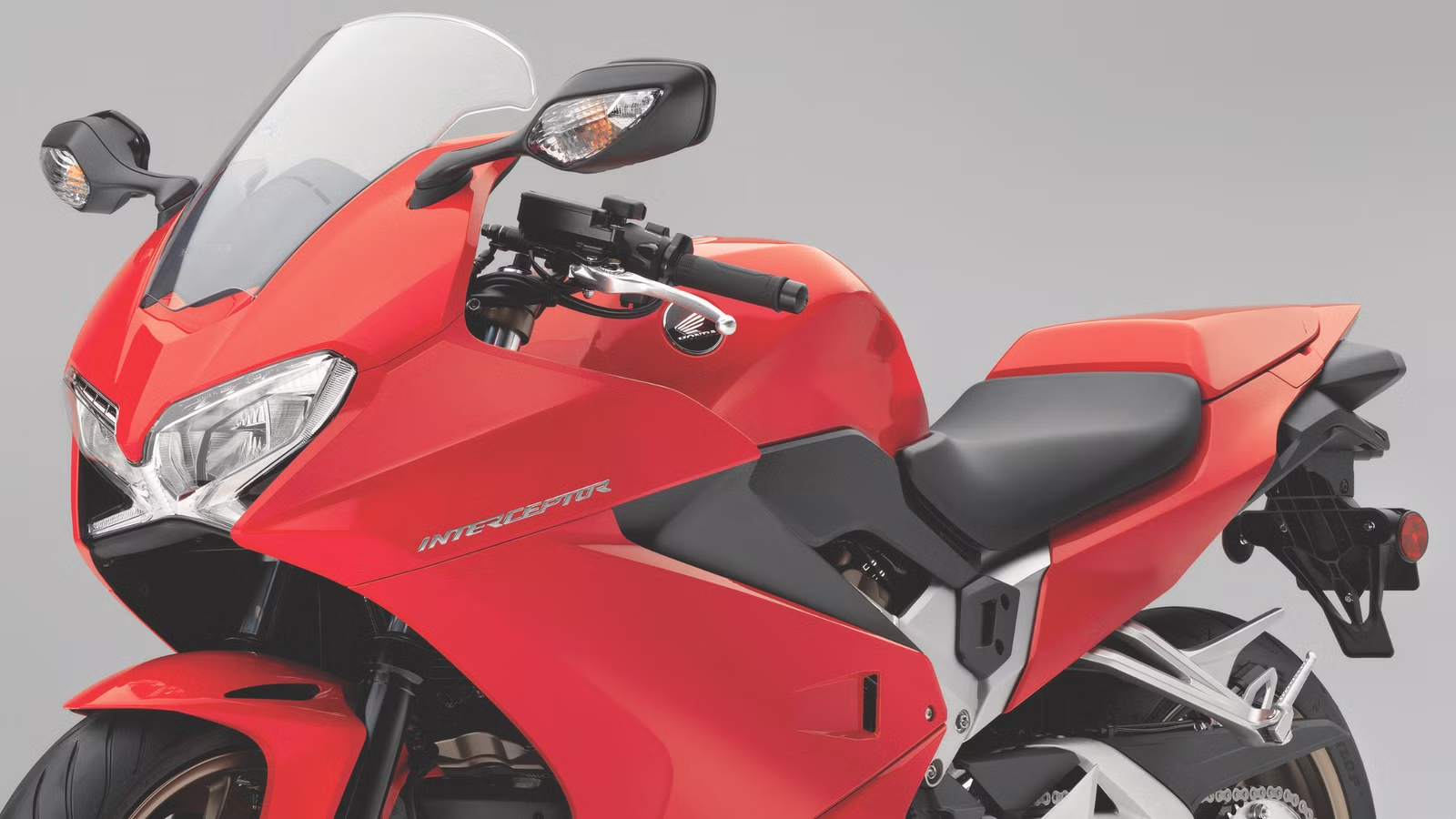
Modern touring motorcycles pack plenty of technology, from six-axis IMUs to bright touchscreen TFTs. Decades ago, though, tech meant pure mechanical engineering more than it did electronics. Honda has always been at the forefront of technological innovation on two wheels, having created legends like the CX500 Turbo and NSR500. Thankfully, Big Red didn’t reserve its smartest ideas solely for cutting-edge sport bikes. Its touring machines also received a healthy dose of clever engineering. One iconic Honda sport tourer applied VTEC technology so well that, even today, you can easily argue it outperforms many modern rivals currently on showroom floors.
The Honda VFR800F Interceptor’s 782 cc VTEC V4 Still Has Modern Rivals Beat

The Honda VFR800’s engine competes in the mid-size sport-touring segment, going up against rivals like the Yamaha Tracer 9, Triumph Tiger Sport 800, BMW F 900 XR, and, for variety’s sake, the Suzuki SV-7GX. While the competition offers inline-threes (with both conventional and crossplane crankshafts), a 270-degree parallel twin, and a 90-degree V-twin, none of them are as exotic as the VFR’s 90-degree V4.
This liquid-cooled engine features a DOHC head with four valves per cylinder. Displacing 782 cc with a short-stroke design and an 11.8:1 compression ratio, it generates 104.5 horsepower at 10,250 RPM and 55.4 pound-feet of torque at 8,500 RPM. Of course, its headlining feature is Honda’s VTEC system, though it operates differently from the system found in Honda automobiles.
The VTEC Doesn’t Work The Same Way As In Honda’s Cars

While Honda cars vary the timing of valves with their VTEC systems, the VFR opens just one intake and one exhaust valve per cylinder up to around 6,400 RPM before engaging all four valves. This boosts torque and fuel efficiency at lower revs while delivering strong top-end power. Working alongside Honda’s PGM-FI fuel injection, the transition is noticeably smoother in this final iteration of the VFR800.

It also ditched the side-mounted radiators of the previous generation for front-mounted units and sent its power to the rear wheel via a six-speed gearbox and chain final drive. The gearbox had a clutch with hydraulic assistance, and an optional upshift-only quickshifter. Honda didn’t stop at the powertrain, surrounding that VTEC V4 with chassis hardware that still holds up today.
A Twin-Spar Aluminum Frame And Single-Sided Swingarm Still Hold Up Today

By the end of its run, the VFR800F was a truly premium motorcycle, although greatly underrated. Its last iteration has a perimeter twin-spar aluminum frame with a die-cast aluminum subframe and a single-sided swingarm made from the same light metal. For suspension, it uses a 43 mm fork at the front and a Pro-Link monoshock at the rear with adjustable preload and rebound damping. If you can get yourself the Interceptor Deluxe trim, it adds adjustable rebound damping for the front fork and a remote preload adjuster for the rear shock.
It uses twin 310 mm front brake discs with radial four-piston fixed calipers. At the rear, it has a 256 mm disc with a two-piston floating caliper. The brakes are mounted on hollow 10-spoke alloy wheels whose fine die-cast construction method was a world first, and they are fitted with tubeless tires. These specs hold up well to all but the most premium middleweight tourers available today, especially the Deluxe.
Two US Variants Were Available — And They Both Cost The Same Today

There were two variants of the Interceptor on sale in the US market for 2014 and 2015 — this is one of the popular Hondas that isn’t on sale anymore. Mechanically, they were mostly identical, differing only in suspension adjustments. It had all-LED lighting with an X-shaped running lamp and an instrument cluster with a large central analog tachometer flanked by LCD screens. A 5.6-gallon fuel tank made sure that you could go quite far on a single tank.
What The Deluxe Offers That The Base Trim Doesn’t

The Deluxe model added the following features over the base model, while weighing seven pounds more at 536 pounds: a dual-channel ABS system, Honda’s switchable HSTC traction control, five-stage heated grips, electronic self-canceling indicators, and a center stand from the factory. Both variants got accessories like color-matched 7.7-gallon hard side cases, an 11.9-gallon top box, an upshift-only quickshifter, and 0.6-inch handlebar risers.
So it makes sense to look for a Deluxe variant, since both trade for roughly $9,000 today in good condition. If you opt for older generations, you can have one for less than $5,000, making it one of the best used motorcycles within that budget. Seeing how well-equipped the VFR800F was makes its matchup against today’s middleweight sport tourers even more interesting.
You Could Have Modern Rivals With Three Cylinders From Triumph And Yamaha

The Tracer 9 is Yamaha’s most complete motorcycle, and the obvious counterpoint to the VFR800F Interceptor. It costs $12,599 new and has an engaging engine with a unique character: the CP3 crossplane inline-three, which generates 117 horsepower. It also has a large seven-inch TFT display and standard luggage in the US market, but Yamaha’s best tech has been left out to keep the costs in check. Another three-cylinder option at a similar price is the Triumph Tiger Sport 800, which retails at $12,845.
There Are Also Two-Cylinder Options From BMW And Suzuki

If you want a prestigious badge on the tank, there is always the BMW F 900 XR, which is the Bavarian brand’s most complete motorcycle. It is reasonably priced, too, at $12,695. However, you have to live with a parallel-twin engine — even if it has a 270-degree firing order — and a lower power output than rivals. Finally, if you want to keep budgets well in control, there is the Suzuki SV-7GX, which costs $8,599. It earns points for its 90-degree V-twin engine, which is now equipped with a by-wire throttle, but in all other areas it lacks the equipment and performance of the other options here.
Sources:Honda Global, KBB

Related posts


Latest Post


No Comments