
Pontiac’s First Front-Engine Supercar GM Was Never Brave Enough To Build
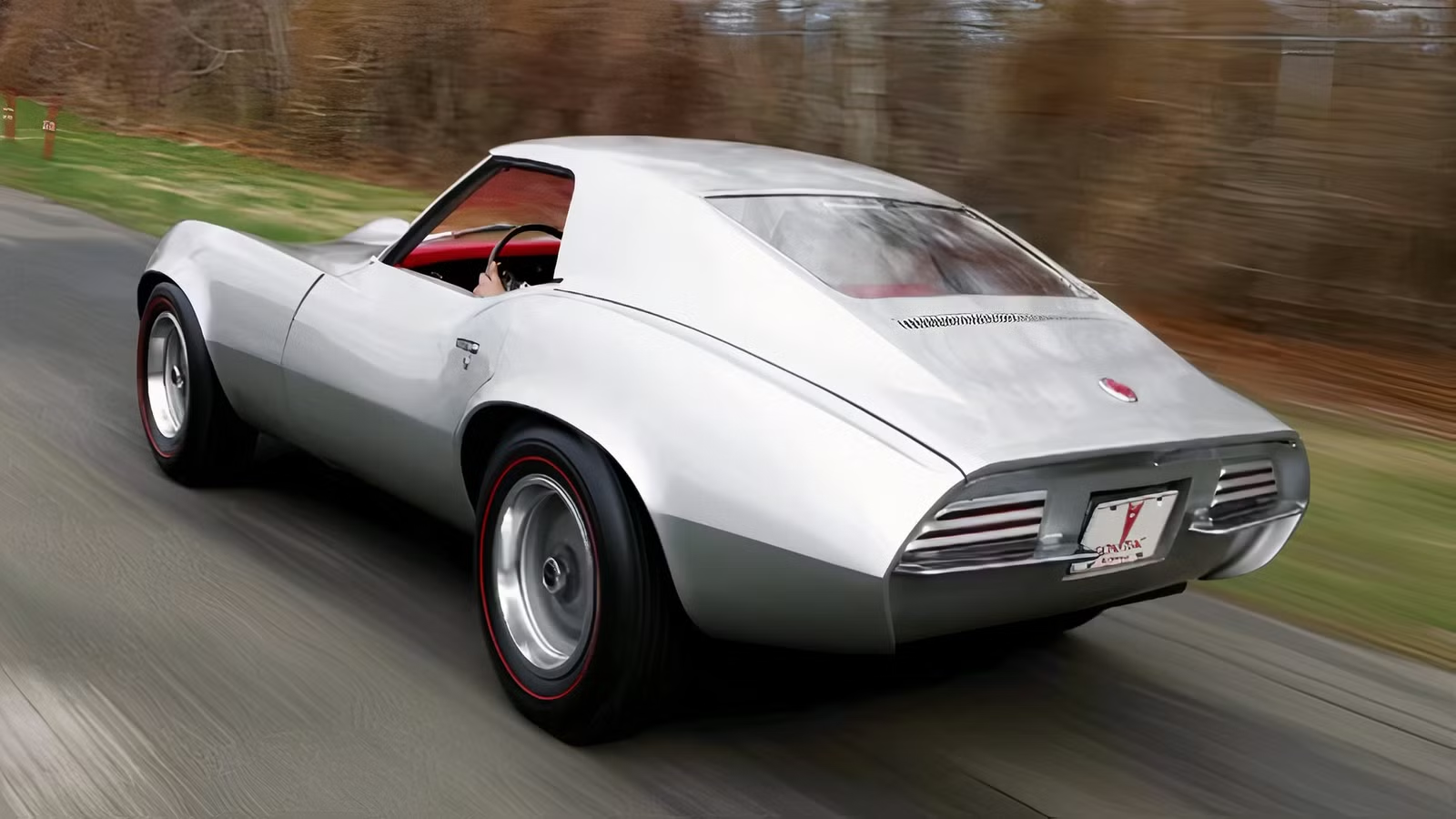
Few chapters in American performance history sting quite like a great car that never got built. Pontiac‘s XP-833 is exactly that — a project so well-engineered and so genuinely threatening that General Motors quietly strangled it in the boardroom before the public ever got a chance to fall in love with it. While Ford and Dodge were locked in their familiar horsepower wars, Pontiac’s engineers were drawing up something far more ambitious: a lightweight, European-flavored sports car that could have rewritten the brand’s legacy entirely.

Behind General Motors‘s corporate walls, a project took shape that sought to lift Pontiac out of the muscle car wars and into the 1960s sports car scene. It would be a sleek, front-engine performance car bearing the Pontiac badge, and unlike many experimental show cars of that time, this project progressed enough to show real production potential. And yet, despite all the momentum, it never made it to the showroom floor — not because Pontiac couldn’t build it, but because doing so threatened to ignite a civil war within General Motors that its bosses were determined to avoid.
UPDATE: 2026/02/19 14:07 EST BY MAGDAN D. CVITESIC
This article has been updated with more detailed information on the development of the Pontiac XP-833 prototypes, including the story of what happened to the original two examples, and the unlikely European alternative inspired by the XP-833’s design and its price today. We also added more technical details that made the XP-833 concepts so unique, and explained how the vision was eventually realized with the Pontiac Solstice in 2005.

The Corvette-Killer Pontiac Never Dared To Build
Pontiac’s bold effort to build a bespoke sports car took on the project name XP-833 and was later popularly dubbed the “Banshee.” It was an experimental project designed to push the company into serious performance territory.
In 1964, John DeLorean, then chief engineer at Pontiac, spearheaded the XP-833 project alongside engineer Bill Collins. While DeLorean supplied the rebellious vision and political maneuvering — famously pitching it as a “Mustang fighter” to sidestep Corvette-related scrutiny — Collins was the project’s technical architect. He designed a lightweight chassis (roughly 2,200 lbs) using a fiberglass body over a steel structure and drew from the GM parts bin to keep production costs manageable. The result was a car nearly 400 lbs lighter than a 1965 Mustang and a remarkable 800 lbs lighter than a Corvette.
The XP-833 was built around advanced engineering, an innovative chassis, and high-performance powertrains — a genuine statement of intent from Pontiac as a serious sports car contender. Engineers kept performance as the primary goal rather than styling alone, envisioning a front-engine coupe that would project a more sophisticated, grown-up image for the marque.

The project leaned heavily on performance hardware drawn directly from the Corvette, which made it far more credible than anything else in Pontiac’s lineup — and that proximity is precisely what caused problems with GM’s leadership. For them, the Corvette was the corporation’s most prized and exclusive sports car nameplate, and its status was to be protected by carefully managing competition among GM’s own divisions.
Despite the engineers’ best efforts, GM executives killed the project to protect the Corvette. The experience deepened DeLorean’s frustration with corporate bureaucracy, ultimately contributing to his departure from GM in 1973. He later brought Collins along to channel their shared vision into an independent venture: the DeLorean Motor Company and the DMC-12.
The timing worked against the project as well. The early 1970s brought stricter emissions regulations and growing pressure around fuel economy, forcing manufacturers to reassess their priorities. Faced with internal opposition and an uncertain market, GM ultimately cancelled the XP-833 altogether, ending any realistic hope of production.
What Happened To The Two Banshee Prototypes?
The two surviving Banshee prototypes were famously rescued from the GM crusher, eventually finding homes with the men who had breathed life into the project. The silver OHC-6 coupe was purchased by Bill Collins, the project’s lead engineer, who kept the car in remarkably original condition for decades. Meanwhile, the white V8 convertible — the more aggressive performance variant — was acquired by Bill Killen, a fellow Pontiac employee.
Corvette DNA And Supercar Ambitions, But No Production Approval

The XP-833 wasn’t merely a styling exercise. For Pontiac’s engineers, it was a direct challenge to the established hierarchy within General Motors. They incorporated suspension designs from the Corvette, a rear-wheel-drive layout, and a well-sorted chassis tuned for balanced handling and real-world road manners — not just straight-line speed. Lightweight construction methods were central to boosting agility, and the approach foreshadowed techniques later seen on the Pontiac Firebird.

|
Engine |
Power |
Torque |
|---|---|---|
|
1.1-liter I4 |
67 hp |
69 lb-ft |
|
1.9-liter I4 |
102 hp |
107 lb-ft |
Visually, the XP-833 wore the aerodynamic “Coke-bottle” styling that left a lasting mark on GM’s global design language. Although the XP-833 never reached production, its DNA migrated to Europe in a very tangible way — most strikingly in the Opel GT, which borrowed the Banshee’s signature pointed nose, hidden clamshell headlights, and high-hipped rear fenders. The connection makes perfect sense, since General Motors owned both Pontiac and Opel at the time.

Debuting in 1968 — just two years after Pontiac presented the XP-833 — and in production from 1968 through 1973, the Opel GT was often called a “mini Corvette.” It served as a smaller, more accessible model inspired by DeLorean and Collins’ original vision for a lightweight, stylish two-seater. Under the hood, however, the Opel was no muscle car. The base engine was a 67-hp 1.1-liter four-cylinder, with the top option being a 1.9-liter unit barely clearing 100 hp. Even in top trim, Opel GTs needed around 10 seconds to reach 60 mph.
Cheap XP-833s On The Used Market?
Well, almost. Opel GTs are now genuine bargains on the used market; Classic.com shows an average price paid of around $15,000, with some examples trading hands for as little as $6,000. In other words, you can own what essentially looks like a smaller version of the legendary Pontiac XP-833 “Banshee” for what amounts to pocket change today — just don’t tell anyone.
The XP-833 featured a unitized steel structure with a bonded fiberglass skin, combining a robust perimeter frame and flat floors for high rigidity at low weight. Tested at the Milford Proving Grounds, its chassis used a coil-over double A-arm front suspension and a 10-bolt live axle with a sophisticated four-link Watts linkage. Engineers used hand-welded, adjustable links to fine-tune geometry, while the high-tucked exhaust and driveshaft placement foreshadowed the C4 Corvette’s design.
Under the hood, plans called for powerful Pontiac-built V8s capable of broad torque delivery. Options included Pontiac’s 389ci engine (standard in the GTO) producing up to 335 hp, alongside massive 421ci blocks rated at 370 hp in Catalina and LeMans models. The powertrain also included a T-10 four-speed gearbox and 9.5-inch manual drum brakes.
In other words, Pontiac had plenty of firepower to make the “Banshee” a genuine Corvette alternative. None of those engines could match a ’65 Corvette fitted with an L68 (400 hp) or L72 (425 hp) 427ci block, but the XP-833’s massive weight advantage could ostensibly have made it the quicker car in the real world.
Although official testing figures were never recorded — since the car never reached production — performance projections still placed the XP-833 firmly in Corvette territory. Pontiac’s planned high-output V8 development suggested output exceeding 300 horsepower, enough to make the car competitive with GM’s flagship sports model and contemporary rivals from both America and Europe.
Killing The XP-833 Changed Pontiac’s Performance Identity

When the XP-833 was cancelled, Pontiac was forced to rethink its approach to performance, which ultimately meant producing performance variants of shared GM platforms like the Pontiac Firebird and Pontiac Trans Am.
While those models became icons in their own right, they were never a bespoke sports car — Pontiac was headed down a fundamentally different path. Building a standalone, globally competitive sports car was no longer on the agenda. Instead, Pontiac was directed to refine existing muscle car formulas, effectively sidelining the brand from GM’s long-term halo car development. With Pontiac returned to its lane, the Corvette’s status as GM’s flagship performance nameplate was secured and the internal threat to the status quo had been neutralized.
As corporate priorities took hold, Pontiac’s focus shifted from rivaling the Europeans to styling, marketing, and high-output versions of shared platforms. In hindsight, cancelling the XP-833 was a turning point that defined Pontiac’s identity for decades and permanently limited the brand’s ability to grow into a premium performance name in its own right.
The Banshee Concepts Tried To Revive Pontiac’s Supercar Dream

Although the XP-833 never went into production, a lingering ambition among Pontiac insiders kept the idea of a dedicated sports car alive. The XP-833 later inspired a series of experimental Banshee concepts, each aimed at pushing Pontiac back toward Corvette territory.
The original Banshee prototypes appeared in 1964, and later iterations such as the Banshee IV followed in the late 1980s. These designs highlighted improved aerodynamics, lightweight construction, and performance goals that mirrored the Corvette’s mission. Even with corporate forces consistently blocking Pontiac from stepping beyond its assigned role within GM’s hierarchy, the brand simply couldn’t shake its ambition to build a premium, performance-focused sports car flagship.

Beyond the original XP-833, Pontiac used the “Banshee” name for three more influential concept cars that shaped the brand’s design direction for decades.
Banshee II (1968)

This concept featured an ultra-aerodynamic fiberglass skin over a modified Firebird chassis, characterized by a “cut-down” racing windshield and deep hood louvers. It later evolved into the “Firebird Fiero,” showcasing flush wheel covers and separate adjustable headrests for the driver and passenger.
Banshee III (1974)

Built on a production Firebird platform, the Banshee III pursued a “soft-look” aesthetic with a long, sloping nose and covered headlamps that directly previewed the 1977 Trans Am. Its most striking feature was a futuristic curved wraparound rear window and fixed side glass that sat perfectly flush with the bodywork.
Banshee IV (1988)

This space-age 2+2 featured a signature twin-nostril nose and a complex fighter jet interior complete with a heads-up display and over 20 buttons on the steering wheel. It used an experimental 4.0L V8 with an “integral” head-and-block design that eliminated the need for head gaskets entirely.
As promising as each concept appeared, they all ran into the same corporate hurdles that had killed the original. As platform sharing intensified through the 1980s and 1990s, Pontiac drifted further toward performance-tuned versions of existing GM models rather than standalone sports car programs.
The effort invested in the Banshee prototypes was far from wasted, however. Technologies and design ideas explored through these programs eventually found their way into production vehicles like the Firebird and Trans Am, particularly in aerodynamic styling and composite bodywork.
Looking back, the XP-833 set a pattern that Pontiac found impossible to break. The brand made repeated attempts to build a true halo sports car, and was consistently blocked by corporate brand protection from above. Pontiac maintained a strong performance image throughout, but always lacked the flagship model that could have reshaped the brand’s long-term identity.
The XP-833 Symbolizes What Pontiac Could Have Been

The XP-833 remains one of Pontiac’s most compelling “what if” moments — another entry in the long list of concepts that never made it to production. It exceeded expectations by demonstrating that the brand had both the engineering talent and the ambition to go well beyond what it was already known for.
A front-engine performance flagship bearing the Pontiac badge never saw the light of day, yet it endures in automotive memory — not only for the drive and ambition it represented, but for the repeated attempts to revive that spirit through the Banshee concepts, even as corporate opposition continued to say no. In hindsight, the XP-833 offers a clear-eyed view of a performance future that Pontiac was never fully permitted to pursue.

Forty years after the XP-833 was shelved, the 2005 Pontiac Solstice finally realized DeLorean’s dream of a lightweight, affordable two-seater that avoided direct competition with the Corvette. Often cited as the Banshee’s spiritual descendant, the Solstice echoed the original concept’s philosophy of delivering a stylish, pure sports car experience for the masses. It launched with a base 177-hp 2.4-liter inline-4, but buyers could also opt for a surprisingly quick 260-hp turbocharged version capable of a 5.5-second 0-60 mph run. It was small and nimble — and it at least gave enthusiasts a glimpse of what the Banshee could have been in the ’60s had Pontiac been allowed to see it through.

Fun fact: the Opel GT also returned a few years after the Pontiac Solstice made its debut, but this time it shared its platform with the Saturn Sky rather than the Solstice. Performance was broadly on par with the Pontiac, with both cars offering turbocharged four-cylinders and serving as a viable alternative to the likes of the Mazda Miata, Porsche Boxster, and Honda S2000 alternative in the mid-2000s. alternative to the likes of the Mazda Miata
Sources: Classic.com, Hagerty, New England Auto Museum.

Related posts




Latest Post


No Comments