
Pontiac Stuffed One Of America’s Greatest Performance V8s In A Plain Sedan
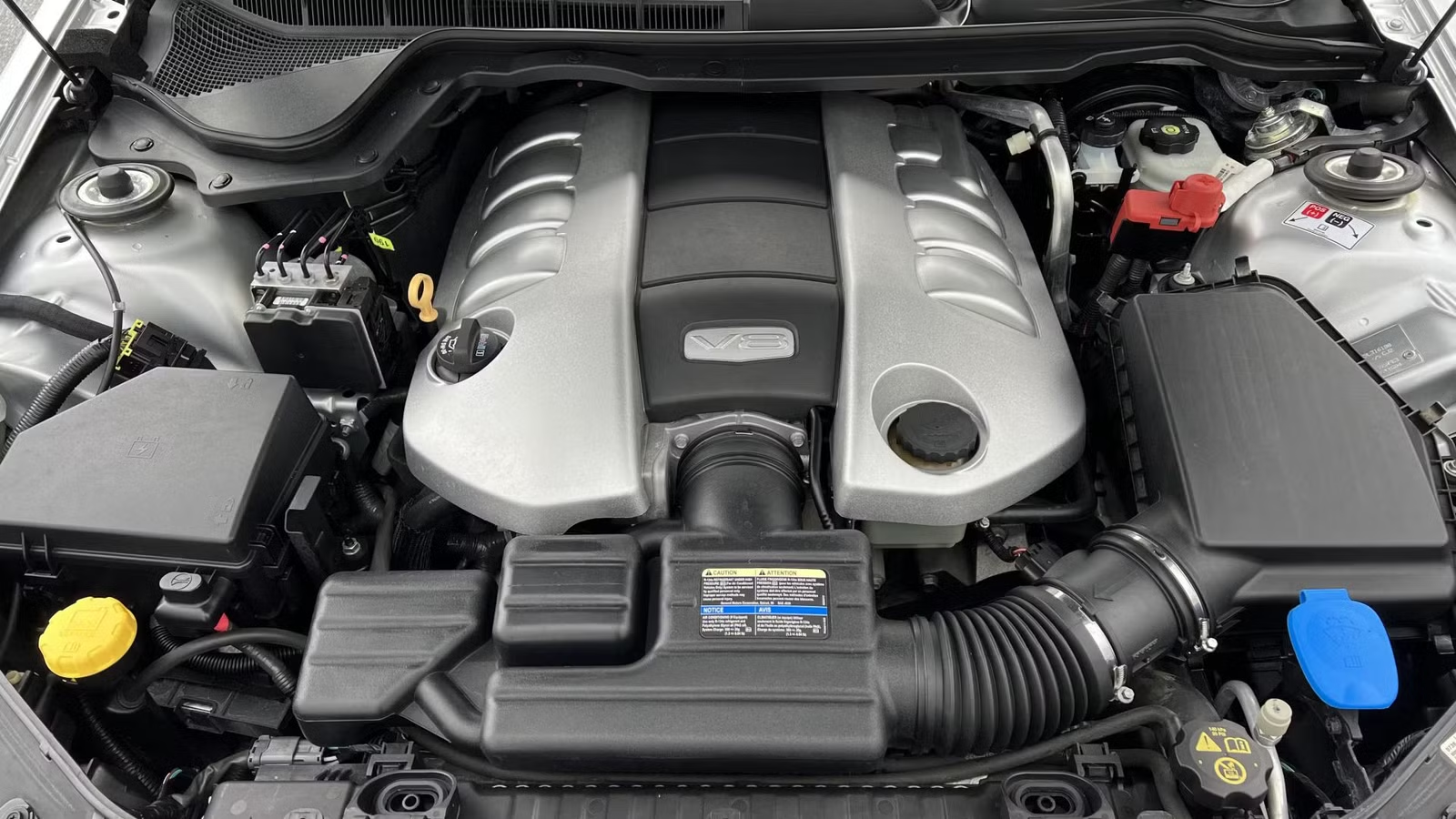
Few automakers have gone out on as high a note as Pontiac. The brand may be gone, but its legacy is very much alive among enthusiasts who know exactly what it was capable of — and the cars it left behind are proof that the engineers never stopped pushing. If anything, some of Pontiac’s most compelling performance machines arrived right at the end, when the brand had little left to lose and everything to prove.

One of those final performance models was fitted with what is arguably one of the best and most powerful General Motors engines ever built. While it was based on an architecture that is commonplace across GM’s lineup, its performance figures were anything but ordinary. That was made especially clear by the understated sedan it ended up in.
The Modern LS Engine Has Been One Of General Motors’s Most Enduring Engine Designs
Since its introduction in 1997, the modern General Motors LS engine has been a cornerstone of GM’s performance lineup. That has obviously included a long list of high-performance Chevrolets, as well as select high-performance Cadillacs. More recent high-performance Pontiacs also received various iterations of the LS. Pontiac is especially associated with one particular version of the LS, and that is the version we are going to focus on here.

The Generation IV LS3 V8 Is A Modern Small-Block With Serious Power

Part of the Generation IV line of LS V8s, the LS3 first appeared in 2008. At 6.2 liters in displacement, the LS3 is one of the larger LS units in the family — yet it still falls under the small-block banner. At launch, it was rated at 430 horsepower and 424 lb-ft of torque. Later factory applications pushed output beyond the 450 hp mark. That is serious power by any measure, let alone for a small-block V8.
The LS3 Was Put Into One Of Pontiac’s Greatest Sleeper Sedans Ever

The LS3 V8 would be a performance legend regardless of what car it was placed in. But it only adds to the story that one of the cars that offered it as an engine option is one of the most celebrated sleeper sedans of all time. The Pontiac G8 GXP was the top-of-the-line variant of the short-lived G8 sedan. This variant came exclusively with the LS3, and Pontiac rated it at 415 hp and 415 lb-ft of torque. That output translated to a claimed 0–60 mph time of just 4.7 seconds and a factory-limited top speed of 146 mph.
Not only was the LS3 standard equipment on the G8 GXP, but buyers could also pair it with a proper 6-speed manual transmission. That combination placed it firmly in the upper echelon of enthusiast appeal. A subtle V8 muscle sedan with big power, genuine practicality, and the option of a manual gearbox? It is hard to argue against the G8 GXP.
It Was A Captive Import Of An Australian Performance Legend
While the Pontiac G8 GXP reads like the most American muscle sedan imaginable, its true origins lay far from Detroit. It is a captive import of the VE-generation Holden Commodore HSV. North American Pontiac versions were assembled at the same Holden plant in Elizabeth, South Australia as the Commodores sold in Australia and New Zealand, then shipped to the United States. It is about as pure a definition of a captive import as you will find.
Barely Any G8 GXPs Were Ever Sold

Given its enthusiast credentials, you might expect the Pontiac G8 GXP to have sold in strong numbers. Sadly, that was not the case. Only 1,829 GXPs were sold in 2009, out of a total of 26,404 G8s across all trim levels that year.
Part of those poor sales figures can be attributed to the GXP being a niche halo model. But much of the blame also falls on Pontiac itself, which was already in a steep decline as a brand. Pontiac was discontinued entirely the following year, and with it went the G8 — after just two model years of production and far fewer cars sold than the brand might have hoped.
SLP Built An Even Wilder Version Of The G8 GXP

“SLP Firehawk” is a name that immediately rings a bell for loyal Pontiac fans. In the 1990s, Street Legal Performance (SLP) made high-performance Firebirds even nastier, and the company was not about to let Pontiac’s final rear-drive sedan escape untouched. SLP converted both G8 GTs and GXPs, but the GXP-based cars became the rarer and more extreme versions. The company supercharged the GXP’s 6.2-liter LS3, added a Blackwing cold-air intake, PowerFlo exhaust, custom PCM tuning, and suspension upgrades, with output reportedly reaching roughly 550 hp.
The Firehawk treatment extended well beyond the engine bay. A flat-black hood and rear spoiler, revised grille treatment, gunmetal 19-inch wheels, Firehawk badging, and an individually numbered dash plaque gave each car a distinct identity. Production was exceptionally limited: just 29 G8s received the Firehawk conversion, and only nine of those were GXPs. That makes the GXP Firehawk far scarcer than even the already uncommon standard GXP, and a particularly desirable piece of Pontiac history.
The LS3 Appeared In A Host Of Other Performance Cars, Too

While we have focused on the Pontiac G8 GXP here, this outstanding sleeper sedan was far from the only car to receive the LS3. One of its earliest applications was as the base engine for post-2007 versions of the C6 Chevrolet Corvette, replacing the outgoing 6.0-liter LS2. The Chevrolet SS — the G8’s spiritual successor, based on the later VF-generation Holden Commodore — carried the LS3 forward as well.
Manual transmission versions of the fifth-generation Chevrolet Camaro SS also used the LS3. A handful of smaller manufacturers took advantage of the engine’s reliability and off-the-shelf availability to power their more exotic offerings. The AC 378 GT Zagato, SIN R1 450, Arrinera Hussarya 33, and Bolwell Nagari 500 all used the LS3. In the Arrinera Hussarya 33, the engine was supercharged, pushing output to a reported 789 hp.
Buying A Pontiac G8 GXP Today

The G8 GXP checks nearly every box enthusiasts look for: a big naturally aspirated V8, an excellent chassis, an available six-speed manual, and genuine scarcity. Add the fact that Pontiac is now a defunct brand, and it seems like the kind of car destined for collector status. Yet G8 GXP values have not exactly taken off. Hagerty currently puts a good-condition example at roughly $25,200, with a 15% premium for the manual transmission. A 78,000-mile automatic GXP that sold for $23,900 in June 2026 shows that buyers can still acquire serious performance for relatively modest money.
The SLP Firehawk sits in another league entirely. A GXP Firehawk with only 874 miles attracted a $68,000 high bid in July 2026, though the reserve was not met. That level of interest signals that collectors are beginning to recognize just how special these cars truly are.
Sources: Holden, Pontiac, Chevrolet, Hagerty, Bring a Trailer

Related posts

Latest Post


No Comments