
The Rare Infiniti Sedan With Four-Wheel Steering And A Detuned 300ZX V6
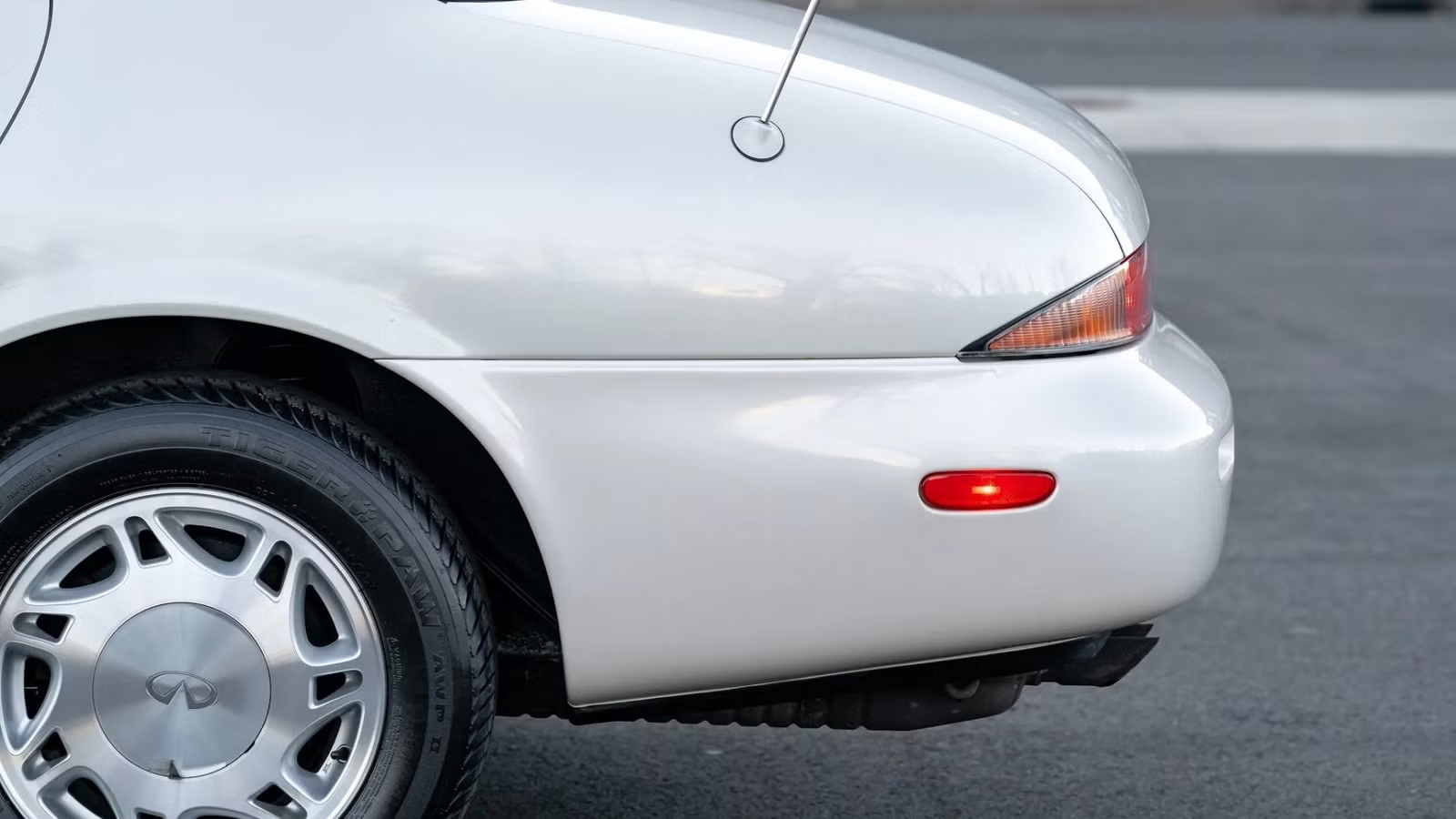
Japanese automakers built some remarkable performance cars in the 1990s, but not all their interesting machines looked sporty. One luxury sedan combined rear-wheel drive, a V6 closely related to the Nissan 300ZX‘s engine, and an advanced four-wheel-steering system, but its unusual styling and focus on comfort kept it out of the enthusiast spotlight. Today, it remains largely forgotten, even as collectors pay serious money for Japanese classics from the same era. Its engineering deserves another look, especially considering how little it costs.
One Of The Strangest Japanese Luxury Sedans Of The 1990s

The early 1990s marked a turning point for Japanese luxury cars. Toyota challenged the establishment with the Lexus LS 400, while Acura proved that Japanese manufacturers could compete with European brands on quality and performance. Nissan joined the fight in 1989 with its Infiniti division and the V8-powered Q45 flagship. However, challenging Mercedes-Benz, BMW, and Jaguar required a broader lineup. Infiniti needed a smaller luxury sedan that could attract buyers without commanding Q45 money. Rather than copying the upright styling of traditional executive cars, Nissan developed a four-door with rounded bodywork, a long hood, and a sweeping roofline. It looked more like a stretched luxury coupe than a conventional sedan.
Beneath those curves sat a rear-wheel-drive platform, a layout familiar to BMW and Mercedes-Benz buyers. It allowed Nissan’s engineers to balance handling and ride comfort without asking the front wheels to handle propulsion. Still, luxury remained the priority – the flowing bodywork emphasized elegance, while the cabin favored rich materials over sporty details. That approach had drawbacks, though – despite its substantial exterior dimensions, the sloping roof and rounded rear limited interior space. Nissan had effectively applied the personal luxury coupe formula to a four-door sedan, creating something quite different from the boxy executive cars of the period.
Underneath The Luxury Car Was Some Very Familiar Nissan Hardware


The styling suggested a soft boulevard cruiser, but the engine bay told another story. Under the hood sat Nissan’s VG30DE, a naturally aspirated 3.0-liter V6 with dual overhead camshafts, 24 valves, and electronic fuel injection – enthusiasts will probably recognize that engine code from the Z32-generation Nissan 300ZX. The sedan used a closely related version producing 210 horsepower and approximately 192–193 lb-ft of torque. That fell slightly below the naturally aspirated 300ZX’s 222 horsepower and 198 lb-ft, reflecting the sedan’s different mission. Nissan prioritized smooth power delivery and quiet operation over outright speed.
The VG30DE was sophisticated machinery for its time. Its twin-cam cylinder heads helped the engine breathe efficiently at higher speeds, while its smooth operation made it equally suitable for luxury-car duty. The sedan’s sound insulation and four-speed automatic transmission kept much of that character in the background. Nevertheless, the combination of a sports-car-related engine and rear-wheel drive gave this comfortable four-door an intriguing mechanical pedigree. And the Touring version had another trick up its sleeve.
The Infiniti J30t Was Essentially A Secret 300ZX Sedan Nobody Remembers

The car was the 1993–1997 Infiniti J30, particularly the J30t Touring. Infiniti marketed it as a “personal luxury sedan,” positioning it between the smaller G20 and flagship Q45. Its distinctive shape came from Nissan’s California design operation, led by Jerry Hirshberg, which favored flowing surfaces over the sharp lines of the previous decade. The production car featured a long hood, short rear deck, slim pillars, and a rounded tail. In Japan, Nissan sold a related model called the Leopard J. Ferie, which even offered a 4.1-liter V8, but American buyers received only the 3.0-liter V6. The J30’s appearance divided opinion from the beginning, but nobody could accuse Infiniti of building another anonymous sedan.
The J30’s engineering went well beyond its powertrain. Its Y32-family rear-wheel-drive platform featured independent suspension, a multilink rear arrangement, and a standard viscous limited-slip differential. The latter helped manage torque distribution between the rear wheels when traction differed. Although it didn’t share the 300ZX’s chassis, the sedan benefited from Nissan’s broader investment in advanced performance technology.

The early J30t added firmer suspension tuning, a rear spoiler, distinctive BBS-style alloy wheels, and, most importantly, Super HICAS four-wheel steering. Nissan also used this technology in the Z32 300ZX Twin Turbo and certain Skyline models. Instead of keeping the rear wheels fixed, Super HICAS used electronically controlled hydraulics to make small steering adjustments. These movements, reaching approximately one degree, helped improve stability and response during cornering. The system aimed to make the J30 more composed without sacrificing comfort.
Super HICAS gave the J30t a genuinely unusual feature for a luxury sedan. A contemporary Car and Driver test noted that the system could produce strange sensations during hard cornering, although the car remained predictable. The J30t still favored safe understeer over playful handling, and, importantly, Infiniti offered Super HICAS on the 1993 and 1994 J30t before dropping it from later Touring models. Those early examples are particularly desirable for enthusiasts interested in Nissan’s more experimental chassis technology.
The J30 Was More Luxury Car Than Sports Sedan, And That Is Part Of Its Appeal

The J30’s interior might be its strongest selling point today. Infiniti worked with Italian luxury furniture specialist Poltrona Frau on the cabin’s design, bringing a touch of European craftsmanship to its Japanese sedan. Rich leather upholstery, genuine wood trim, and a traditional analog clock created a warm, upscale atmosphere. Automatic climate control, power-adjustable front seats, a Bose sound system, and a power sunroof reinforced its premium positioning. Thick insulation kept road and engine noise under control, while the straightforward dashboard avoided the clutter found in some technology-heavy luxury cars.
Its performance was less impressive. Period tests recorded 3,580 pounds for the J30t, along with a 0–60 mph time of 8.7 seconds and a quarter-mile run of 16.8 seconds at 85 mph. Those figures were respectable for an early-1990s luxury sedan, but hardly thrilling. The four-speed automatic also limited driver involvement, and Infiniti never offered a manual transmission. Practicality suffered, too. Despite measuring 191.3 inches long, the J30 offered limited rear-seat space and just 10 cubic feet of trunk capacity. Buyers looking for maximum passenger room had better options.

The J30’s appeal lies in its unusual engineering rather than hidden performance potential. Its short lifespan adds to the story. Infiniti sold the J30 through the 1997 model year, with roughly 90,000 examples reaching American buyers during its run. Sales declined as the decade progressed, and the model never achieved the recognition of the Q45 or later G35. Infiniti’s front-wheel-drive I30 also provided a more conventional midsize luxury option. The J30 eventually faded into obscurity, leaving behind an unusual blend of premium features, distinctive styling, and technology from Nissan’s most ambitious years.
At Around $5,700, The J30 Is Still A Bargain Piece Of Nissan’s Golden Era

A new Infiniti J30 cost approximately $33,000 in 1993, placing it firmly in premium-car territory. More than three decades later, depreciation has made it remarkably affordable – a black 1993 J30 with approximately 75,000 miles sold for $5,700 on Bring a Trailer in July 2026. It retained its VG30DE V6, four-speed automatic, black leather upholstery, and several original luxury features. However, its Touring-style rear spoiler was an aftermarket addition, and it was a standard J30 rather than an early Super HICAS-equipped J30t.
While clean Z32 300ZXs and other celebrated Japanese performance cars attract stronger bidding, the J30 remains relatively inexpensive. Buyers should still budget for aging electronics, worn suspension components, and timing-belt maintenance, since neglected luxury cars can quickly become expensive projects.

Ironically, the styling that once made the J30 difficult to sell has become one of its biggest attractions. Its rounded profile still divides opinion, but few 1990s luxury sedans look anything like it. The early J30t is especially appealing because it combines that distinctive design with Super HICAS, a limited-slip differential, and a genuinely luxurious cabin. None of those features guarantees future appreciation, and finding a well-maintained example may prove harder than finding a cheap one. Still, the J30 offers an affordable entry into an increasingly celebrated era of Japanese engineering.
Source: Infiniti, Nissan, Bring a Trailer

Related posts



Latest Post


No Comments