
Kawasaki H1R: The $1,500 Racer That Finished 2nd to Agostini
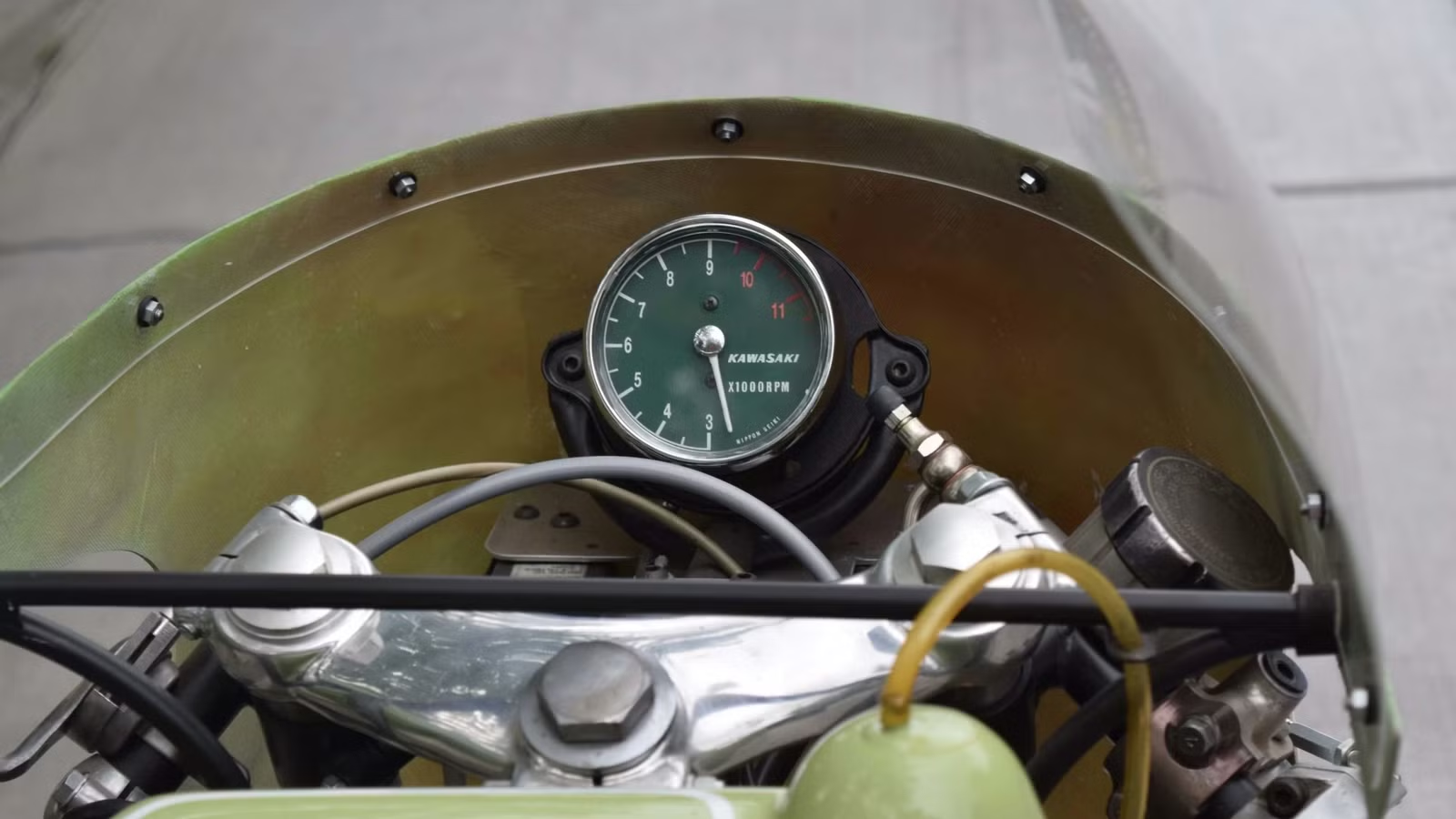
In 1970, Giacomo Agostini won his fifth consecutive 500cc World Championship aboard MV Agusta’s purpose-built factory racer, developed over years with resources most manufacturers could not approach. The rider who finished second was a New Zealander who had bought his motorcycle off a Florida dealer floor for $1,500. The bike shared its castings with a street model Kawasaki was selling to weekend riders, a machine the press had already nicknamed the Widowmaker for what it did to inexperienced owners. That the same platform could finish second in a world championship, behind only the most dominant factory racing program of the era, was either a profound embarrassment to the established order or a signal that everything was about to change. It turned out to be both.
European Factory Teams Had Already Written Off the Two-Strokes

The 500cc Grand Prix class in 1970 was, to those who ran it, a settled question. MV Agusta had won the 500cc constructors title every year since 1958. Agostini had won the riders title since 1966. The factory’s three-cylinder machine was a purpose-built racing engine making 84 horsepower at 13,500 rpm, developed by a team of dedicated engineers for a single purpose and refined over a decade of continuous competition. Against it, the Japanese manufacturers had produced street-derived machines that went fast in a straight line and fell apart or wobbled dangerously when the circuits got technical. Two-stroke engines, in particular, were viewed as unsuitable for Grand Prix distances: too fragile, too narrow in their powerband, and far too thirsty to cover the fuel loads a full GP demanded.
There was evidence for this view. The Yamaha TR2 that also competed in the 1970 500cc class was actually only 351cc, stretched to compete on sheer speed rather than matched displacement. Honda had withdrawn from GP racing entirely at the end of 1967, leaving the class to MV Agusta and a scattering of underfunded privateers on aging machinery. The infrastructure of the class, its calendar, its competitive culture, and the assumptions of its governing bodies had all been built around four-stroke factory teams running purpose-built engines. What arrived at circuits in 1970 from Kawasaki was so far outside that template that most of the paddock did not immediately understand what they were looking at.

10 Big-Bore Vintage Superbikes Real Riders Worship Forever
These legendary machines from motorcycling’s golden era continue to command massive respect and serious auction money decades later.
A Street Bike Stripped, Tuned, and Sent to the Grid

The machine Kawasaki sent to the circuits in 1970 was not, in any conventional sense, a purpose-built GP racer. Its engine shared crankcase and cylinder castings with the H1 Mach III, a 498cc two-stroke triple that Kawasaki had introduced in 1969 for the street market. The racing version added a dry clutch, a close-ratio five-speed gearbox, larger carburetors, a higher compression ratio, and modified port timing to extract more output from the same basic architecture. The expansion chambers, which are the tuned exhaust systems that define a two-stroke’s power delivery, were hand-finished and developed specifically for the racer; the distinctive crossover header arrangement was the only way to achieve adequate cornering clearance for a three-cylinder layout. A new dual-loop frame replaced the street bike’s chassis.
The result was a machine that produced 75 horsepower from 498cc, figures that only make sense in the context of two-stroke thermodynamics: a two-stroke fires on every revolution rather than every other, and a properly tuned expansion chamber creates a pressure wave that effectively supercharges the cylinder at the rpm where the system resonates. Below that rpm, the effect reverses and the engine loses power output quickly. The H1R’s powerband started making meaningful power around 7,000 rpm and delivered everything it had in a narrow window above that point. Below it, there was almost nothing. On a circuit with long straights and slow corners, the rider had to manage entry speeds carefully enough to maintain revs through the technical sections, because letting the engine drop below the powerband meant rebuilding momentum from almost zero.
The Kawasaki H1R Was the $1,500 Racer That Rewrote the 500cc Rulebook

|
Model |
Engine |
Power |
Weight |
Top Speed |
Type |
|---|---|---|---|---|---|
|
Kawasaki H1R |
498cc 2-stroke triple |
75 hp |
286 lb dry |
159 mph |
Customer racer |
|
MV Agusta 500 Three |
498cc 4-stroke triple |
84 hp |
260 lb dry |
163 mph |
Factory racer |
|
Yamaha TR2 (overbored) |
351cc 2-stroke twin |
65 hp |
265 lb |
150 mph |
Customer racer |
The machine at the center of the 1970 500cc championship challenge was the Kawasaki H1R, and the rider Kawasaki most relied upon to demonstrate its potential was Ginger Molloy of New Zealand. Molloy sourced one of the rare H1Rs from a Florida dealership and first raced it at the 1970 Daytona 200, where the bike was clocked at 159.83 mph on the banking. He would go on to score four second-place finishes across the 1970 season, accumulating enough points that only Agostini, who won ten races, stood ahead of him in the final championship standings. Kawasaki finished second in the constructors’ championship. The bike that achieved this was built from street parts, sold to a privateer for $1,500, and received no meaningful factory support beyond parts supply.
The H1R was also something else: the first multi-cylinder two-stroke racing motorcycle sold commercially to privateer teams. Every previous two-stroke GP challenger had been a factory machine, available to approved riders under factory contract and unavailable to anyone outside that system. Kawasaki’s decision to build a small run of customer racers and distribute them through its dealer network was itself a structural shift in how the 500cc class worked. It meant that any rider with $1,500 and enough talent could buy the same machine that was finishing second in world championships, a democratization of access that the European factory model had never permitted.
The Powerband, the Fuel Load, and the Physics of Almost Winning

The H1R’s above-7,000-rpm powerband was not its only liability at GP distances. The bike consumed fuel at approximately 18 liters per 100 kilometers, a rate that required heavy fuel loads for championship rounds and added weight at the start of a race that the MV Agusta’s more efficient four-stroke never carried. The three-cylinder engine was also mounted high in the frame to achieve adequate ground clearance, which raised the center of gravity and contributed to the handling instability that became the machine’s most discussed characteristic. Riders who understood it described an approach that required keeping revs up through corners even when instinct suggested otherwise, because the cost of letting them drop was losing the powerband entirely.
Production figures are much debated. All report fewer than 50 built over two years, with most going to the US market, while some cite either 35 or 40. Whatever the true figure is, all agree the number was small and that the majority went to American privateers through Kawasaki’s dealer network. For 1971, Kawasaki offered the H1R-A upgrade kit, which lifted output to 80 horsepower at 9,500 rpm. The frame and chassis continued to develop, and the handling problems that had characterized the first-year machines improved, though they never entirely resolved.
Dave Simmonds and the Win That Came One Season Too Late

The outright GP victory that had eluded the H1R in its championship-contending 1970 season finally arrived at the last race of the 1971 season, the Spanish Grand Prix at Jarama. Dave Simmonds, a British rider who had previously won the 1969 125cc World Championship on a Kawasaki, delivered the result. Agostini had already secured the 1971 500cc title and elected not to contest the season finale, which shaped the outcome. The win was still the win, and it gave Kawasaki its first victory in the premier 500cc class by any measure. Simmonds had also finished second to Agostini at the Finnish Grand Prix that year, and third in both the Dutch and Italian GPs, ending the season fourth overall in the championship.
The context of the Simmonds win is worth sitting with. It arrived after the window for the H1R program had already begun to close. Kawasaki was developing the H2 Mach IV for the street market, and the engineering resources that might have developed a proper factory GP effort were being directed elsewhere. By 1974, Kawasaki had withdrawn from full Grand Prix participation to focus on other racing disciplines, before the two-stroke era the H1R had helped trigger reached its full expression in the KR series that dominated the late 1970s and 1980s. The bike that started the revolution did not get to ride it all the way through.
The Missing Link Kawasaki Never Talked About

The Kawasaki KR250 and KR500 that dominated Grand Prix racing in the late 1970s and early 1980s were purpose-built factory machines developed with the institutional knowledge, the engineering depth, and the competitive intent that the H1R program had never enjoyed. The lineage between the two is real but rarely stated. Kawasaki’s later GP machines owed a structural debt to the H1R’s proof of concept: that a two-stroke triple could compete at the highest level, that a customer racer sold through a dealer network could challenge factory programs built over decades, and that the 500cc class’s four-stroke establishment was not as permanent as it appeared.
What Kawasaki never did, then or since, was properly claim that chapter of its history. The H1R program was loosely organized, factory support was minimal and unofficial, and the factory’s public position was largely to watch what privateers like Molloy accomplished rather than to announce it as a deliberate racing strategy. The result is a bike that finished second in a world championship, delivered the first win of a new era in GP racing, was built on a $1,500 budget from street-bike castings, and left almost no institutional trace in the brand’s official memory. The riders knew what they had. The factory, as far as the record shows, preferred not to discuss it.
Kawasaki H1R Values: What Survivors Fetch Today
|
Model |
Driver/Incomplete |
Good |
Excellent |
Top Result |
|---|---|---|---|---|
|
Kawasaki H1R (1970-71) |
$5,000–$15,000 |
$15,000–$30,000 |
$38,500 (2019) |
$45,000+ |
The H1R market is thin and condition-dependent, with results varying sharply based on completeness, originality, and documented racing history. A 1970 H1R Road Racer sold for $38,500 at auction in 2019, the most useful confirmed primary result available, though it predates recent market softening. Standard H1Rs without verifiable competition credentials struggled to clear $15,000 at a major January 2025 US auction, a meaningful retreat from that 2019 level. A modified 1969 example with a race-tuned engine but incomplete chassis sold in early 2025 for $11,500, reflecting its incomplete state rather than what a correct original commands. A bike that sold new for $1,500 now starts at ten times that in honest driver condition. Where it goes from there depends almost entirely on what paperwork comes with it.
Sources: Motorcycle Classics, Mecum.

Related posts
Latest Post


No Comments