
5 Unkillable Japanese SUVs Bargain Hunters Are Snatching Up Now
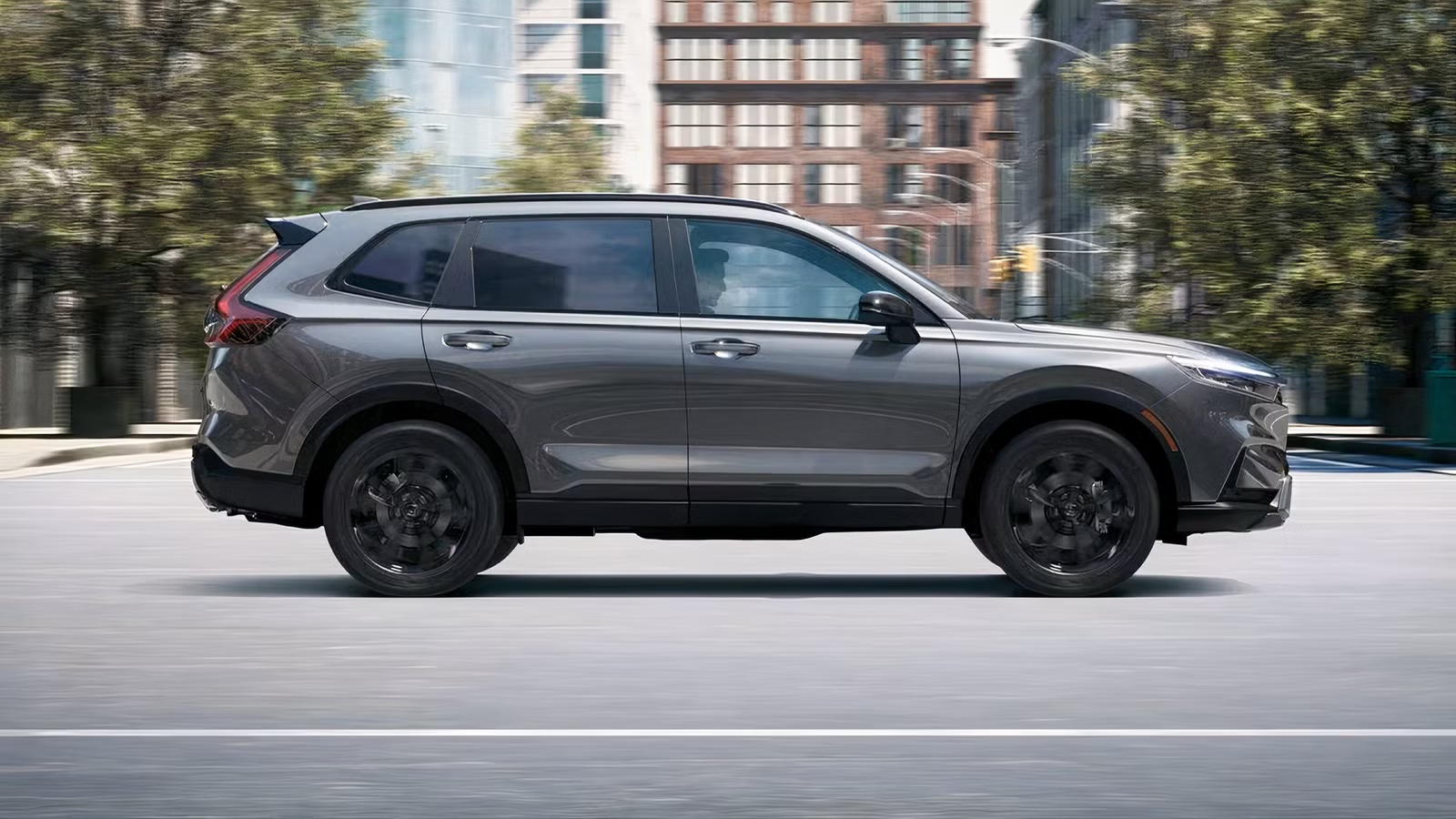
Demand for SUVs remains strong in 2026, even as vehicle prices rise, making buyers take a closer look at what they’re getting for their outlay and shifting the conversation from finding the cheapest SUV to finding one that delivers a value-packed blend of affordability, everyday usability, efficiency, and reliability.

The starting MSRP, especially for model-intensive Japanese makes, doesn’t always tell the whole story because many companies build value into higher trim levels rather than adding options onto lower trims. Japanese SUVs often nail that mix of affordability, efficiency, ownership costs, and resale potential. Here are five.
Value Runs Much Deeper Than The Big Numbers On The Window Sticker
The best-value SUV isn’t necessarily the one with the lowest price tag. A competitive MSRP gets buyers into the showroom, but value depends on a much broader mix of short- and long-term factors, including standard equipment, reliability, depreciation and the ongoing costs of fuel, maintenance, repairs and insurance. Looking at the full ownership picture shows that the lowest-priced SUV is rarely the one with the highest value.


Today’s Japanese SUVs primarily follow a tiered system for their trim content, which means that buyers will pay more for included trim content. Most of the time, that results in a more value-rich model, with some trim-level prices rising less than they would if the included features were added to a lower trim level. The criticism, though, is that it also forces buyers to pay for content they may not want, but there’s no denying that the overall purchase is well worth the price.
The Players: Five Japanese SUVs Whose Value Surpasses Their MSRPs
Many shoppers are finding that the better price at the dealership isn’t always the lowest, but rather that point in the lineup where equipment, comfort, and capability increase faster than the monthly payment. That’s where many Japanese manufacturers continue to excel, offering well-equipped mid- and upper-level trims that hide the higher starting price better, while delivering near-luxury experiences.
2026 Mazda CX-5 2.5 S Premium Plus—Starting Price: $38,990

Priced from $29,990 to $38,990, the 2026 Mazda CX-5 lineup offers several value-packed choices, all AWD and powered by a 187-horsepower 2.5-liter four-cylinder engine. Starting with the CX-5 2.5 S, the lineup builds content in five steps to the all-inclusive 2.5 S Premium Plus whose only options are premium paint ($595) and a host of functional, lifestyle and appearance accessories. If you want to swap out leather seating for microsuede, for example, you have to drop down a trim level or two.
2026 Honda CR-V Sport Touring Hybrid—Starting Price: $42,550

The 2026 Honda CR-V ranges from $30,920 to $42,550, with the top-of-the-line Sport Touring Hybrid including features like AWD, 19-inch wheels, and hands-free liftgate operation that aren’t available on lower trim levels or would add thousands to the sticker price. The flagship Sport Touring Hybrid also gets Honda’s efficient and powerful 204-horsepower 2.0-liter four-cylinder dual-motor powertrain and luxury-level refinement.
2026 Toyota RAV4 Limited—Starting Price: $43,300

The 2026 Toyota RAV4 was reworked as a hybrid-only model. Prices span from $31,900 for the FWD LE to $48,500 for the plug-in GR Sport. The Limited trim comes only in AWD and sits at the top of the non-PHEV models. Nearing luxury status, the RAV4 Limited is perhaps the most complete version, with larger digital displays, advanced convenience features, and upscale styling touches.
2026 Subaru Outback Limited XT—Starting Price: $44,365

Mostly dismissed as a wagon or crossover, the midsize 2026 Subaru Outback is as much an SUV as the Honda CR-V and Mazda CX-5, and looks the part as well. Its lineup stretches from the $34,995 Premium to the $47,995 Touring XT. The Limited XT uses Subaru’s 260-hp 2.4-liter turbocharged Boxer-four engine and adds leather upholstery and 19-inch wheels, superficially matching the Touring XT that costs $3,600 more.
2026 Toyota Highlander Hybrid XLE—Starting Price: $48,020

The midsize AWD-only 2026 Toyota Highlander is not a cheap SUV, starting with the XLE at $46,270 and climbing to $55,675 for the Hybrid Platinum. Using Toyota’s powerful and efficient 2.5-liter four-cylinder hybrid powertrain, the Hybrid XLE is one rung up the ladder from the entry-level Highlander. What makes it worth the price is a reasonably equipped model range that already includes luxuries like synthetic leather, heated seats, a power liftgate, middle-row captain’s chairs, and a comprehensive suite of driving aids.
The Value: These Japanese SUVs Deliver Value Long After Leaving The Dealership
The purchase price is only the first chapter of SUV ownership. After you drive out of the dealership, fuel, maintenance, repairs and insurance will all add to the cost of owning your SUV (often thousands of dollars in your first three to five years). As such, the best value isn’t always the SUV with the lowest MSRP or “price as equipped.” A costlier hybrid may offset the initial outlay through fuel savings, a longer warranty may reduce maintenance costs, or a well-built SUV may require fewer repairs.
2026 Mazda CX-5 2.5 S Premium Plus

The 2026 Mazda CX-5 2.5 S Premium Plus proves that a well-equipped gasoline-powered SUV can still offer reasonable running costs. The EPA estimates annual fuel expenses at $2,400, which is about average for a midsize SUV with a large four-cylinder engine, and Edmunds estimates maintenance over five years in the $5,500–$6,000 range, depending on location and driving habits, and insurance in the $2,500–$6,500 range, depending on various other factors. RepairPal pegs the annual cost of repairs at $447.
2026 Honda CR-V Sport Touring Hybrid

The 2026 Honda CR-V Sport Touring Hybrid is among the least expensive SUVs to fuel, projected to come in around $1,700 annually. Edmunds projects maintenance over five years to cost around $5,000, give or take a couple hundred dollars depending on location and driving habits, and insurance in the $2,450–$6,600 range, while RepairPal puts repairs at $407.
2026 Toyota RAV4 Limited

Probably the most popular SUV on the market, the Toyota RAV4 is also among the most efficient (especially now that it’s only available as a hybrid), projected by the EPA to cost about $1,500 annually to fuel. Five-year maintenance costs come in at $5,700–$6,000, according to Kelley Blue Book, but insurance costs will approach $10,000 over five years, due to the Limited’s status in the RAV4 lineup. Annual repairs are expected in the $430 bracket.
2026 Subaru Outback Limited XT

The turbocharged 2026 Subaru Outback Limited XT sacrifices efficiency for stronger performance on and off the road, with an EPA-estimated annual fuel bill of $2,600. Five-year maintenance is expected in the $4,900–$5,500 range, according to Edmunds, which also pegs insurance at $2,700–$6,600. Repairs are estimated to average upward of $600, according to RepairPal.
2026 Toyota Highlander Hybrid XLE

The 2026 Toyota Highlander Hybrid maintains its position in the family three-row SUV segment, largely due to its remarkable $1,800 annual fuel bill (according to the EPA), which is highly competitive among hybrids of any size. Edmunds estimates maintenance to cost $5,425–$5,875 over five years, and insurance to run $2,825–$7,000, which is indicative of the model’s desirability. Repair bills are average, at $489, according to RepairPal.
The Long Run: Reliability Pays Off Long After The New-Car Smell Fades
The other big factor that makes a new car purchase worth the money is the way it keeps working in the real world. You can’t put a price on “it starts every morning and gets me where I want to go.” That’s reliability, and it builds a vehicle’s reputation and shapes owner satisfaction. It also aids resale value. SUVs that consistently perform well in owner surveys tend to remain in higher demand on the used market, which slows depreciation and further reduces cost of ownership.
2026 Mazda CX-5 2.5 S Premium Plus

The 2026 Mazda CX-5 earns a J.D. Power Quality & Reliability score of 82/100, placing it among the strongest performers in the compact SUV segment. Edmunds projects the Premium Plus trim will lose about $17,460–$17,675 in value over its first five years, depending on location and upkeep, which means it retains about 60 percent of its value (trending toward more upscale SUVs).
2026 Honda CR-V Sport Touring Hybrid

Honda’s flagship CR-V Hybrid for 2026 is rated by J.D. Power at 83/100 in Quality & Reliability, reflecting consistently strong owner loyalty. Edmunds also projects comparatively modest five-year depreciation in the $13,100–$13,300 range, helping it retain about 71 percent of its value. It has been named in one recall to fix the tire repair kit bottle.
2026 Toyota RAV4 Limited

The Toyota RAV4 is in its first year of the new generation, and that is rarely good for reliability and owner feedback. With that in mind, its J.D. Power Quality & Reliability score of 77/100 is sort of understandable. Desirability remains one of its strengths, though, and its depreciation is projected at $13,425–$14,300, giving it a resale value of about 67 percent.
2026 Subaru Outback Limited XT

The 2026 Subaru Outback is right in the mix, with a J.D. Power Quality & Reliability score of 81/100 reinforcing Subaru’s bulletproof reputation. Edmunds projects five-year depreciation for the Limited XT at $18,500–$18,945, which means it retains about 60 percent of its value, making it one of the better AWD used wagon bargains in the marketplace.
2026 Toyota Highlander Hybrid XLE

The 2026 Toyota Highlander Hybrid earns a J.D. Power Quality & Reliability score of 80/100, continuing as one of the strongest family SUVs for dependability. Edmunds’s resale studies place the Highlander Hybrid among the leaders in the midsize three-row SUV segment, retaining about 65 percent of its value after its first five years, with $17,800–$18,140 in depreciation.
The Verdict: The Honda CR-V Sport Touring Hybrid Is Worth Every Dollar

Choosing the best bang-for-the-buck SUV means looking well beyond the MSRP. Content, fuel economy, reliability, maintenance, insurance, and depreciation all factor into the value equation, and the gap among the five Japanese SUVs on this list is narrow, once you get beyond the clear-cut leader that emerges as the most complete package to deliver maximum value from driving off the dealership lot to five years down the road.
#1—The 2026 Honda CR-V Sport Touring Hybrid

The 2026 Honda CR-V Sport Touring Hybrid strikes the strongest balance across all ownership metrics. It pairs excellent fuel economy with a reputation for dependability, manageable maintenance costs and outstanding resale value. Even its MSRP is the second lowest on this list, which is notable for the fully loaded top trim of its model range.
#2—The 2026 Toyota Highlander Hybrid XLE

The 2026 Toyota Highlander Hybrid XLE stands apart as the most family-friendly choice. While its initial price is the highest of this group (understandably, since it’s also the largest), it is also the best-equipped entry-level hybrid model in the segment. It delivers remarkable fuel economy, is backed by a reputation for reliability, has manageable maintenance costs, and commands a strong resale value.
#3—The 2026 Mazda CX-5 2.5 S Premium Plus

The 2026 Mazda CX-5 2.5 S Premium Plus may be the surprise of the group to the uninitiated, but it has a veteran demeanor as a dedicated performer. Its purchase price is the lowest in the group (even though it resides at the top of its model range), and its price undercuts premium SUVs, especially when you factor in its equipment levels. Its main shortcoming is a large naturally aspirated four-cylinder engine that returns mediocre fuel economy and higher fuel costs.
#4—The 2026 Subaru Outback Limited XT

Fuel costs are also the Achilles’ heel of the 2026 Subaru Outback Limited XT, whose turbocharged large four-cylinder engine further hampers fuel consumption. Some will say the near-top-of-the-line wagon is not really an SUV, but there’s no arguing with its looks and abilities. Ironically, its biggest detriments may also be its biggest benefits to owners who want a bit more power and a proven AWD system.
#5—The 2026 Toyota RAV4 Limited

The Toyota RAV4 is one of the more desirable SUVs in the market, but it doesn’t have a particularly strong record of quality and reliability in owner surveys, and given it’s a first-year vehicle, that again proves its biggest challenge. It is, however, one of the more dependable long-term SUVs—dependable for its owners and returning a good resale value when it’s time to sell. Excellent fuel economy and low maintenance costs contribute to its overall value.
Sources: OEMs, the EPA, Edmunds, J.D. Power, RepairPal, CarEdge, NHTSA, Kelley Blue Book

Related posts




Latest Post


No Comments