
Our 2028 Lotus Elise Render Has One Expensive Problem
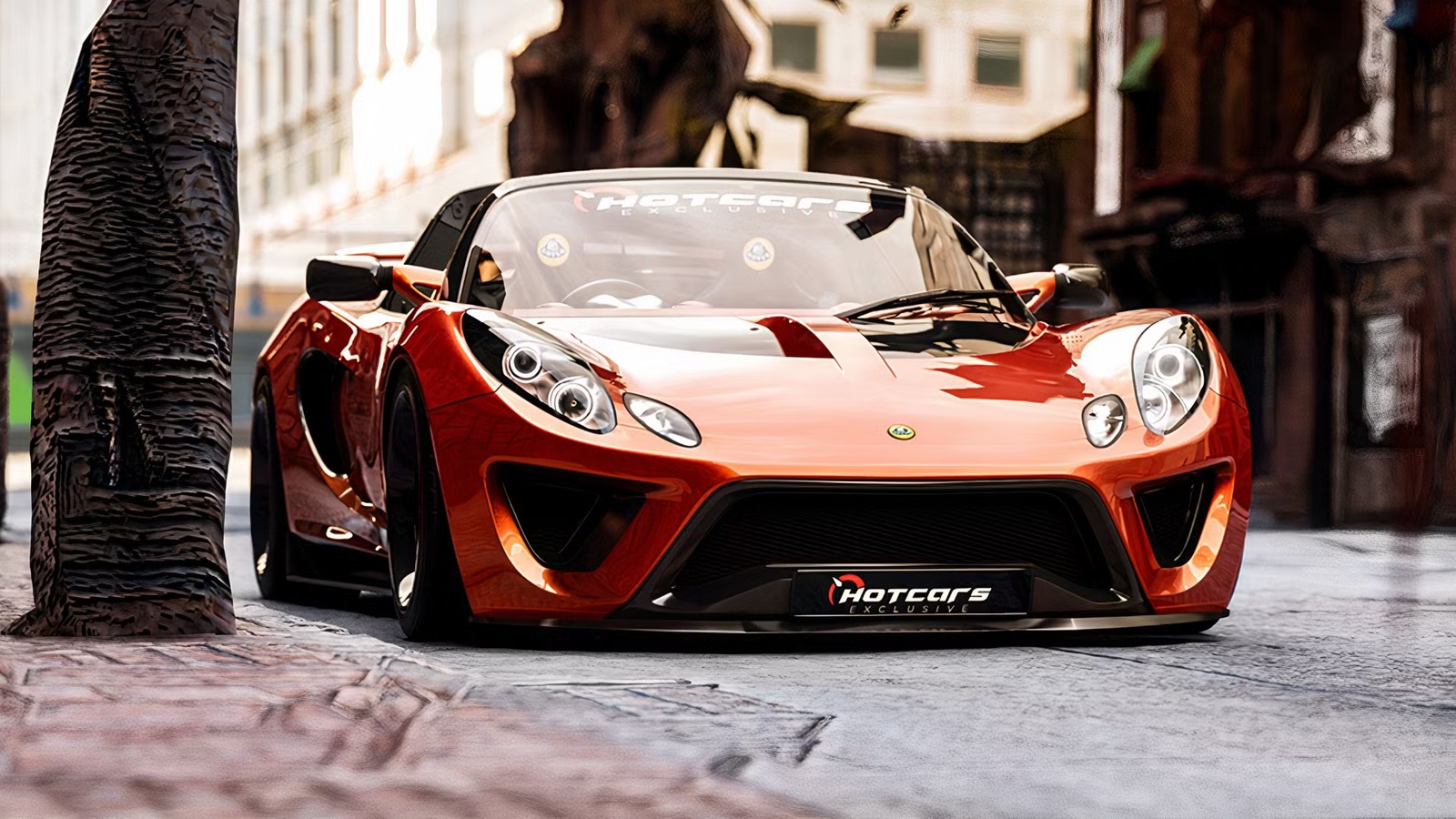
There’s a particular kind of sports car that can embarrass a much more expensive machine without winning a horsepower contest. It weighs about as much as the other car’s options list. Our rendered 2028 Lotus Elise brings that philosophy back, wearing burnt-orange paint, a manual shifter, and a feeling that it’s already roundhouse kicked a Porsche. As for actually building it, well, that’s another matter.
Our 2028 Lotus Elise Refuses To Get Bigger

Our 2028 Lotus Elise render imagines what a new Lotus Elise could look like if the British sports car maker returned to its lightweight roots. The orange body, low-slung nose, deep front air intakes, and black aerodynamic trim give this two-seat roadster supercar attitude. Happily, it still looks small enough to enjoy a twisty back road without needing a spotter.
The profile, though, tells the better story. Short overhangs, a compact cockpit, black multi-spoke wheels, and side intakes recall the original mid-engine Lotus Elise. At the rear, four circular taillights and a central exhaust sit above a substantial diffuser. The shape is appealingly familiar, although those complicated front headlights look like they require their own instruction manual.
When the Lotus Elise debuted in 1996, its fiberglass body and bonded-aluminum chassis helped keep weight around 1,600 pounds. Colin Chapman’s lightweight philosophy gave the roadster a reputation for astonishing handling. The U.S.-spec Lotus Elise arrived for the 2005 model year with a Toyota-sourced engine, then left American showrooms after 2011. Production continued elsewhere until 2021.

The minimalist cockpit in our 2028 Lotus Elise concept carries that idea forward with simple round gauges, a small steering wheel, and an exposed manual gear shifter. It’s refreshingly free of dashboard-sized screens, and the right-hand-drive layout honors its British origins. There is a catch: turning these pretty pictures into a U.S.-legal sports car would require proper crash protection, emissions compliance, and modern equipment. Each addition threatens the Elise’s signature lightness.
A 300 HP Lotus Elise Could Make Bigger Numbers Look Silly

For this mythical 2028 Lotus Elise, we’d choose a turbocharged 2.0-liter four-cylinder with around 300 horsepower, rear-wheel drive, and a six-speed manual transmission. Pair that with an LSD, double-wishbone suspension, and a target curb weight near 2,200 pounds, and the power-to-weight ratio looks tasty.
The American-market 2007 Lotus Elise demonstrates why more power is hardly essential. Its naturally aspirated 1.8-liter four-cylinder made 190 horsepower, yet a tested 1,975-pound example reached 60 mph in 4.8 seconds and covered the quarter-mile in 13.6 seconds. With 300 horsepower, a new Elise might threaten a sub-four-second 0-60 mph run, even though that remains pure speculation.
The real attraction would be the corners. A modern Lotus Cars Elise with communicative steering, low mass, and a manual gearbox could be more rewarding on a mountain road than a far more powerful sports car. The original Elise also offered brutal ride quality, difficult entry, and luggage space best measured in sandwiches. We’d welcome better seats and a little sound insulation, but loading it with every luxury feature would defeat the exercise before the engine even started.
Selling A New Lotus Elise Would Be Harder Than Designing One

Here comes the expensive problem. The original U.S.-market 2005 Lotus Elise launched at roughly $40,000, an extraordinary price for a mid-engine sports car. Replicating that formula would be difficult. Lightweight materials, low-volume manufacturing, federal safety requirements, and the cost of developing a dedicated chassis could push an imagined replacement into expensive sports-car territory. A cheap, featherweight Elise sounds wonderful until someone has to finance it.
Lotus’s actual product strategy makes the fantasy harder to justify. Its planned 2028 Type 135 is a V8 hybrid supercar with over 1,000 metric horsepower, not an announced Elise revival. Meanwhile, the Lotus Emira continues as the brand’s combustion-powered sports car, with U.S. prices starting above $100,000. A stripped-down Elise would need to sit below that car without stealing too many buyers, a tricky assignment for a company with limited production scale.
The Real Challenge

Used Lotus Elise prices show why the name still carries weight in North America. Across a one-year period, the average sale price is about $45,000, with the top transaction at $121,000. Those figures cover different versions and conditions, but they suggest demand for the original roadster. They also raise an awkward question: would buyers pay $75,000, $85,000, or even more for a new Elise when a Mazda MX-5 Miata or Toyota GR86 offers a more affordable way to enjoy driving?
That’s why this 2028 Lotus Elise render is slightly cruel. A sports car doesn’t need 500 horsepower, giant tires, or television-sized touchscreens to feel special. This one’s got the right proportions, the right transmission, and enough grunt to upset pricier machinery. Lotus could probably make the driving experience magical, too. Making the business case work without turning the Elise into an expensive toy is the real challenge.

Related posts


Latest Post


No Comments