
The 2028 Harley-Davidson Muscle Car Nobody Asked For
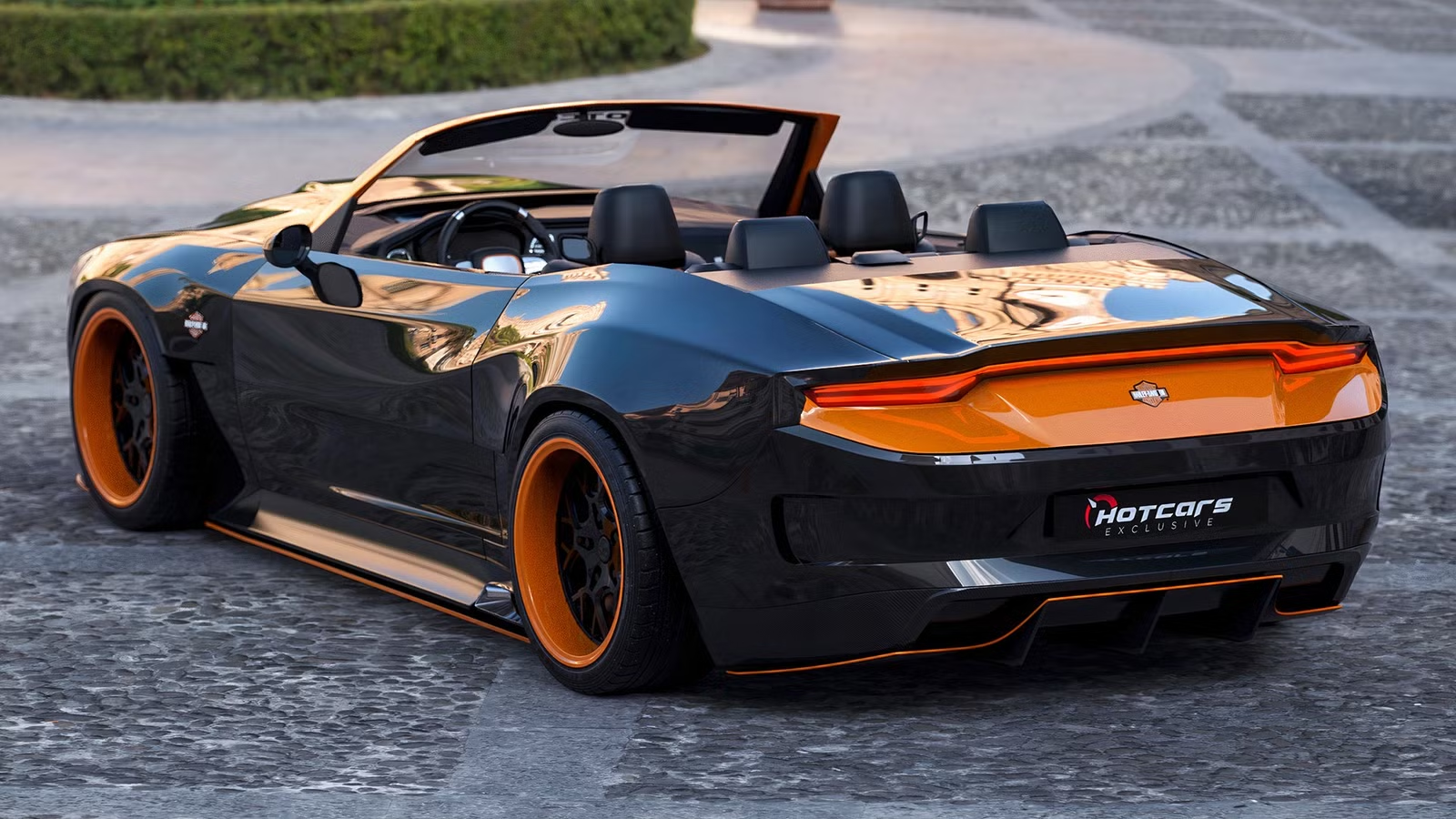
Imagine a Harley-Davidson with four seats instead of two wheels that makes your neighbors reconsider their property values. Our highly imaginary 2028 Harley-Davidson muscle car takes that questionable proposal seriously. This black-and-orange convertible looks committed to challenge American V8 royalty, although turning motorcycle grunt into a performance car could be harder than sewing another logo onto a leather jacket.
A Harley-Davidson Muscle Car Could Look Like A Mustang With An Attitude Problem

This render has the unmistakable shape of a performance car, but the attitude comes straight from a motorcycle parking lot. The long hood, low nose, and squared-off front end suggest a Ford Mustang that’s spent too much time hanging around Harley-Davidson dealerships.
Black paint is interrupted by orange accents on the windshield frame, front splitter, and oversized wheels. Those deep-dish rims give our Harley-Davidson convertible muscle car a custom-show appearance, although they might also make every pothole feel like an attack on the family savings. Slim LED headlights and a vented hood update the design without making it look like an electric crossover wearing a costume.
From the side, you can see exaggerated rear fenders, a sharply sculpted door, and a ride height better suited to smooth asphalt than a supermarket entrance. The open-top layout is the cleverest part. Harley-Davidson motorcycles promise fresh air and a sense of occasion; a four-seat American muscle car convertible could offer some of that experience while letting passengers bring more than one spare pair of socks.

Around the back, a full-width red taillight sits above an orange rear panel and an aggressive diffuser. It’s dramatic, perhaps excessively so. The rear looks like it wants to enter a drag race while the front is still posing for photographs. And yet, given the badge, it still fits somehow.
The V8 Question Could Make Or Break This Harley-Davidson Fantasy

A Harley-Davidson muscle car would live or die by its exhaust note. Our totally-not-real 2028 model deserves a supercharged V8 under that enormous hood, ideally a 5.0-liter engine with the kind of low-end shove that makes the rear tires nervous. A Ford-derived setup could make sense for an imaginary build, with output somewhere around 700 horsepower. As to Ford and Harley working together on this, well, we did mention this was all hypothetical, right?
But back to fantasy: the obvious problem is that borrowing a V8 from another American performance car might leave the Harley-Davidson badge doing all the branding work. To earn its identity, this four-wheeled Harley would need a distinctive exhaust tune, immediate throttle response, and enough mechanical personality to make a simple Sunday cruise memorable. Side-exit exhaust tips suit the render, but anyone stepping out in shorts would appreciate a warning label the size of a dinner menu.
The Tough Part

Rear-wheel drive would be nonnegotiable for the fantasy, while a six-speed manual would add the involvement many muscle car fans need. An auto could handle drag-strip duties. Either way, it would need substantial brakes, sticky tires, an LSD, and suspension that could cope with both enormous power and the weight of a convertible body. Orange wheels alone can’t perform miracles (but they come close).
Could our 2028 Harley-Davidson V8 muscle car hit 60 mph in under four seconds? Possibly, with enough grip and a properly tuned chassis. But straight-line speed is the easy sales pitch. Making a low-slung, open-top car feel composed over broken American pavement would be the harder achievement. Without serious structural reinforcement, this thing might shake harder than a coffee machine strapped to a jackhammer.
The 2028 Harley-Davidson Muscle Car Might Be Better As A Dream

The cabin offers another opportunity to give this Harley-Davidson concept car a genuine identity. We’d imagine analog-inspired gauges, black leather, orange stitching, and sturdy metal switches that feel satisfying through driving gloves. A modest touchscreen could handle navigation and music without swallowing the entire dashboard. Of course, someone would inevitably suggest installing a giant illuminated bar-and-shield emblem, probably right where the passenger airbag should go.
Then there’s the potential price. A bespoke 700-hp convertible with custom bodywork and proper engineering could easily cost stupid money. At $100,000 or more, this Harley-Davidson muscle car would face uncomfortable comparisons with the Ford Mustang and other American performance cars. A customer might love the badge and the noise, but neither would excuse poor visibility, cramped rear seats, or a front splitter that loses an argument with every driveway.
Better Off Left Alone

The intended buyer is another puzzle. Would Harley-Davidson motorcycle owners want four wheels and a V8, or would they rather have another bike in the garage? Would Ford Mustang buyers entertain an unfamiliar nameplate if the car delivered a convincing drive? And how many Americans would pay luxury car money for a vehicle whose biggest selling point is looking spectacular at a stop light? Tough questions, barely any answers.
For now, the imaginary 2028 Harley-Davidson muscle car is probably best left where it thrives: in a set of outrageous digital renders. We’d happily keep the roofless silhouette, black-and-orange color scheme, and supercharged V8 fantasy. We’d also ask for smaller wheels, more suspension travel, and a price that doesn’t require selling the motorcycle first. It’s an entertaining American muscle car idea, even if nobody needs to see it on an order form.

Related posts
Latest Post


No Comments