
AGV Unveils Pista GP R3 Helmet With Sphera System Aimed at Cutting Concussion Risk
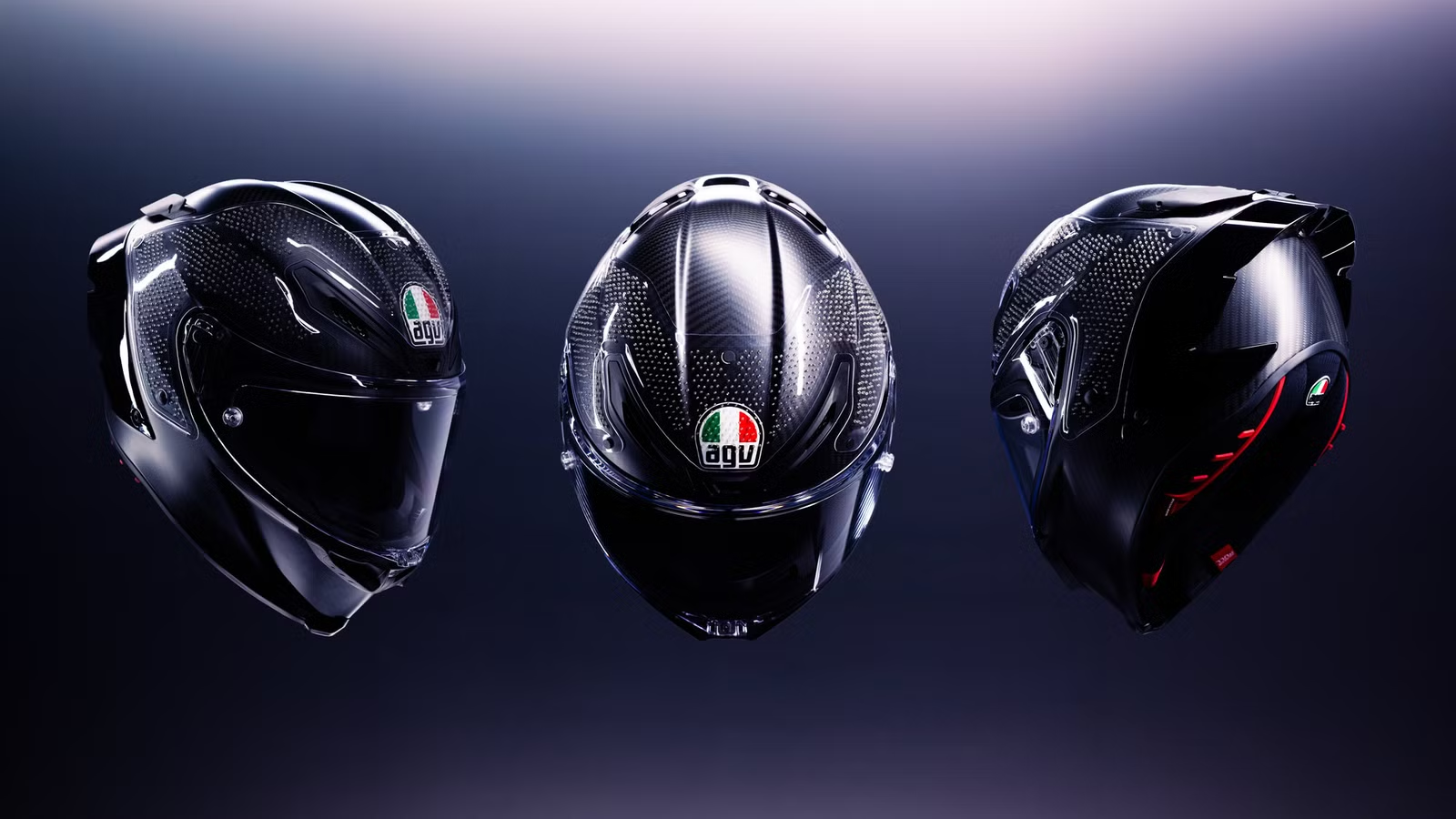
AGV has announced the Pista GP R3, the latest evolution of its racetrack-focused, full carbon-fiber helmet. An updated flagship helmet is newsworthy, but that’s not what caught our attention here: the brand has debuted a new technology designed to mitigate rotational forces, called AGV Sphera, Powered by RLS (Release Layer System). According to AGV literature, the unique Sphera technology reduces the risk of concussions by a factor of six. In fact, if you watched the San Marino and Rimini Riviera Grand Prix, then you already saw the lid and its new technology, with official AGV riders in the MotoGP, Moto2 and Moto3 paddocks taking the new lid on track during the Misano round.

The Italian helmet manufacturer says that the R3 is the most significant evolution of the Pista GP platform since its introduction. The Pista GP line was made famous by nine-time world champion Valentino Rossi. The outer shell is still made entirely of carbon fiber and maintains an incredibly aggressive, aerodynamic profile in line with the Pista family of helmets as we know them. The biggest update is the addition of the brand’s Sphera tech, which intends to help manage forces imposed on the rider during a crash.
How Sphera Works
The Pista GP R3 is designed to meet the newest racing helmet standard, known as FIM FRHPhe-02, established by the International Motorcycling Federation. This relatively new safety standard has an express focus on oblique impacts, which have become a more commonly discussed topic of research and development in recent years. While the language is dense, many readers may be familiar with Mips (Multi-directional Impact Protection System), which is one of the first systems to begin addressing rotational forces. Mips notes that in real-world falls, a rider’s head usually strikes the ground at an angle and is sent into a spinning motion that can strain the brain. Standard helmet tests, by contrast, drop the helmet vertically onto a flat surface.

Conventional helmet drop tests, such as those used in the U.S. DOT standard, FMVSS No. 218, are rudimentary by comparison and do not measure such forces. That standard we use in the states sets requirements for impact attenuation, penetration and retention, leaving a lot to be desired when compared to ECE 22.06, Snell, or FRHPhe-02 standards.
According to AGV, oblique impacts cause rotational acceleration of the brain, one of the leading causes of severe brain injury. When the helmet and skull rotate, the brain, suspended in cerebrospinal fluid, follows with a slight delay. That relative rotation between skull and brain is what generates damaging stress. So, that’s where a linear-only drop test falls short, as straight-line impact forces are not the only source of potential injury.

Sphera was co-developed with RLS (Release Layer System), a British startup specializing in helmet safety technologies. Put simply, Sphera is an outer shell attached to the helmet’s main shell, and the two are separated by a matrix of hundreds of microspheres. In the event of an angled or oblique impact, the outer layer is designed to detach in a controlled manner, dissipating some of the energy and limiting the rotational force transmitted to the rider’s head.
Interestingly, elements of this approach are something we’ve seen before in simpler forms. Arai designs the spoilers and vents on its helmets to break away in a crash, allowing the brand’s rounded shell profile to “glance off” the ground without snagging. The Japanese company says this minimizes rotational forces.
There are several directly comparable safety technologies on the market that do approach rotational forces and will likely be familiar to anyone who has shopped for a helmet recently. What’s unique about Sphera is the exterior placement. In a Mips-equipped helmet, a low-friction layer is attached to the inner surface of the expanded polystyrene (EPS) liner, with the comfort padding fixed inside it. That layer is designed to move in all directions to help redirect rotational motion in certain angled impacts.

Competitor 6D uses its patented Omni-Directional Suspension tech, which places two separate liners on either side of an array of elastomeric isolation dampers. Basically, imagine tiny rubbery shock absorbers between the two liners. On 6D’s second-generation ATR-2, those liners are an expanded polypropylene outer layer and an EPS inner layer. Bell’s Spherical technology, developed with Mips, uses a ball-and-socket design in which an outer liner rotates around an inner liner inside the shell during a crash. The common point here is that a growing number of brands are addressing rotational forces with dedicated systems.
Unlike these internal systems, Sphera operates on the helmet exterior, at the point of contact, detaching in a controlled way to limit how much rotational force reaches the head. In simpler terms, the outer layer takes some of the spin, so your head and brain aren’t affected as much. AGV said this is the first time the technology has been used in a motorcycle helmet.
Behind The Sixfold Figure

AGV said tests by independent organizations support its concussion claim. The laboratory work was conducted by the Aragon Engineering Research Institute at the University of Zaragoza. The sixfold reduction is the average of results from frontal, right-side and left-side impacts. Those results were converted into a probability of AIS2+ concussion risk using the Brain Injury Criterion, or BrIC, metric.
The comparison measures the helmet with Sphera against a configuration without it. That means the figure is not a direct comparison to competing solutions such as Mips, and rear impacts were not part of the average. According to the brand, the results show a marked improvement on a Sphera-equipped helmet.
It’s Still A Pista!

Designing a flagship helmet is no small feat. AGV says the R3 required more than 100 new molds for new and redesigned components, and the full carbon-fiber helmet underwent wind-tunnel and real-world testing with the help of MotoGP stars. For this generation, the spoiler has been completely redesigned in both size and side-surface shape. The goal is to reduce drag in the cornering position, when the rider’s head is turned toward the apex and corner exit. The Italian firm says these improvements help reduce rider fatigue.
The vents are now made from Grilamid, a composite of plastic and carbon fiber, said to offer a balance of durability and weight reduction. New rear vents improve airflow as it exits the shell, increasing circulation through the helmet. The interior has also been updated with a snugger, more ergonomic fit, according to AGV.
The Pista’s visor remains a central feature. AGV says it offers the broadest horizontal and vertical field of view in its class. On the R3, the visor is up to 5 millimeters thick and uses an opening mechanism with greater retention force, reducing the chance of it opening during an impact. The current Pista GP RR features a rapid hydration system, though AGV has not yet confirmed whether it carries over to the R3, we do anticipate the same feature being present.

Perhaps the most notable figure is one that didn’t change: the weight. According to AGV, the Pista GP R3 is no heavier than its predecessor. Adding an extra layer to the shell without adding weight is fairly impressive. One note here is that helmets sold within the United States will need to carry a DOT FMVSS No. 218 certification and that could potentially impact the U.S.-bound R3 units.
Availability Starts In Early 2027

According to AGV representatives in the United States, the Pista GP R3 will be available in the United States beginning in the first quarter of 2027. The company has not announced pricing. The current Pista GP RR is the brand’s top-tier helmet, with U.S. pricing that begins north of $1,600, and a limited-edition version has sold for $1,729. We can anticipate a similar ballpark. For those interested in a closer look, take a peek at your favorite AGV-endorsed MotoGP, Moto2, and Moto3 riders, who are currently using it in competition.
Source: AGV

Related posts


Latest Post


No Comments