
Mitsubishi Starion ESI-R: The 188-HP Wide-Body Coupe
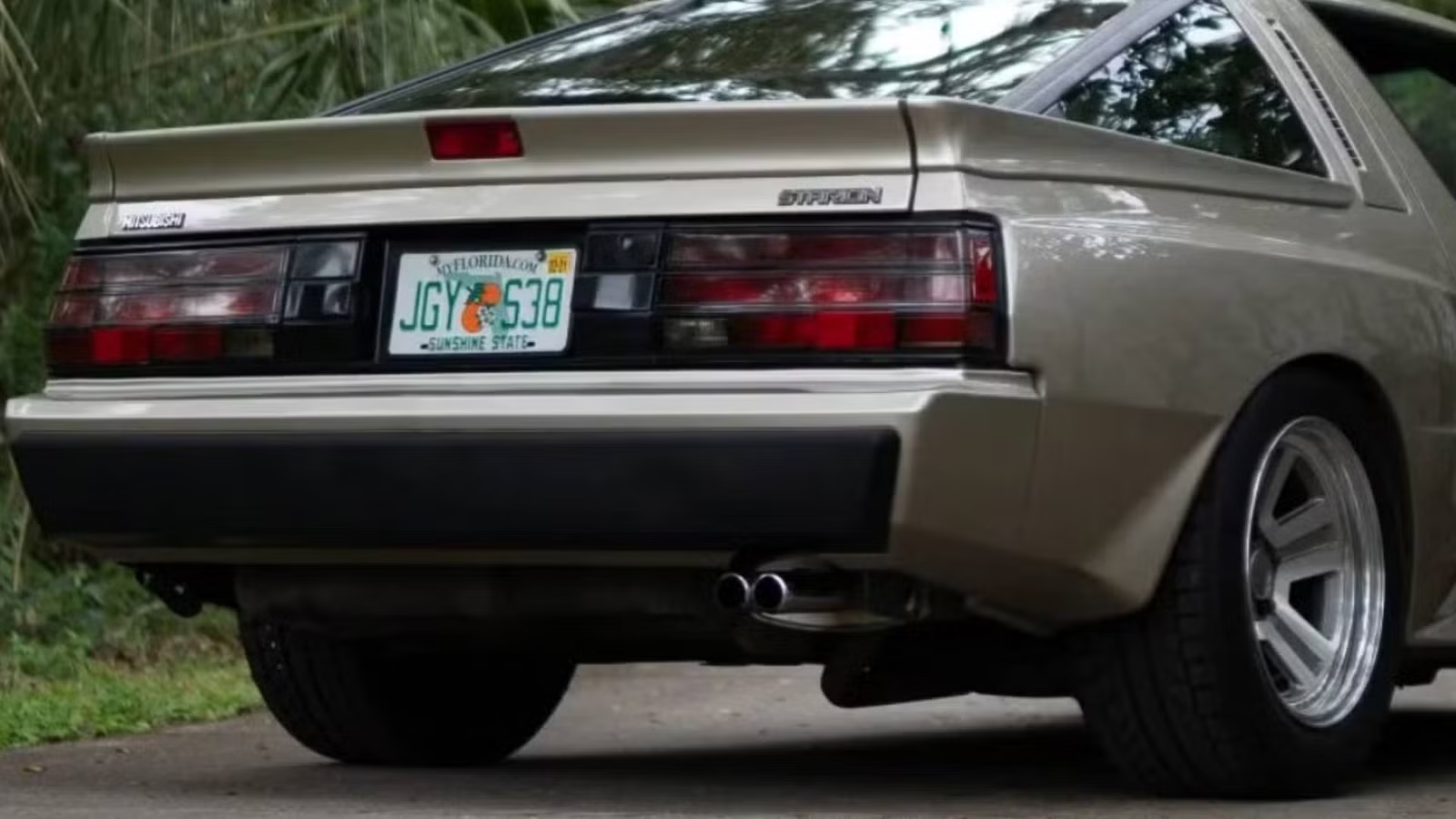
Japanese performance cars from the late 90s were once cheap used cars. Today, clean examples of the Toyota Supra Mk4, Mazda RX-7 and Nissan Skyline can cost serious money.

Things were very different back then. European performance cars were having a pretty good run, with the big manufacturers churning out cars that ended up on bedroom walls. Japanese automakers were catching up too. They were building cars that could give the Europeans a proper fight without asking buyers to spend European money. Turbo engines, rear-wheel drive and fairly simple mechanicals turned out to be a pretty good recipe.
Speaking of which, one Japanese coupe had pretty much all the right ingredients. It had a turbo, rear-wheel drive, a wide body and enough performance to take on the likes of the Porsche 944 Turbo, Mazda RX-7 and Mk2 Supra. There is even an interesting bit of engineering history connecting its engine technology to Porsche. Yet somehow, it never became a collector favorite like the Supra, RX-7 or Skyline.
The Turbo Coupe That Got Lost Along The Way

The recipe sounds familiar today. Take a relatively light coupe, put a turbocharged four-cylinder motor under the hood, drive the rear wheels, and give it enough styling to stand out.
During the 1980s, this formula was becoming popular in Japan. Engine size mattered there because cars with engines over 2.0 liters faced higher taxes. That gave automakers a reason to keep engines small and use turbocharging to make bigger-car power without moving into a higher tax bracket.
The forgotten car in this story followed that formula pretty closely. It wasn’t the fastest car or the meanest car of its era, but it had plenty going for it. There was strong torque, independent suspension, and even a limited-slip differential. Then there was the styling. Pop-up headlights, a long hood, low roof, and wide wheel arches gave it the sort of presence that is hard to find today. So, what exactly was this car?
Meet The Mitsubishi Starion ESI-R

The answer is the Mitsubishi Starion. Mitsubishi launched the Starion in 1982, and it stayed around until 1989. By the end of its production run, the ESI-R was the top-spec version sold in the US.
The 1988 ESI-R housed a 2.6-liter turbocharged and intercooled inline-four under the hood. This power mill churned out 188 hp at 5,000 rpm and 234 lb-ft at 2,500 rpm. It could be had with a five-speed manual or a four-speed automatic.
The 188 hp figure doesn’t sound like much today, but the torque is where things get interesting. With 234 lb-ft arriving at just 2,500 rpm, the Starion had plenty of shove once the turbo came alive. On tarmac, that was enough for 0-60 mph in the high-seven-second range, depending on the car and conditions.
Besides that, the Starion also had independent suspension and could be fitted with a limited-slip differential, giving all that turbo torque a decent place to go.
The Wide-Body Japanese Wedge

The Starion’s design is probably the first thing you’ll notice. It looks like a car from the ’80s in the best possible way. The early versions were relatively narrow, partly because of Japan’s vehicle dimension rules. Mitsubishi, in 1986, added roughly 60 mm to the width, bringing those chunky wheel arches into the picture. By 1988, the Starion stretched 68.3 inches across.
The wide-body versions also got bigger wheels with staggered tire widths, while the hood scoop fed air to the intercooler. Useful stuff, but it also made the car look like it meant business.
Then there’s the shape itself. Pop-up headlights, a long nose, low roof and those sharp, straight lines. Park it next to a modern sports coupe and it would probably look like the Starion took a wrong turn somewhere around 1988. Or maybe the modern coupes did.
It Was Also A Chrysler Conquest

The Starion reached North America through Mitsubishi’s long partnership with Chrysler, which had bought a 15-percent stake in the Japanese automaker back in 1971. Mitsubishi started selling the Starion through its own dealers in 1983, while Chrysler dealers got a near-identical car from 1984. It was sold as the Dodge Conquest and Plymouth Conquest until 1986, before carrying only Chrysler badges from 1987 through 1989.
The wide-body Conquest was called the TSi, which stood for Turbo Sport Intercooled. It was built alongside the Starion ESI-R from 1986 to 1989 and shared the same 2.6-liter turbo four.
All of them were built at Mitsubishi’s plant in Okazaki, Japan, so underneath the different badges, they were essentially the same car. Over time, the whole family even earned the nickname “StarQuests.” So if you find an old Conquest and wonder why it looks suspiciously familiar, there is a very good reason.
The Porsche Connection Is Hiding In The Engine

This is probably the most interesting part of the Starion story. Mitsubishi developed its Silent Shaft system to cut down the vibrations that come with a four-cylinder engine. In simpler words, the solution was basically: fight shake with shake. It used two counter-rotating balance shafts that spun at twice crankshaft speed, helping cancel out vibrations from the pistons moving up and down in a large 2.6-liter four-pot.
The basic idea goes back to British engineer Frederick Lanchester, but Mitsubishi developed and patented its own version and put it into production. Then things get interesting. Porsche later licensed Mitsubishi’s balance-shaft technology for the four-cylinder engine in the 944.
So while the Starion and 944 were rivals on the road, there was a bit of Mitsubishi engineering hiding inside the Porsche’s engine bay. Not a bad connection for a car that is often overlooked today.
It Could Take On The Porsche 944 And Nissan 300ZX

By the late 1980s, the Starion was mixing it with some pretty serious machinery. The 1988 Porsche 944 Turbo was making 217 hp from its 2.5-liter turbo four, while the Nissan 300ZX Turbo had around 205 hp and 227 lb-ft from a 3.0-liter V6. The Starion couldn’t quite match either on horsepower, but then it had 234 lb-ft of torque to play with. For a 1980s Japanese coupe, that was plenty of shove. And unlike the numbers might suggest, it wasn’t exactly bringing a knife to a gunfight.

Mitsubishi was serious about proving that, too. Factory-backed Starions won the Nelson Ledges 24-hour race four years in a row from 1984 to 1987. That’s not a bad line to have on the resume.
The Cars That Followed Stole Its Thunder

Starion production ended after 1989, and Mitsubishi never really replaced it with another car using the same recipe. The Eclipse arrived in the US for the 1990 model year and took over as the company’s better-known sporty coupe. Meanwhile, the Japanese performance scene was getting ready for a very different era.
The R32 Skyline GT-R arrived in 1989 with a twin-turbo 2.6-liter inline-six and all-wheel drive. A few years later came the Mk4 Supra, complete with Toyota’s 2JZ-GTE and 320 hp in US spec. Neither car started out as the cultural phenomenon they would eventually become.
The tuning scene helped, so did the movies and eventually, video games. The Starion never quite got that same second life.
It had its own share of old-school quirks, too. Turbo lag could make the power delivery feel a little sleepy by modern standards, the steering could get heavy, and it wasn’t exactly cheap when new. It even got a small Hollywood cameo in The Cannonball Run II, but that wasn’t enough to keep it in the spotlight.
The Supra, RX-7 and Skyline became names even casual car fans now know. The Starion? That’s the one that usually needs a little explaining.
It Still Costs Far Less Than A Turbo Supra
That forgotten status is now part of the appeal. The average price for standard Starion variants is around $17,500, although conditions can move that number around quite a bit. A 1988 Starion sold for $15,900 in July 2026, while the highest recorded sale for a standard production-spec Starion sits at $40,700.
That’s not exactly pocket change for an old Mitsubishi, but park it next to a clean Mk4 Supra Turbo and the Starion suddenly looks like a bargain. The right Supras are now fetching well into six figures.
There are a few catches, though. The Starion has a much smaller enthusiast following, and some parts can be harder to track down than they are for a Supra or 300ZX. But that’s also what makes it interesting. You’re not picking the obvious Japanese classic. You’re finding the one that somehow slipped through the cracks.

Related posts
Latest Post


No Comments