
McMurtry’s Fan Car Is Almost In Production—And Its 0–60 Time Is Still Barely Real
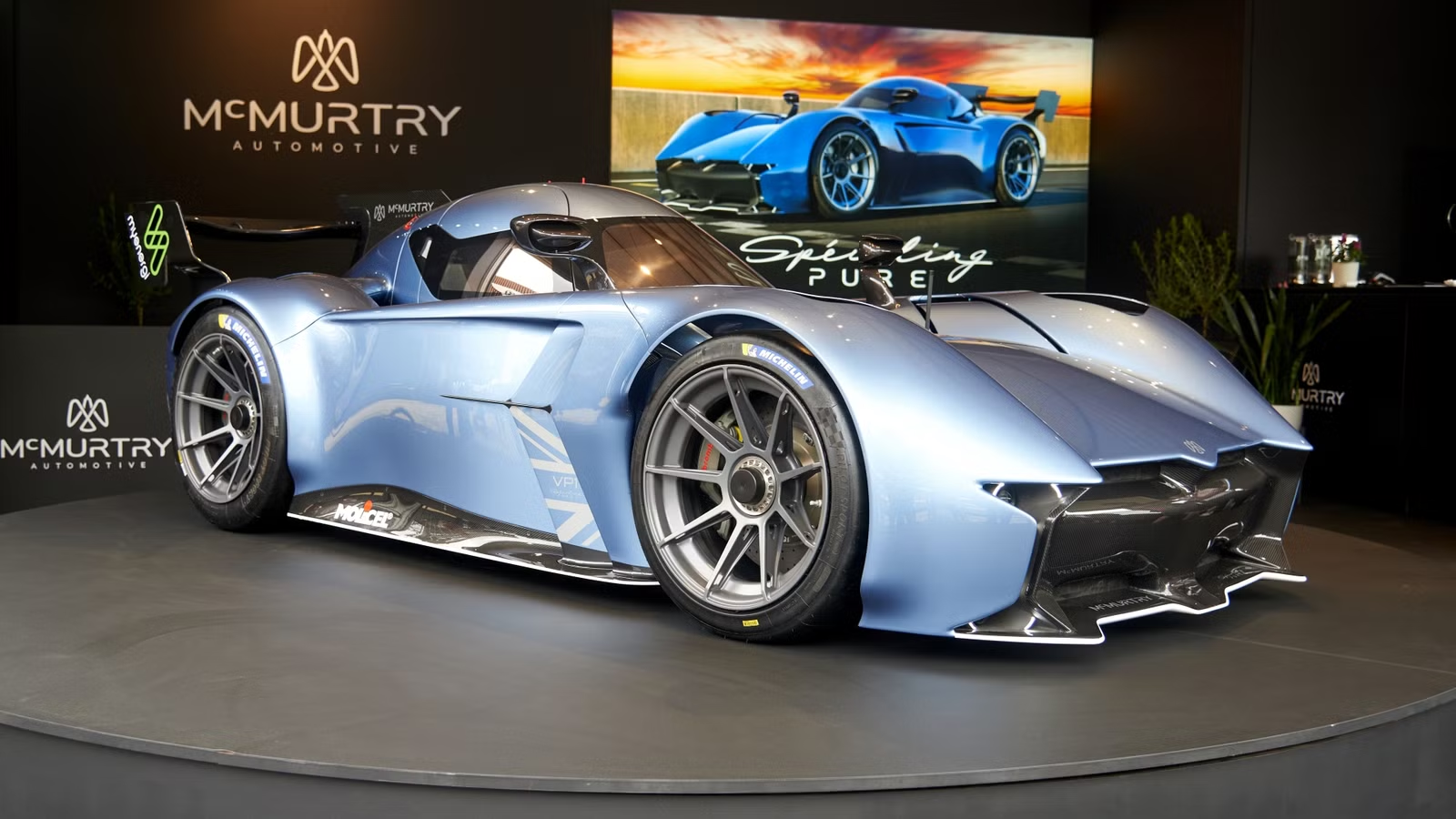
The McMurtry Spéirling hit 60 mph in 1.38 seconds at Goodwood—a number that still sounds like a typo—and the company has now confirmed the production version is nearly ready. McMurtry Automotive announced this week that the road-legal Spéirling is approaching production readiness, moving the single-seat electric hypercar from record-setting prototype to something buyers can actually order.

The timing matters. For the better part of three years, the Spéirling existed primarily as a demonstration of what was possible when you threw out conventional aerodynamic thinking entirely. Now the question shifts from “can they build it” to “will the production car actually do what the prototype did” — and the early answer is that McMurtry intends to keep the core of what makes the Spéirling extraordinary intact.
How The Fan-Car Downforce System Actually Works
The Spéirling doesn’t generate downforce the way every other performance car does. There are no large wings, no elaborate diffusers fighting for real estate at the rear. Instead, a set of electrically driven fans mounted beneath the car actively suck air out from under the floor, creating a low-pressure zone between the chassis and the road surface. The result is suction-based downforce—the same principle that made the Brabham BT46B infamous in 1978 Formula 1, before it was banned after a single race.

In practice, this approach generates downforce at any speed, including a standstill. Traditional wings need airflow to work—below roughly 30 mph, they contribute almost nothing. The Spéirling’s fan system is speed-independent, which means the car has full aerodynamic grip the moment it moves. That’s a significant part of why the 0-60 figure is what it is: the tires aren’t fighting wheelspin against a gripless surface; they’re pressing into a car that’s already being pushed into the ground with hundreds of kilograms of downforce.
The 1.38-Second Figure—And Whether Production Changes It

The Goodwood record run used a prototype configured specifically for maximum performance, and the honest question for any production hypercar is how much gets compromised in the transition to road legality. Lighting, crash structures, noise regulations, and durability requirements all add weight and complexity.
McMurtry has indicated the production Spéirling retains the twin-motor electric powertrain and the fan-car downforce system in its road-going form. The company has quoted over 1,000 horsepower from the electric motors and a curb weight of approximately 1,000 kilograms — a power-to-weight ratio that puts it in a category of its own. Battery capacity sits in the range needed for track use rather than long-distance touring, which reflects the car’s purpose honestly. Whether the production car can precisely match 1.38 seconds in independent testing remains to be confirmed, but McMurtry has been careful not to walk back the performance claims tied to the powertrain and downforce setup.
Where It Stands Against The Fastest Electric Hypercars

The hypercar EV segment has gotten genuinely competitive. The Rimac Nevera clocks 0-60 in 1.74 seconds and produces 1,914 horsepower across four motors—remarkable numbers from a car that also functions as a usable grand tourer. The Lotus Evija targets around 2,000 horsepower but has faced a drawn-out production timeline. The Aspark Owl claimed a 1.69-second 0-60 in testing, making it one of the few cars in the same conversation as the Spéirling on raw acceleration.
What separates the Spéirling from all of them is the fan-car system. The Nevera, Evija, and Owl all rely on conventional aerodynamics—passive downforce that scales with speed. The Spéirling generates grip through active suction regardless of velocity, which changes the physics of acceleration in a fundamental way. It’s less a faster version of an existing formula and more a different formula entirely.
Production Timeline And What Comes Next
McMurtry hasn’t published a firm on-sale date, but the production-readiness confirmation this week signals the company has cleared the engineering and validation phase. Pricing hasn’t been officially announced at a specific figure, though the Spéirling is positioned firmly in the upper tier of the hypercar market—a segment where seven-figure asking prices are standard, and production runs are typically measured in dozens rather than hundreds of units.
For buyers watching this space, the Spéirling’s arrival would represent something genuinely new rather than an incremental step forward. Fan-car aerodynamics have never made it to a road-legal production vehicle before. If McMurtry delivers what the prototype demonstrated, the production Spéirling won’t just be one of the fastest electric cars — it will be the only road car that works the way it does.
Sources: Road & Track, Electrek, Autoblog

Related posts
Latest Post


No Comments