
Mazda RX-3: The Rotary That Ended the Skyline GT-R’s Streak
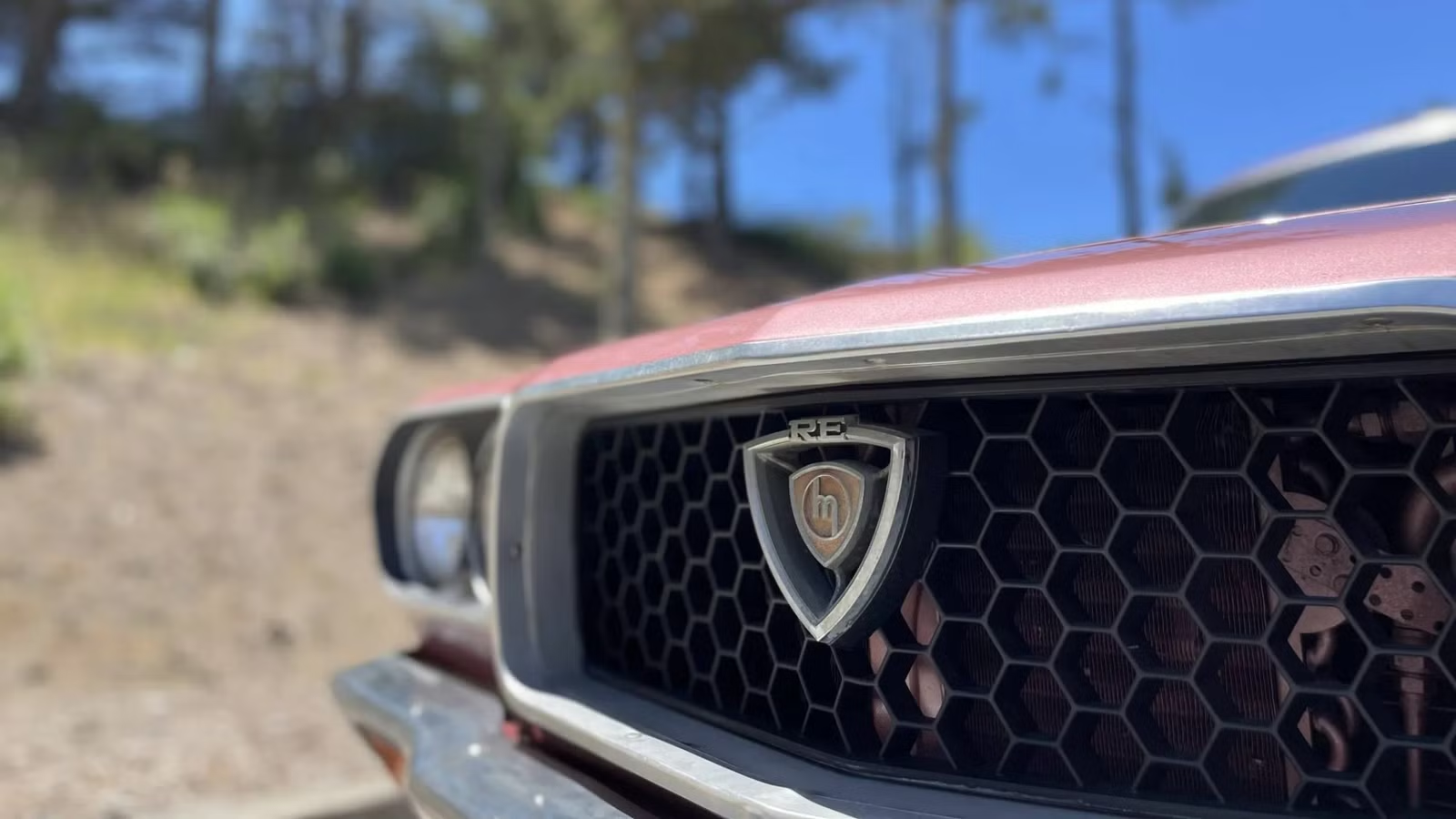
In late 1971, Japanese touring car racing had one answer to every question, and it wore a Skyline badge. The GT-R had won so often that fans joked its only real rival was another Skyline, and Nissan was openly lining up a milestone 50th win. Then Mazda showed up at Fuji with something small, light, and strange, built on the bones of a family compact. Today, rotary fans talk about the RX-7 and RX-8. The car that first humbled Nissan’s legend rarely gets mentioned at all.
The Japanese Touring Car Streak Nobody Could Break

The Nissan Skyline GT-R took its first win on May 3, 1969, in the TS-b race at the JAF Grand Prix at Fuji Speedway, and it barely stopped winning after that. Its S20 straight-six descended from the racing engines of the Prince Motor Company, which merged with Nissan in 1966, and in race trim it gave the boxy sedan, nicknamed Hakosuka, a real edge over everything else in its class. Nissan’s own heritage history recalls that people said the Skyline’s only rival was the Skyline.
The wins piled up through 1970 and into 1971, first with the four-door PGC10 sedan and then with the KPGC10 two-door coupe, which made its race debut in March 1971. By October that year, Nissan was closing in on a round 50, and the Hakosuka was arguably at its peak, winning in rain and fog at Fuji while rivals scrambled for minor places.
Plenty of manufacturers had tried and failed to stop it. What finally did the job wasn’t a bigger six-cylinder or a purpose-built racer, but a compact engine with no pistons at all.

Mazda’s Rotary Gamble On The Racetrack

Mazda had bet its identity on the rotary engine, and racing was how it planned to prove the idea worked. Before turning its attention back home, the company raced its rotary Cosmo and R100 coupe at grueling European endurance events, including the Spa 24 Hours and the Marathon de la Route. Those races proved the engine could last, which mattered for a technology many buyers still distrusted.
Back in Japan, Mazda’s larger Capella rotary took the fight to the Skylines first. It kept finishing behind them, though, with GT-Rs filling the top spots and the Mazda collecting third-place finishes at Fuji in 1971. Mazda needed something lighter and nimbler to turn podiums into wins.
The answer came from an unlikely place. Mazda took its new family compact, a car otherwise sold with ordinary four-cylinder engines, and dropped the rotary into it. On paper it looked like an economy car with an unusual engine, which is exactly why Nissan didn’t see it coming.
The Mazda RX-3 Savanna That Beat Nissan’s Legend

Mazda launched the Savanna in Japan in September 1971, selling it overseas as the RX-3. It was essentially the Grand Familia compact with a rotary engine and its own nose, and early cars used the 982 cc 10A twin-rotor rated at 104 hp in Japanese trim. An early 10A coupe weighed roughly 1,950 lbs, and Britain’s Motor magazine recorded 0 to 60 mph in 10.2 seconds in its 1973 road test.
Those numbers look modest today, but the RX-3’s racing advantage lay in its packaging. It was lighter and wider-tracked than the Capella, and its choice of engines sometimes let it compete in more than one class. American buyers got a different car from the start, with the larger 1,146 cc 12A rated at 90 hp SAE net, and the RX-3 stayed on sale in the US from 1972 through 1978.
The Race That Ended The Streak

The decisive race was the Fuji Tourist Trophy on December 12, 1971. Crashes and reliability problems thinned the Skyline field, and a brand-new 10A RX-3 took the win, beating the most dominant touring car in Japan on its home circuit.
What exactly it ended is where the accounts diverge. Nissan’s official heritage records say the GT-R’s consecutive winning streak stopped at 49, with 29 straight for the works team, and that the 50th win came at the very next race on March 20, 1972. Japanese Nostalgic Car disputes the streak itself, arguing that the first 49 weren’t consecutive and that many were class wins rather than outright victories. Either way, the RX-3 is the car that broke the legend’s aura.
How The RX-3 Built A Rotary Racing Dynasty

One win could have been a fluke, so Mazda kept proving it wasn’t. For 1972, the racing Savanna moved to the larger 12A engine, and in May that year RX-3s finished first, second, and third in the Fuji Touring Car Grand Prix. The rivalry with Nissan only intensified, and the RX-3 took the Fuji Grand Champion touring car class title in 1972, 1973, and 1975.
Nissan, meanwhile, stepped back. The Skyline still added wins after the Fuji loss, but Nissan halted its works racing program in 1972 to focus on emissions and fuel economy, leaving the field open to the rotary. The RX-3 became a regular sight at the front of Japanese touring car grids, in factory and privateer hands alike.
The Win Record That Made Mazda’s Rotary Legend

The milestone arrived in 1976. At the JAF Touring Car Grand Prix, the RX-3 claimed its 100th domestic Japanese racing victory, completing six seasons of success that began with that December day at Fuji. Mazda’s history credits the car with extending the brand, promoting the rotary, and establishing its reputation for building great driver’s cars.
That reputation carried straight into the RX-7, which replaced the RX-3 in 1978 and inherited both its Savanna name in Japan and its role as Mazda’s rotary standard-bearer. Every rotary success that followed, from the RX-7’s racing wins to Mazda’s later endurance glory, traces back to the compact that first beat the Hakosuka.
What A Mazda RX-3 Is Worth Today

The RX-3 has quietly become a serious collector car. Its current market benchmark sits at about $52,000, with the record sale reaching $100,000 for a 1973 Super Deluxe coupe in December 2023. Projects have changed hands for far less, with the lowest recorded sale at $16,250 for a 1973 five-speed car needing work.
Import status shapes what you’re buying. US-market RX-3s were sold new here, so they are left-hand drive with the 12A engine and need no import paperwork. Japanese-market Savannas are right-hand drive and well past the federal 25-year rule, but buyers should still insist on full import documentation, since registration requirements vary by state.
Chassis codes indicate which engine a car was originally fitted with. According to Ate Up With Motor, early non-US cars carry the S102A prefix and the 10A engine, while S124A cars use the 12A, first for America and later worldwide. The same history estimates roughly 80,000 S102A coupes and sedans, about 85,000 S124A coupes and sedans, and around 75,000 US-market wagons. With the RX-7 and RX-8 hogging the rotary spotlight, the car that first humbled the Skyline GT-R remains one of the most underrated Mazdas you can buy.
Sources: Nissan, Japanese Nostalgic Car, Classic.com.

Related posts



Latest Post


No Comments