
The Naked Motorcycle That Makes The Yamaha MT-07 Feel Overpriced
For years, the Yamaha MT-07 has enjoyed a unique status in the American motorcycle market. It wasn’t simply another middleweight naked but something that riders recommended when someone wanted a machine that was quick, entertaining, practical, and attainable. It That reputation wasn’t built on outright performance.

Instead, Yamaha perfected a formula that balanced character, everyday usability, and affordability. For a long time, there simply wasn’t another Japanese middleweight naked that offered significantly more performance without carrying an even higher price tag. That assumption no longer holds true.
The Middleweight Naked Class Has Been Grading On A Curve
The middleweight naked category has always operated under an unwritten agreement between manufacturers and buyers. You accept less outright horsepower than a supersport, less touring capability than an adventure bike, and fewer premium electronics than flagship machines. In return, you received something arguably more valuable: a lightweight motorcycle that felt alive on real roads without demanding a premium price.

That equation only works if no one manages to improve both sides of it. Once a manufacturer starts offering noticeably stronger performance while keeping pricing competitive, the benchmark inevitably shifts. Suddenly, buyers begin asking harder questions about what they’re actually paying for instead of simply following tradition.
Yamaha MT-07 Is Widely Considered The Benchmark Of Middleweight Nakeds

The 2026 MT-07 carries an MSRP of $8,599, a number that’s crept steadily upward from the bike’s budget-friendly FZ-07 origins a decade ago. Under the tank sits the familiar 689cc CP2 parallel twin, good for roughly 73 hp and 50 lb-ft, moving a claimed 403-pound wet weight with a 31.7-inch seat height that keeps most riders flat-footed at stops.
What’s new for 2026 is real, not cosmetic filler. Yamaha gave the bike an all-new tubular-steel frame, stiffer than before, along with an inverted 41mm KYB front fork and radially mounted four-piston front calipers — genuine upgrades over the old model’s budget-spec hardware. They’re also exactly why the price climbed the way it did.
The Honda CB750 Hornet Makes The Yamaha MT-07 Feel Overpriced
Base Price: $7,999

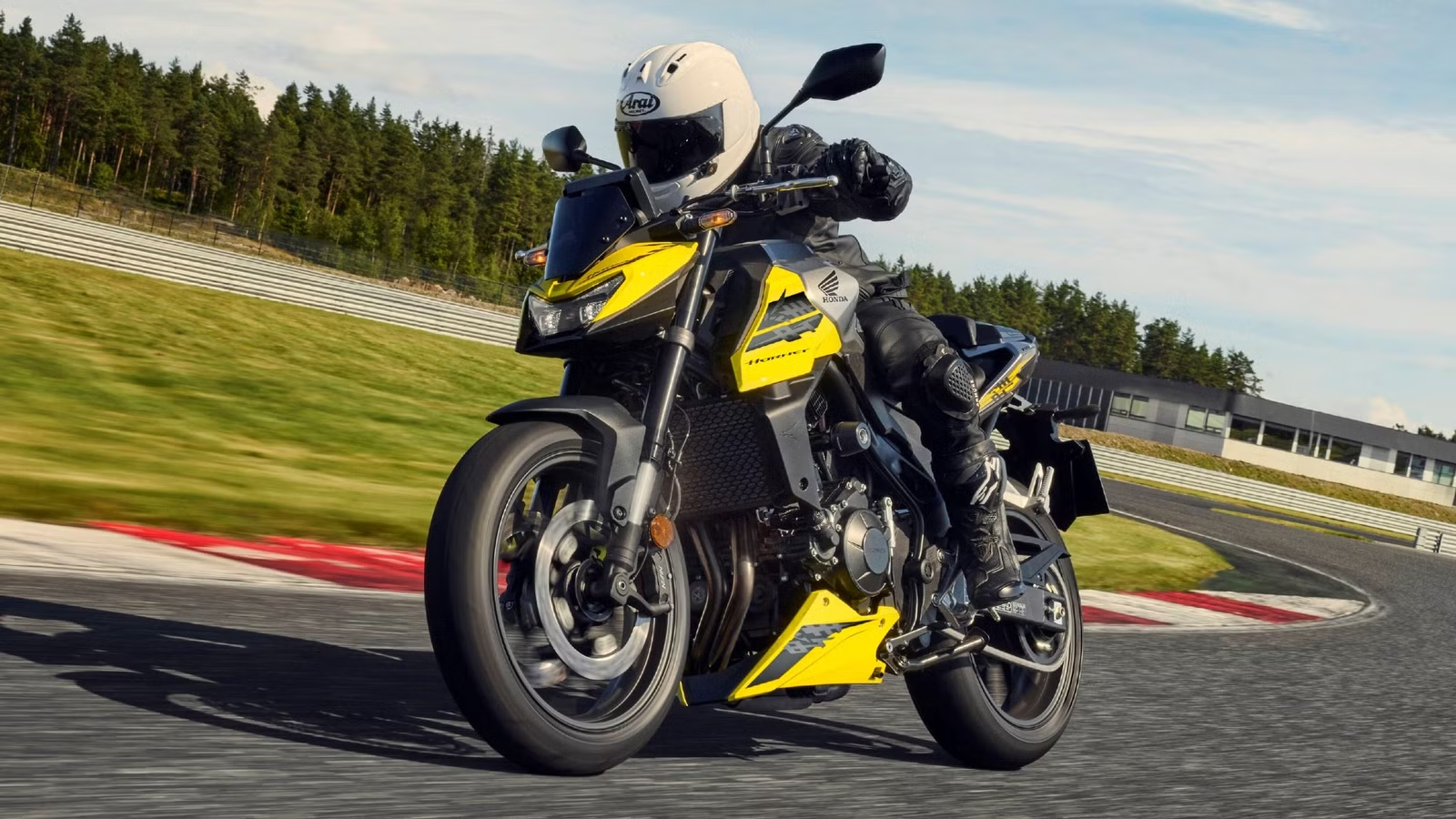
Enter the Honda CB750 Hornet E-Clutch, a bike that spent its first two years on sale in Europe racking up sales numbers and awards before finally landing stateside for the 2025 model year. For 2026, Honda didn’t touch the price. It just made the bike better. Despite adding E-Clutch as standard equipment, Honda held the 2026 CB750 Hornet at the same $7,999 sticker as the outgoing model.
That’s $600 cheaper than the MT-07, which doesn’t sound like much until you start listing what’s included at the lower number: a standard quick-shifter, a 5-inch TFT dash with smartphone connectivity, adjustable ride modes, and — new this year — clutchless shifting that costs nothing extra. Yamaha’s $8,599 buys a genuinely upgraded chassis. Honda’s $7,999 buys that plus a feature list that used to live on bikes twice the price.
Built Japanese But Looks European

The Hornet doesn’t look like it rolled off a spec sheet in Kumamoto. Its styling comes out of Honda’s R&D studio in Rome, and it shows. The fuel tank is shaped around the outline of a hornet’s wing, and from the sharply angled nose fairing to the razor-thin tail section, there’s a tension in the surfacing that most Japanese standards don’t bother chasing. It’s an industrial, almost architectural design language, and it photographs something far more expensive than the cheapest bike in its class.
Moving On From “The Dark Side of Japan”

Yamaha’s “Dark Side of Japan” design language put the MT-07 on the map — minimalist, angular, deliberately raw. It still works. But park a 2026 MT-07 next to the Hornet and the Yamaha starts to look like it’s playing it safe. The Hornet’s shrouds and tail feel like they were drawn by someone trying to make a statement. That’s a subjective call, sure, but it’s one plenty of showroom browsers will make with their eyes before they ever throw a leg over either bike.
Engine Performance That Defines Usability

This is where Honda makes its strongest argument. The CB750 Hornet’s 755cc liquid-cooled parallel-twin produces 90.5 horsepower at 9,500 rpm and 55 lb-ft of torque at 7,250 rpm. By comparison, Yamaha’s proven 689cc CP2 generates roughly 73 hp and about 50 lb-ft of torque. That gives the Honda approximately a 24 percent horsepower advantage while still costing $600 less. Numbers never tell the whole story, but they matter when the difference is this significant.
Two 270-Degree Twins, Two Different Personalities

Both engines use a 270-degree firing order, which is why both bikes have that lumpy, V-twin-style pulse instead of the buzzy feel of a flat-plane parallel twin. However, displacement matters here. The Hornet’s extra 66cc doesn’t just pad the horsepower figure — it broadens the usable spread of the engine, so there’s more torque to lean on in the midrange without chasing the tach.
Honda builds the Hornet around its Unicam cylinder head, the same basic layout used on the CRF450R motocrosser: the intake valves are actuated directly by the cam while the exhaust valves work through rocker arms, a setup that keeps the engine shorter, lighter, and lower in the frame than a conventional dual-cam design would allow. It’s a piece of dirt-bike DNA doing quiet work on a street bike.
Chassis And Hardware Work Side By Side

Honda’s spec sheet lists the 2026 CB750 Hornet E-Clutch’s curb weight — full tank, all fluids, ready to ride — at 432 pounds, roughly 29 pounds heavier than the MT-07’s claimed 403 pounds (wet). That’s a real concession, and it’s worth stating plainly rather than pretending the Hornet wins on every number. However, run the power-to-weight math and the Hornet still comes out ahead, delivering more horsepower per pound than the lighter Yamaha despite carrying the extra bulk.
Suspension And Brakes

Both bikes run legitimate, non-budget suspension. The Hornet uses a 41mm Showa SFF-BP inverted front fork paired with a Pro-Link single rear shock offering seven-stage preload adjustability, while the MT-07 counters with its own new 41mm KYB inverted fork and a linked monocross KYB shock. Braking hardware in the Hornet consists of dual 296mm discs paired with four-piston Nissin radial calipers, while the MT-07 runs its own radially mounted four-piston setup on twin discs. Neither bike embarrasses the other here.
The Tech And Equipment Honda Doesn’t Charge Extra For

Honda’s E-Clutch system lets you shift with your left foot alone, no handlebar clutch lever required, while still letting you pull the lever and ride it like a conventional bike whenever you want. It also functions as a quick-shifter, enabling clutchless, full-throttle gear changes in both directions. For 2026, it’s standard on every Hornet, not a paid option. The MT-07 has no equivalent at any price point.
5-Inch TFT, RoadSync, And Ride Modes

Both bikes get a 5-inch color TFT dash and smartphone connectivity — Honda through RoadSync, Yamaha through its Y-Connect app. Where they split is depth of adjustment. The Hornet’s ride modes span Standard, Sport, Rain, and two rider-programmable User settings, each tunable across power delivery, engine braking, and traction control.
Yamaha’s YRC electronics on the MT-07 are simpler by comparison. Add it all up, and the picture gets uncomfortable for Yamaha fast: more power, more standard tech, a design that photographs better, and a lower price. The MT-07 isn’t a bad motorcycle — it never has been. However, the reasons to pay $600 more for it just got a lot harder to find.
Source: Honda Powersports

Related posts


Latest Post


No Comments