
Lucid’s Recall Comes At The Worst Possible Time For EV Buyers Already Spooked By Battery Reliability
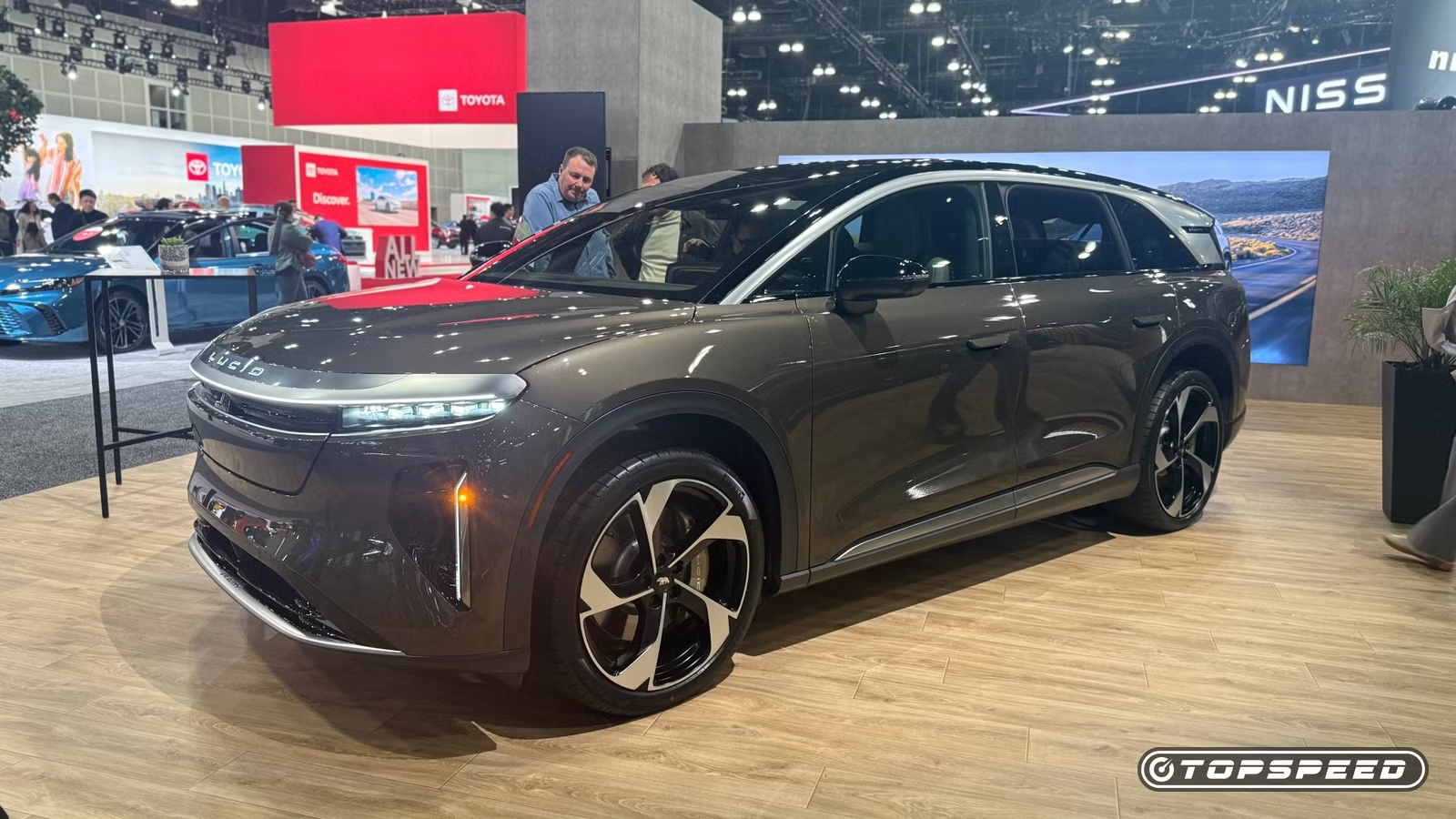
Lucid Group filed its largest-ever U.S. recall on September 9, covering 27,185 Air sedans from the 2022 through 2026 model years for an exterior lighting circuit that can overheat and pose a fire risk. NHTSA advised owners of unupdated vehicles to park outside and away from structures until a software fix is confirmed — the kind of language that tends to stick in people’s minds long after the technical fix is applied.

The recall itself is largely resolved. Lucid pushed software version 2.10.0 over the air in July, and roughly 20,719 of the 27,185 affected vehicles — about 77 percent of the fleet — had already received it before the recall was even formally filed. For most owners, the practical action is simply confirming the update in their vehicle’s settings or the Lucid app. But for luxury EV shoppers weighing a $100,000-plus Air against a Tesla Model S or Mercedes EQS, the headline lands at the worst possible moment.
What the Defect Actually Is, and Why It Matters
The root cause is narrower than the phrase “fire risk recall” implies. The Air’s low-voltage exterior lighting circuit is governed by a software-controlled eFuse — essentially a digital circuit breaker — that was supposed to cut power before the circuit overheated. Under certain conditions, it didn’t. Excess amperage could flow through the wiring, producing heat, smoke, and in three confirmed cases, fire. A fourth failure mode: the headlights or taillights could simply go dark.

All three confirmed fires involved the front lighting circuit and occurred over a three-year window. Lucid also logged four smoke reports between October 2025 and April 2026, plus 33 warranty claims tied to damaged center high-mounted stop lamp wiring harnesses. That’s a real pattern, not a single anomalous event — though it’s worth being precise about what failed. This is the same low-voltage circuit that runs your exterior LEDs, not the high-voltage traction battery pack. The fix is a software rewrite of the eFuse’s overcurrent thresholds, not a hardware replacement or a dealer visit. Lucid also disabled a function that previously allowed a faulted circuit to re-energize within the same key cycle, which was the mechanism that let overheating compound.
A Fast OTA Response That Still Leaves Questions Open

Lucid’s operational response was genuinely quick. The 2.10.0 update shipped in July, weeks before the formal NHTSA filing. By the time the recall was officially logged as campaign 26V540000, three-quarters of the affected fleet was already remediated. Owners who haven’t confirmed the update — or whose cars lack a reliable cellular connection — are being notified by October 16 with instructions to install it or contact a Lucid service center.
That speed matters. It’s the kind of software-backbone capability that Lucid and other connected-car makers have been promising for years: catch a fault, push a fix, close the loop without pulling every car into a bay. In that narrow sense, the recall demonstrates the system working. But the same software-defined architecture that enabled the fast fix also enabled the flaw to ship in the first place — a tension that’s becoming a recurring theme across the industry as automakers lean harder on software to manage vehicle electronics.
The Harder Question for Luxury EV Shoppers

Here’s where the recall becomes more than a technical footnote. Battery reliability — broadly defined as anxiety about what can go wrong with an EV’s electrical systems — is the single biggest hesitation driving luxury EV shoppers away from early commitments, according to TopSpeed’s own recent research on the segment. A fire-risk recall, even one that’s largely resolved, feeds directly into that anxiety.
For a buyer comparing the Air against the Model S or the EQS, the calculus involves more than range figures and interior quality. It involves confidence in the maker’s engineering maturity and quality control. Tesla and Mercedes carry decades of production experience and dealer networks that can absorb a recall without existential brand damage. Lucid is still a young company, still burning significant cash, and still fighting for the kind of volume that builds institutional manufacturing knowledge. Three confirmed fires and 33 wiring harness warranty claims across five model years of production isn’t a catastrophic record, but it’s a data point that a careful buyer will weigh.
The timing compounds the problem. Lucid’s stock has been sliding for weeks — from around $6.20 in mid-August to the mid-$4 range by early September — reflecting broader investor concern about demand and cash burn. A recall headline, even a largely-resolved one, adds brand-damage risk on top of those existing pressures. For shoppers who were already on the fence about trusting an early-stage EV maker with a six-figure purchase, this is the kind of news that pushes a decision back rather than forward.
What Affected Owners Should Do Right Now

If you own a 2022–2026 Lucid Air, the action is straightforward. Open the vehicle’s settings menu or the Lucid app and confirm you’re running software version 2.10.0 or later. If you are, the recall remedy is complete and the fire risk has been addressed. If you’re not — or if your car doesn’t have a consistent cellular connection — park outside and away from enclosed structures until you can confirm the update or reach a Lucid service center. Formal owner notification letters are scheduled to go out by October 16, but there’s no reason to wait for the mail.
The OTA fix works, and Lucid moved faster than most automakers would have on a recall of this scope. But speed of remedy and depth of buyer confidence are different things. For the luxury EV segment, where trust is still being earned one ownership cycle at a time, recalls like this one are worth watching — not because they’re necessarily disqualifying, but because they’re part of the honest picture of what it means to buy from a maker still writing its quality story.

Related posts


Latest Post


No Comments