
Lotus Emira V6 SE: Last Mid-Engine Manual Supercharged Car
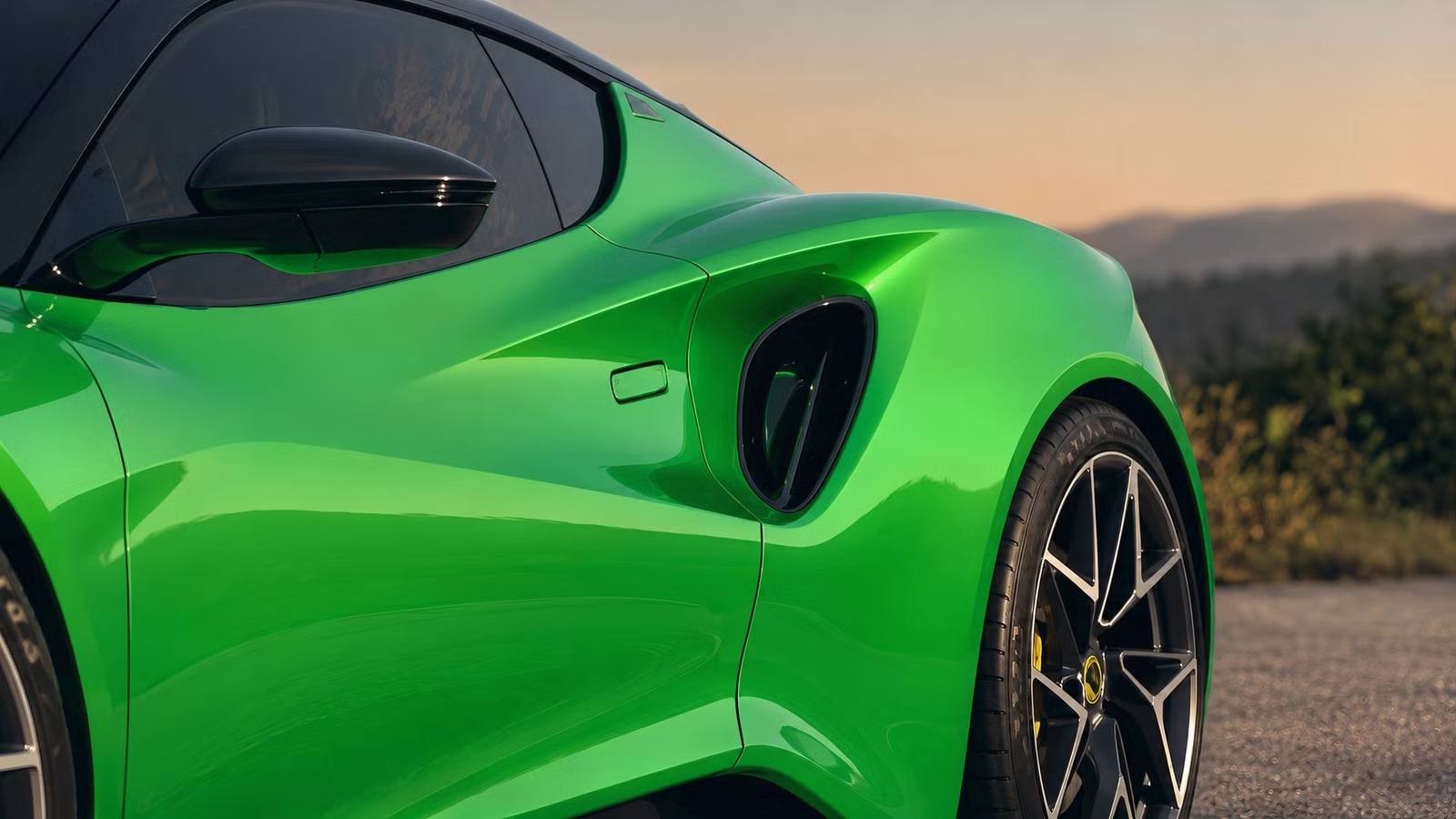
Sports-car progress is supposed to make the old version feel obsolete. This one apparently didn’t get the memo. A faster four-cylinder is here, but the slower, older, heavier V6 still hangs onto three things the industry keeps throwing away: a supercharger, a factory six-speed manual, and hydraulic steering.

Funny how odd mechanical recipes get cooler the moment they start disappearing. Even a forgotten V8 sports car can suddenly look like a great idea once its era is over. Porsche has already confirmed that 718 production ended in October 2025, so this analog window isn’t just closing. Someone already has a hand on the latch.
The Faster Four-Cylinder Leaves The V6 Behind
Start with the car that should bury the mystery V6. On paper, it has almost every reason to. The new 420 Sport makes 420 PS—roughly 416 hp—and 369 lb-ft from an AMG-sourced 2.0-liter turbo four, then fires it through an eight-speed dual-clutch transmission. The official 420 Sport data calls it the lightest, most powerful, and most aerodynamically capable version yet, while the optional Lightweight Handling Pack strips 25 kg and adds 25 kg of downforce.

Then the stopwatch makes things worse for the V6. Depending on which published estimate you pick, the 420 Sport lands somewhere between 3.3 and 3.9 seconds to 60 mph; that range isn’t perfectly apples-to-apples because some sources use 62 mph. The manufacturer’s technical data is cleaner: 3.7 seconds to 60 and 3.9 seconds to 62. The older 400-hp V6 needs 4.3 seconds to 60. Even the weight comparison needs some care because published figures vary by market and equipment, but the four-cylinder can be configured lighter, while the V6 is listed at 1,446 kg DIN. However you slice it, the newer car has the numbers on its side. The spreadsheet has spoken.

And the advantage doesn’t stop at one acceleration run. Peak torque is 500 Nm, top speed is 186 mph, and the new aero and cooling work were designed around harder use. None of that is fake progress. The car is quicker, lighter in its most focused specification, and easier to keep in its powerband because the DCT can hammer through ratios without asking the driver to coordinate a clutch pedal and lever.
That’s what makes the older car harder to dismiss. Enthusiasts haven’t stopped caring about old-school layouts—rear-drive passenger cars are even creeping back onto product plans—but layout is only part of the experience. The 420 Sport is objectively quicker, and it still keeps electrohydraulic steering. What it drops are the supercharged V6 and the manual gearbox. Those are two-thirds of the combination, and they’re exactly why the slower car refuses to become irrelevant.
The Mid-Engine Manual Competition Is Disappearing

For years, the obvious counterargument was the Porsche 718 Cayman. It was mid-engined, offered a proper manual in several versions, and could even be had with a naturally aspirated flat-six. But by the first half of 2026, the story had shifted from production to leftovers: Porsche delivered 2,789 Boxster and Cayman examples from the remaining pipeline after the line had already shut down.
Manual transmissions aren’t dead. The Mazda MX-5, Toyota GR86, Ford Mustang, and others still give drivers three pedals. But this story is much narrower: a mid-engine sports car combining a supercharged engine, a factory manual, and hydraulically assisted steering. That’s a far stranger overlap in 2026 than another generic “save the manuals” list suggests.

David Alpert / HotCars / Valnet
The rest of the mid-engine world has largely gone the other way. McLaren’s 750S uses a seven-speed Seamless Shift Gearbox, while the W1 gets an eight-speed DCT. The W1 even retains hydraulic steering, proving that hydraulic assistance itself hasn’t vanished. Aston Martin’s Valhalla also uses an eight-speed DCT. The individual pieces are still out there. What is disappearing is the recipe that puts them together, making the mechanical simplicity we still celebrate in a De Tomaso Pantera feel a long way from a 2026 showroom.
And that is why “last ever” goes too far. Tiny-volume exotics, special-market cars, or something nobody has announced yet can wreck an absolute claim overnight. The stronger claim is also the safer one: among regular-production mid-engine sports cars on sale in 2026, the combination of a supercharged engine, a factory three-pedal manual, and hydraulically assisted steering effectively stands alone. Now we can finally name it.
The Analog Triple Threat Is The Lotus Emira V6

The car is the 2026 Lotus Emira V6 SE—and this is where the story stops being interesting on paper and starts getting wonderfully strange. Behind the seats sits Toyota’s 3,456cc 2GR-FE V6, fitted with an Edelbrock 1740 supercharger and tuned to 400 hp. With the six-speed manual, Lotus lists 420 Nm, or 310 lb-ft, and a 180-mph top speed. Then comes the hardware that makes the whole thing feel almost defiant in 2026: an Aisin/Toyota six-speed, a limited-slip differential, and an exposed shift mechanism that puts the six-speed gate right in the middle of the cabin theater. The supercharger is mechanically driven, too, rather than spun by exhaust gases like a turbo. In an era of ever-faster DCTs and smaller turbo engines, this is a spec sheet that looks increasingly like contraband from another time.

And then there is the steering. Lotus’s V6 technical specification describes an electrohydraulic rack-and-pinion system, with an electric motor powering the hydraulic assistance instead of replacing it with a purely electric rack. That distinction sounds nerdy until you remember what this car is trying to preserve. The steering isn’t just there to change direction; it is another mechanical conversation happening between the front tires and your hands. Pair that with the supercharged V6 and a manual lever you physically move through an exposed gate, and suddenly the Emira V6 SE starts to look less like the slower alternative and more like the version holding the door open for an entire kind of driving experience.
Lotus hasn’t simply frozen the old car in amber, either. For 2026, it added a new compression mount for the manual gearbox to sharpen shift precision and revised cooling across the range. The V6 SE can still be ordered with an automatic, so this is not a manual-only trim. But it is the only current core Emira powertrain that still gives buyers a factory six-speed manual at all; the Turbo, Turbo SE, and 420 Sport have all gone eight-speed DCT. That leaves the V6 SE carrying the supercharger and clutch pedal into a much faster future that still keeps hydraulic steering—but no longer combines all three in the same car. If you like mechanical combinations that age into cult objects, overlooked performance wagons show how quickly the market can miss something once it is gone.
The Clark Edition Feels Like A Send-Off

Lotus made the symbolism even harder to miss with the Emira Clark Edition. Only 60 were built for selected markets to honor Jim Clark and the extraordinary 1965 season in which he won both the Formula 1 World Championship and the Indianapolis 500. Every Clark Edition uses the 400-hp supercharged V6, six-speed manual, limited-slip differential, and what Lotus calls “unfiltered hydraulic steering feel.” It even gets a sixties-style wooden gear knob. Lotus never literally calls this a farewell edition, so it would be wrong to put those words in the company’s mouth. But when a 60-car tribute to one of its greatest drivers deliberately keeps the slower manual powertrain instead of the quicker DCT setup, the sentimental weight is hard to miss.
Why This $133,000 Lotus Matters More Than Speed

Now for the awkward part: $133,000 is real U.S. showroom territory for an optioned 2026 V6 SE, not some theoretical fantasy-spec number. One current V6 SE listing at Lotus Orlando shows a $132,050 MSRP and a $133,438 retail price after documentation and filing fees. That is serious money for a car selling you, quite deliberately, older-school hardware.
And the comparison only gets tougher. The 420 Sport was announced with a U.S. starting price of $122,900 before options, while bringing more power and much quicker acceleration. It still keeps electrohydraulic steering, so Lotus hasn’t thrown every tactile ingredient away. But the exact recipe disappears: supercharged V6, six-speed manual, hydraulic rack. An optioned V6 SE can therefore land above the 420 Sport’s starting price and still be the slower car. Normally, that sounds like a bad deal. Here, that mismatch is the point.

For enthusiasts used to hunting sub-$20,000 muscle-car bargains, a $133,000 Lotus is firmly watch-more-than-buy territory. That luxury barrier is real. But this car does not need to be attainable to matter, and slower does not automatically mean better. What matters is that we are watching a very specific mechanical combination disappear while it is still sitting on a showroom floor.
The faster four-cylinder deserves every number it puts on the board. The V6 manual does not need to beat it. It still gives one driver a clutch pedal, a six-speed lever, a supercharger working behind the cabin, and a hydraulically assisted rack in one mid-engine package. Faster cars will keep coming. This exact combination is already disappearing from showroom floors. That is what makes the slower one worth remembering.

Related posts



Latest Post


No Comments