
The 125cc Honda Twin That Revved To A Wild 10,500 RPM In 1959
All the way back in 1959, a 125cc four-stroke sounded, to most, like basic transportation. That said, one tiny Japanese twin had very different priorities, making its best power near the top of the tach and carrying hardware that looked suspiciously serious for something this small.

It was compact enough to pass for a commuter, but Honda had been learning some expensive lessons in international racing. Luckily for all of us, those lessons were about to reach the street.
Honda Needed More Than A Sensible 125cc Commuter
Honda’s small-displacement motorcycles had already demonstrated the value of simple, economical transportation, and the Benly name itself translated to ‘convenient’, which made complete sense for riders looking for cheap mobility. Soichiro Honda had much bigger ambitions, though, and they involved proving that Japanese motorcycles could compete with Europe’s best.

Honda announced its intention to race at the Isle of Man TT in 1954, putting the young Japanese manufacturer on a collision course with established European motorcycle companies. The performance gap initially was substantial; Honda’s early 125cc racing engine produced roughly 8 hp, while leading rivals were extracting around 18 hp from the same displacement class.
Testing Times

Honda delayed its TT debut while engineers continued developing the bikes at home. That patience was key because the company was learning how much power a tiny four-stroke engine could produce if it could safely rev high enough. Those lessons would eventually influence something far more relevant to everyday riders in Japan and, soon enough, the growing American motorcycle market.
The standard Honda Benly continued to be the sensible side of the family. The CA92 used a pressed-steel frame, 16-inch wheels, and an electric starter that made it particularly appealing when American Honda began selling motorcycles in the United States. Honda now had a practical small-bike platform, and the next step was to make one considerably more entertaining.
Racing Taught Honda How High A Tiny Twin Could Rev

Honda finally arrived at the Isle of Man in 1959 with machinery that looked dramatically more ambitious than its earlier efforts. The factory RC141 used a 124.6cc four-stroke parallel-twin engine with double overhead camshafts and a six-speed transmission, producing a claimed 17 hp.
Honda then developed the RC142, retaining the same 1.73-inch bore and 1.61-inch stroke while adopting a four-valve cylinder head. Output climbed to 18.5 hp, and the little racing twin could spin to an incredible 14,000-rpm redline.
Gaining Experience

At this point, that number needs some separation from the Honda at the center of this story. The RC142 was a purpose-built Honda racing motorcycle, while the one in question here was a street bike. Put simply, the relationship between the two is more interesting than pretending they were mechanically identical.
Honda’s first Isle of Man TT campaign didn’t end with an overall victory, but Naomi Taniguchi finished sixth in the 125cc race and Honda secured the Manufacturers’ Team Prize. More importantly, the company had shown that its high-revving four-stroke twins belonged on the same circuit as established European racing machinery. Importantly, Honda had also gathered exactly the sort of experience that could make its production motorcycles much faster.
The Honda CB92 Benly Super Sport Made 15 HP At 10,500 RPM

What it all boiled down to was the 1959 Honda CB92 Benly Super Sport, a 124cc air-cooled OHC parallel twin producing 15 hp at 10,500 rpm. That five-figure power peak is what makes the CB92 astounding even more than six decades later. Plenty of modern motorcycle engines enjoy revs, but a 125cc production four-stroke doing this in 1959 deserves a little applause.
Honda gave the CB92 a 10:1 compression ratio and a larger 20mm Keihin carburetor, while stronger valves helped the engine tolerate its increased performance. The crankshaft ran in three main bearings, another indication that Honda expected owners to spend plenty of time near the fun end of the tachometer.
Compare that with the regular C92 Benly, which produced 12 hp at 9,500 rpm with an 8.3:1 compression ratio. Honda had squeezed 25 percent more peak horsepower from essentially the same engine displacement while moving the power peak another 1,000 rpm higher. For a small Japanese motorcycle launched before the 1960s had properly begun, that’s a pretty cool escalation.
The payoff was a claimed top speed of roughly 80 mph. That’s the number that really puts the Honda CB92 into perspective for American riders today. An 80-mph 125cc motorcycle sounds awesome even now, yet Honda was selling one when much of the U.S. still associated small motorcycles with inexpensive transportation rather than serious performance.
Honda Built The Rest Of The Bike To Keep Up

Don’t be fooled into thinking the Honda CB92 Super Sport was created by warming over the engine and calling it a day. Its chassis received changes that made the little 125 look and behave more like the sports motorcycle Honda wanted it to be.
The pressed-steel frame and leading-link front suspension remained connected to the Benly family, but the CB92 traded the standard model’s enclosed rear suspension for exposed coil-over units. Honda also moved to 18-inch wheels rather than the 16-inch wheels used by more commuter-oriented versions. The changes immediately gave the CB92 a leaner, more purposeful stance.
Out Of Place? Hardly

Early examples received an alloy fuel tank shaped with clear inspiration from Honda’s racing machinery. A shorter bench seat and tubular handlebar further separated the Super Sport from Honda’s everyday 125cc motorcycles, while an optional solo seat with a raised rear section could make the CB92 look even closer to the company’s competition bikes.
Another neat aspect was its front brake. Early Honda CB92s used a substantial 8-inch double-leading-shoe drum with a magnesium backing plate. Honda eventually changed that component to cast aluminum, but the size remained impressive enough that the same 8-inch drum diameter appeared on larger Honda CB72 and CB77 models. Apparently nobody told the engineers that a 125 was supposed to know its place.
This Little 125 Helped Define What A Honda CB Would Become

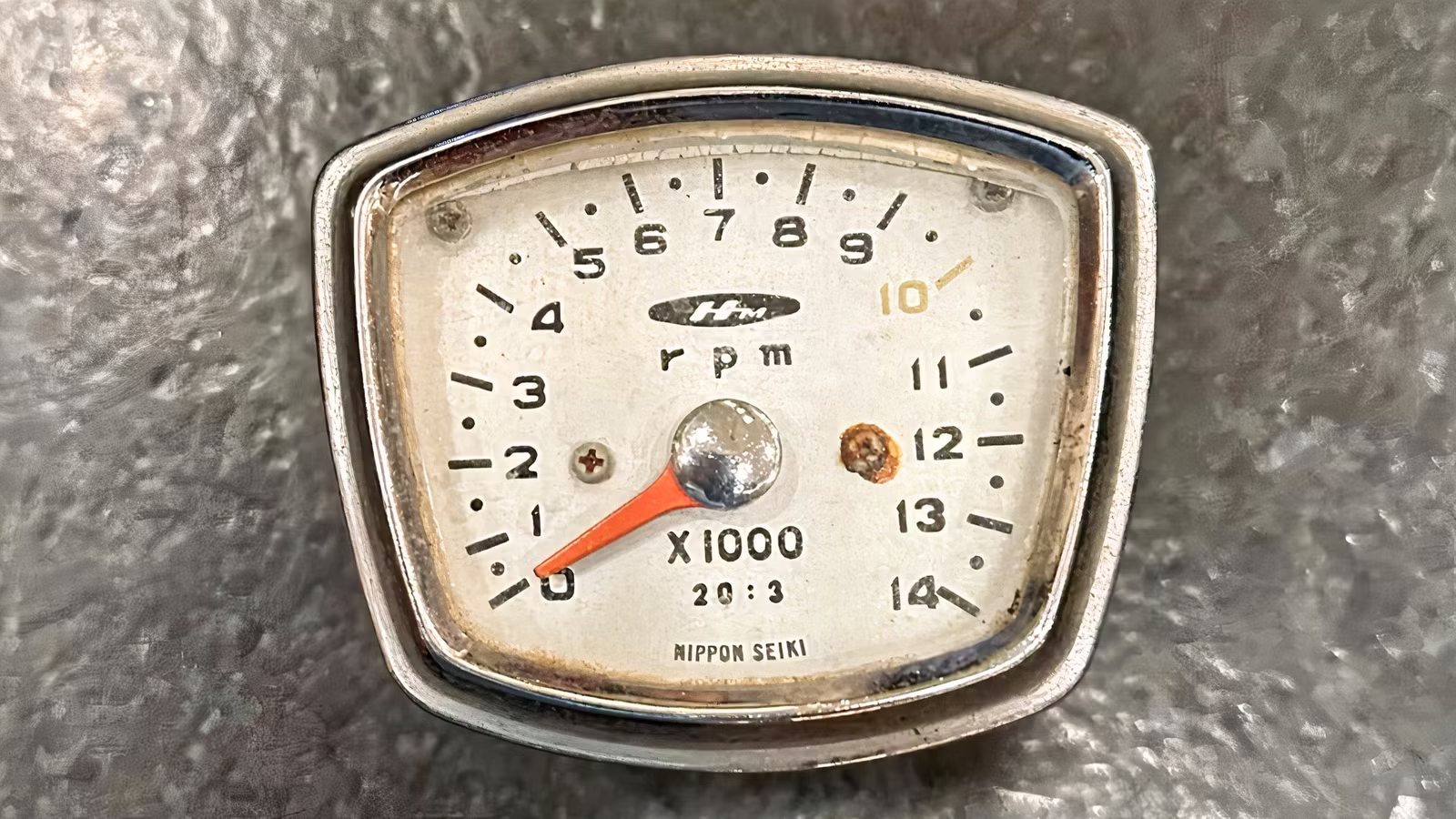
Honda even offered YB racing parts for owners who thought the standard CB92 needed a little more go. Available equipment included a hotter camshaft and a revised cylinder head, along with open megaphone exhausts. A cable-driven tachometer calibrated to 14,000 rpm could replace the speedometer in the headlight shell.
That factory-supported performance potential helped the CB92 build a racing reputation of its own. Hajime Kitano won the 1959 Mount Asama Volcano Race aboard a CB92, while the motorcycle later found competition success in the United States. Dave Ekins raced a modified example in America, and Mary McGee competed on a CB92 as her career moved from sports-car racing into motorcycles.
Tiny Origins

The American connection is important because the CB92 arrived during the period when Honda was establishing itself in the U.S. market. Roughly 1,000 examples are estimated to have reached America between 1960 and 1962, although precise official U.S. sales figures aren’t clear. Naturally, that scarcity has helped make surviving CB92s quite desirable among collectors of vintage Honda motorcycles and classic Japanese motorcycles today.
All in, the CB92’s 10,500-rpm power peak makes a great headline because it still sounds incredible for a 1959 Honda 125cc motorcycle. Who’d have thought that long before high-revving Honda motorcycles became part of the company’s identity in the United States, this tiny parallel twin had already figured out the formula?
Sources: TopSpeed, Motorcycle Classics, Classic Mechanics, Honda.

Related posts


Latest Post


No Comments