
Last Front-Engine Manual Corvette: The 2019 Z06
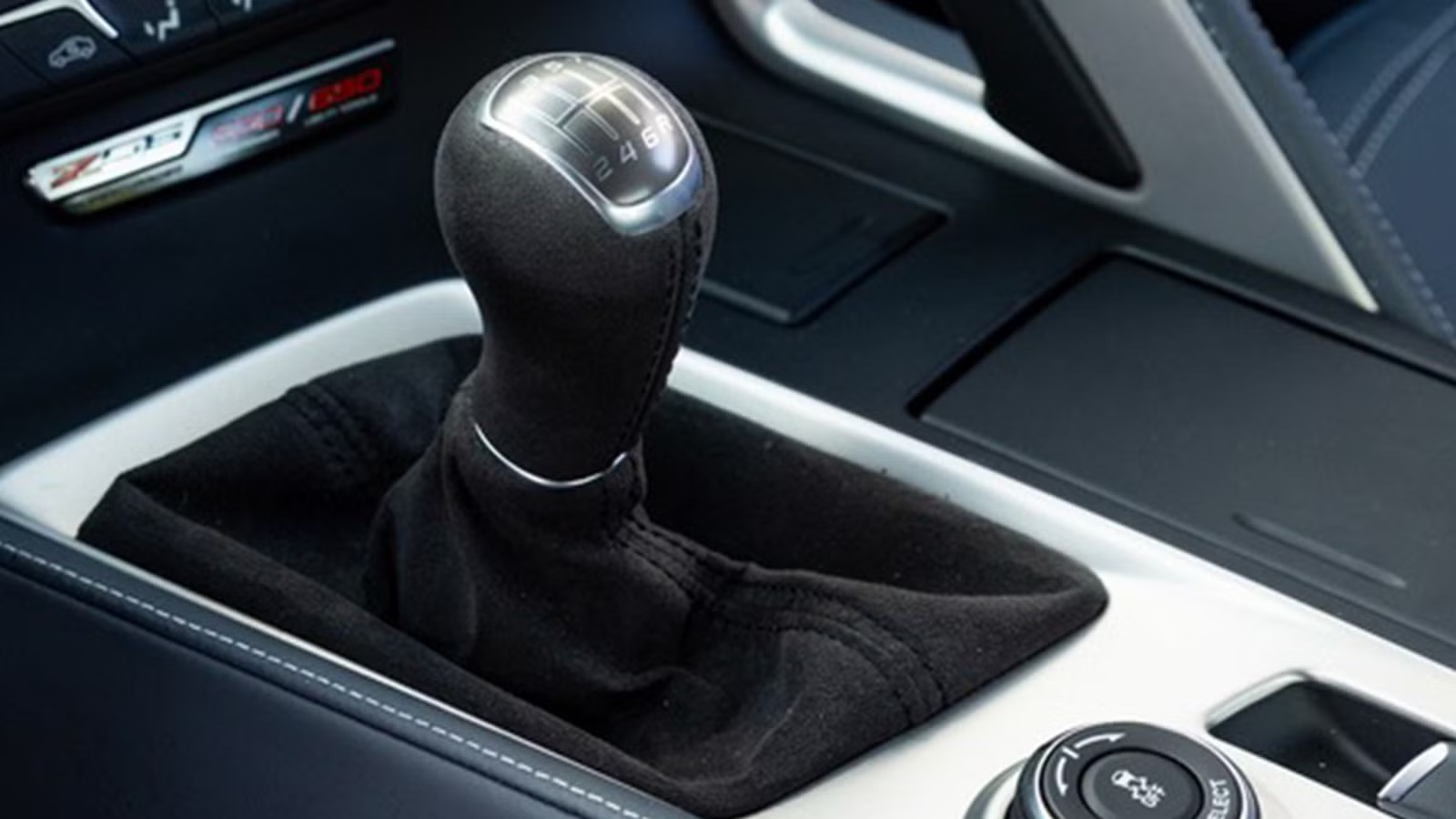
Chevrolet has spent more than 70 years building sports cars around driver involvement, but sometime in the last few years the automaker closed the book on one specific piece of that identity for good. A generation of its most important model came and went, and with it went a mechanical connection that nobody at the company has any plans to bring back. The car that replaced it shattered performance records nobody thought were reachable. It also broke a tradition stretching back to the 1950s. Here is the car that turned out to be the final word on doing it yourself.
The Death Of The Three Pedal American Sports Car

Manual transmissions have been dying across the sports car segment for a decade, and it has not been a slow fade. Buyers say they want three pedals in surveys, then walk into showrooms and order the automatic anyway, because dual-clutch gearboxes now shift faster than any human ever could. Porsche, BMW, and Ford have all trimmed manual availability model by model, and the reasoning is nearly identical everywhere: a stick shift costs real engineering money to certify, package, and calibrate, and fewer buyers choose it every single year.
The math gets uglier at the top of the performance ladder. A modern electronically controlled gearbox can rev match, launch, and shift under load with a precision no left leg can replicate, and lap times have followed the technology rather than tradition. That leaves manual gearboxes surviving mostly on emotion, and emotion does not pay for a bespoke transmission line. One American nameplate rode that decline all the way to the very end, and its final front-engine, stick-shift chapter closed with barely a press release to mark it.
Why The Next Generation Corvette Left The Manual Behind


When Chevrolet moved its flagship sports car to a mid-engine layout, the manual gearbox did not survive the transition. The current car pairs its V8 exclusively with an eight-speed dual-clutch automatic, a transmission engineered specifically around the packaging demands of a mid-engine chassis, and there has never been a factory clutch pedal option since. Chevrolet has been blunt and consistent about why, repeating the same explanation across seven model years without softening it once.
Routing a physical shift linkage through a mid-engine car’s structural spine creates real engineering headaches that a front-engine layout never had to solve, and Chevrolet’s engineers decided fairly early that the tradeoff was not worth chasing for a shrinking slice of buyers. Even when the transmission specialist Tremec displayed a manual gearbox built to the current car’s mounting points at a trade show, company leadership shot the idea down almost immediately, calling it a non-starter for production. The door on a factory three-pedal option has stayed shut ever since, and every signal from the people building the car says it is staying that way.
The 2019 Chevrolet Corvette Z06 Was The Last Of Its Kind

The finality of that shift traces back to one specific car. On November 14, 2019, a black 2019 Corvette Z06 coupe with an Adrenaline Red interior, the Z07 package, and a seven-speed manual transmission rolled off the line at Chevrolet’s Bowling Green, Kentucky, plant. Months earlier, the automaker had already auctioned off the rights to that exact build slot at a charity sale, and bidding for what would become the final front-engine Corvette ever built turned into a record-setting charity result worth $2.7 million, with every cent benefiting a foundation that supports wounded veterans and first responders.
Underneath the ceremony sat a genuinely serious car. The Z06’s supercharged 6.2-liter LT4 V8 made 650 hp and 650 lb-ft of torque, good for a 0 to 60 mph run of roughly 3.0 seconds, figures that comfortably matched contemporary rivals built around a completely different formula. The Dodge Viper ACR, the last manual-only American supercar before it and itself discontinued in 2017, made 645 hp and 600 lb-ft from a naturally aspirated 8.4-liter V10, hitting 60 mph in about 3.2 seconds. Two very different engines, two clutch pedals, and two American nameplates that ran out the clock on analog performance within two years of each other.
Chevrolet Engineers Have Closed The Door On A Manual C8

Chevrolet’s own engineering leadership has made the finality explicit, more than once and without hedging. At the C8’s launch, longtime Corvette chief engineer Tadge Juechter explained that a clutch pedal simply would not fit in the mid-engine car’s footwell, and that routing shift linkage through the car’s tubular aluminum spine would have compromised the structure itself. He also pointed to demand: the manual take rate on the Corvette had fallen from roughly 35 to 50 percent in 2014 down to about 15 percent by the C7’s final year, a number too small to justify a bespoke gearbox program.
Years later, current executive chief engineer Tony Roma delivered the same verdict when a supplier showed a manual transmission built to fit the C8’s mounting points. Asked directly whether it signaled a factory manual was coming, Roma called it “not real” and said Chevrolet has no plans to even discuss the idea, adding that the dual-clutch automatic makes the current car both faster and better on track. Two chief engineers, seven years apart, arrived at the identical conclusion.
What A Manual C7 Corvette Is Worth Today

Values are starting to reflect that finality. The current market benchmark for a C7 Z06 sits right around $76,000, with the average recorded sale price landing just under $80,000, and well-optioned manual cars tend to sit above that line. The floor is a good deal lower: one 2016 Z06 with a seven-speed manual sold for as little as $41,500 in late 2025, proof the market still has a wide spread depending on condition and options, but the trend for clean manual examples has been pointing up rather than down.
Compare that against the closest thing America ever built to a rival for this kind of send-off. The manual-only Viper ACR generation that closed out that nameplate entirely, built from 2013 through 2017, now averages around $272,000 at sale, with the strongest documented example, a final-year 2017 Extreme edition, fetching nearly $600,000. The Viper’s numbers run far higher because production was tiny by comparison, but the underlying story rhymes. Both cars are the last manual-only send-offs from their respective nameplates, and both markets have started treating that fact as something worth paying for.
Why Clean Manual C7s Are Becoming Modern Classics

Part of the appeal is mechanical rather than nostalgic. The C7’s LS-based architecture responds well to tuning, and its factory ECU has none of the locked-down software restrictions that make later, more software-dependent Corvettes harder for independent shops to modify. That keeps a healthy aftermarket alive around these cars in a way electrified, software-gated performance vehicles rarely allow.
Supply is the other half of the equation. A minority of C7s left the factory with a clutch pedal at all, and that share only shrank as the generation aged, which means clean, unmodified manual examples are a genuinely finite pool rather than a category that keeps refreshing itself. Buyers chasing the last analog Corvette are increasingly competing over the same shrinking group of cars, and the prices are starting to show it.
A Front Engine Farewell In A Hybrid Future

Measure that 650 hp manual Z06 against where the Corvette nameplate stands now and the gap becomes almost comic. The current range-topping ZR1X pairs a twin-turbocharged 5.5-liter V8 with a front-axle electric motor for 1,250 combined hp, hitting 60 mph in as little as 1.89 seconds through an all-wheel-drive hybrid system that shares almost nothing conceptually with the car that came before it. It is a genuinely stunning machine, and it is also proof of exactly how far the nameplate has traveled from the formula this story is built around.
That contrast is the whole point. The last front-engine, manual Corvette was not the fastest car Chevrolet ever built, and it was never going to be. What it offered instead was a direct mechanical link between driver and machine that the C8 generation, for all its speed, simply does not replicate. Collectors chasing clean examples today are not buying acceleration numbers. They are buying the last version of a Corvette that asked something of the person behind the wheel, and that is a harder thing to manufacture than horsepower.
Sources: Hagerty, Classic.com, Bring a Trailer.

Related posts


Latest Post


No Comments