
1968 Dodge Dart GSS: The 440-Powered Compact You Never Knew
The 1968 Dodge performance catalog contained all the ingredients for a truly ridiculous muscle car. Dodge would sell you its compact and sporty Dart GTS. It would sell you a 375-horsepower, 440-cubic-inch Magnum V8. But right beside that engine’s specifications was the catch: not available on Dart GTS. Detroit had drawn a neat little line between its nimble car and its powerful engine. But during the muscle-car era, a manufacturer’s order sheet wasn’t the final word.
Detroit’s Craziest Muscle Cars Came From Out Of Town

Even by the late 1960s, most models assembled in Detroit didn’t prioritize cutting-edge power-to-weight ratios. When customers demanded more grunt in lighter cars, dealerships around North America responded by assembling these “special editions” themselves.
Yenko Chevrolet of Canonsburg, Pennsylvania, may be the dealership most synonymous with engine-swapped pony cars. Don Yenko began converting Camaros to 427 cubic-inch big-block power in 1967. The American Muscle Car Museum documents one surviving 1968 Yenko with its original 427, rated at 450 horsepower, backed by an M21 four-speed, and 3.73 Positraction rear end. That was a lot of power for Chevrolet’s compact pony car.
Yenko was not the only dealer with the same idea. Gorries’ Chevrolet in downtown Toronto created its own special-edition Camaro, the Black Panther, and offered performance conversions that included 427 power. The name was a wink at “Panther,” Chevrolet’s original codename for the Camaro program.


That was the real trick of the “dealer special edition” era: the wildest car in town might never appear in a national brochure. Detroit supplied the ingredients, but ambitious dealerships were willing to mix them in combinations the factory either hadn’t imagined yet, hadn’t approved yet, or simply refused to sell.
Dodge Had The Perfect Big-Block And The Perfect Lightweight Car, Just Not Together

There’s a lot to love about Mopar’s A-body compact cars of the 1960s. The Dodge Dart and Plymouth Valiant/Barracuda used lightweight unibody construction and Chrysler’s familiar torsion-bar front suspension. Longitudinal torsion bars extended out from the firewall and rotated when the suspension moved, effectively serving as the front springs.
The A-body chassis was an excellent platform for small-block performance. The 1968 Dart GTS came standard with Dodge’s new 340 cubic-inch V8, rated at 275 horsepower and 340 lb-ft of torque. But Chrysler had much more engine sitting elsewhere in the catalog. Dodge’s 440 Magnum was rated at 375 horsepower and 480 lb-ft in 1968. It would have made a wonderfully unreasonable Dart, except Dodge’s own performance brochure explicitly said the 440 was not available in the GTS.

Dodge had already proven a big-block V8 would physically fit. The Dart GTS arrived for 1967 with an available 383 cubic-inch V8. The most difficult aspect of fitting a big block in the compact’s engine bay may have been engineering exhaust headers that could snake past the torsion bars. But Mopar made it work. Dodge advertised the Dart’s 383 at 300 horsepower and 400 lb-ft, but stopped short of offering the 440, despite the higher-displacement engine sharing a block.
Mr. Norm’s Dart GSS Put 440 Cubic Inches In A Compact

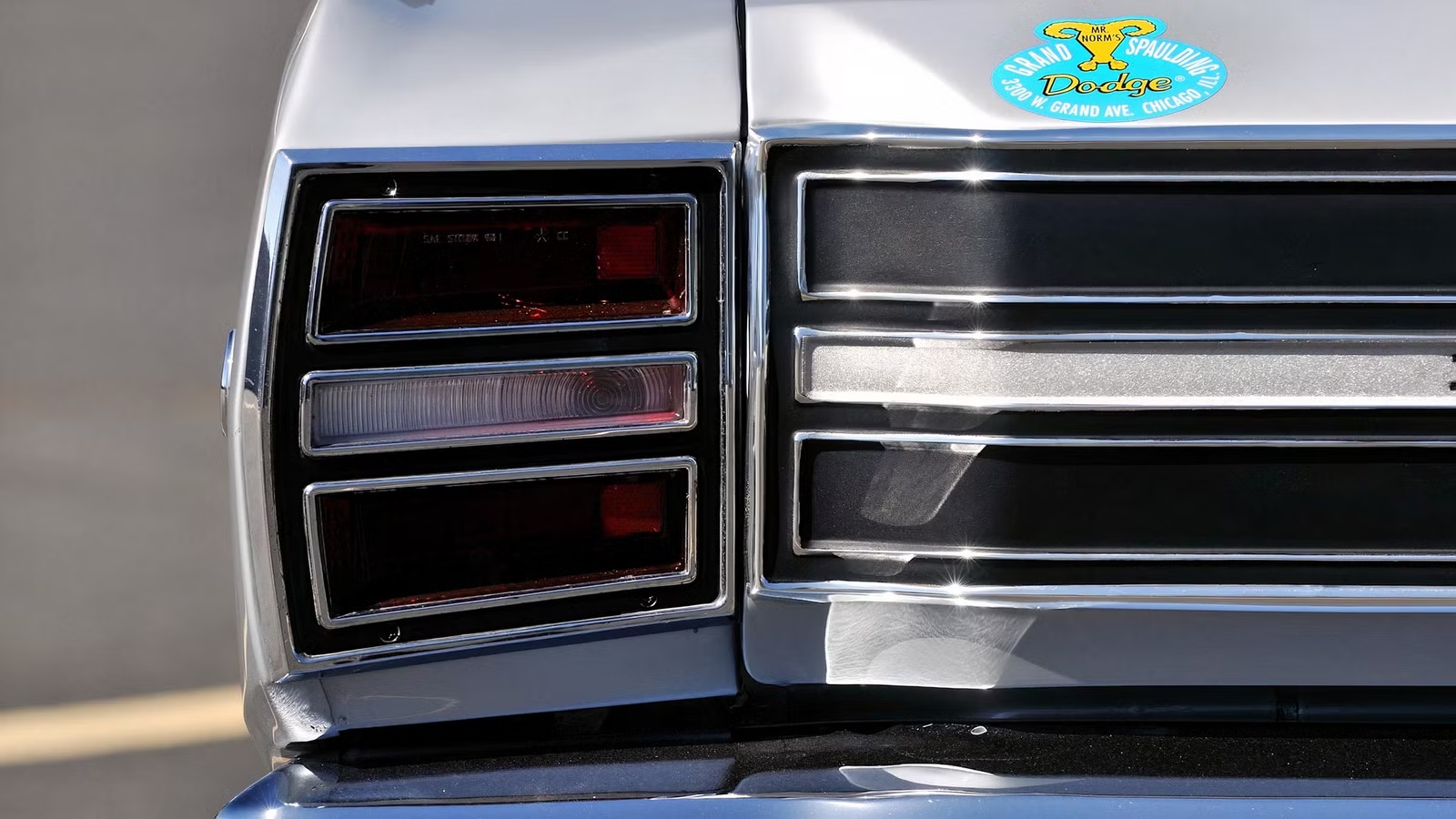
The dealer famous for dialing the Dart up to “11” was Norm Kraus. He was better known to Chicago as “Mr. Norm.” Grand Spaulding Dodge opened in 1962 and almost immediately made high performance its business, fielding a racing team by 1964 and building a national reputation around fast Dodges. So when Kraus looked at a Dart GTS and a 440 Magnum and wondered why Dodge had not combined them, he knew what he was doing. Grand Spaulding had the customers and racing credibility to make Detroit listen. The resulting 1968 Dart GSS was sold through a dealership, but the paper trail shows something much more interesting than a backyard engine swap.
Dodge Special Order 1.68-1703 called for 48 Dart GTS hardtops. Hamtramck was instructed to build them without an engine, transmission, carburetor, or air cleaner. Trenton Engineering assembled the special A13 440 engines, while Hamtramck dressed them with 383 oil pans and exhaust manifolds—components already engineered to fit in an A-body engine bay. Cars and powerplants traveled separately to Hurst-Campbell in Madison Heights, where the drivetrains went in according to Dodge instructions. Dodge service personnel even inspected the completed cars before they continued to Grand Spaulding. A surviving build sheet for VIN LS23M8B225234 carries the remark “BUILD LESS ENG TRANS CARB AIR CLNR,” corroborating this unusual production process.

The concept was simple enough: take the Dart GTS, which Dodge offered with a 300-horsepower big-block 383, and give it a 375-horsepower 440 Magnum instead. What’s so intriguing about the GSS is that Grand Spaulding received it already completed by Hurst-Campbell in metro Detroit. But despite this, it never appeared in Dodge’s catalog.
Making A 440 Fit Was The Easy Part

Putting Dodge’s 440 into its compact Dart required much more than winching the big V8 down between the fenders. Luckily for Mr. Norm, the regular Dart GTS already came with heavy-duty suspension hardware. Dodge’s 1968 catalog lists heavy-duty torsion bars, heavy-duty ball joints, six-leaf rear springs and a sway bar, plus E70-14 wide-tread tires on 5.5J wheels. The brochure also notes an extra leaf in the right rear spring to help control torque and wheel hop. That foundation mattered once the 440’s 480 lb-ft arrived.
Muscle-car folklore gets slippery here. Mecum’s photos of survivor VIN LS23M8B225241 show a full-size battery under the hood with the big-block V8–but no A/C compressor or power-steering pump. That supports some of the accessory-restriction lore while directly undermining the common claim that every GSS moved its battery to the trunk.

The most confusing aspect of the Dart GSS may be a single sentence in the paperwork reproduced for Dodge Special Order 1.68-1703: “Engineering has done development work on this installation.” The order also specifies 383 oil pans and exhaust manifolds for the special A13 440 engines and says Hurst-Campbell was to install them according to Dodge instructions. Yet the same document says Dodge could not support warranty for the cars. That makes the project look less like a rogue dealership swap and more like a tiny skunkworks program operating in the gray area between factory and dealer.
The Dart GSS Was Too Good An Idea For Dodge To Ignore

For 1969, Dodge offered an M-code 440 Dart GTS. The recipe was still wonderfully unreasonable: 440 power in an A-body, backed by a TorqueFlite automatic, with a “440 Four Barrel” hood callout identifying what lay underneath. The following year’s car turned the 440 Dart from a single-dealer special-order story into a broader Dodge offering.
Today, the 48-car 1968 special order is an infamous piece of muscle-car history. But Mopar fans outside of Chicago likely hadn’t heard of it in 1968. Imagine walking into a Dodge dealer in 1968 and being told the 440 V8 was not available in a Dart GTS. Then, in the next model year, seeing an M-code 440 Dart on the same showroom floor.

Grand Spaulding did not simply thumb its nose at Dodge and build a rogue hot rod. You might say Mopar went “rogue” alongside the dealership. Dodge Engineering did development work on the installation, Chrysler arranged the unfinished cars and engines, Hurst-Campbell installed the powertrains, Dodge personnel inspected the finished cars, and Grand Spaulding put them in front of customers.
Sources: Dodge, General Motors, GTS Registry, NHRA, American Muscle Car Museum, Red Vette Ranch, Mecum Auctions.

Related posts



Latest Post


No Comments