
America’s First Fiberglass Sports Car: It Wasn’t the Corvette
Ask any car enthusiast who built America’s first fiberglass sports car, and the answer comes back before you finish the question. The 1953 Chevrolet Corvette is one of the most repeated “firsts” in automotive history, and it happens to be wrong.

The truth is that three different cars hold a legitimate claim to the title. The argument turns entirely on what “first” actually means — first with the material, first to reveal, or first to sell. The real answer belongs to a boat builder in Southern California, whose work sat underneath every ‘first’ that Detroit later claimed.
America’s First Fiberglass Sports Car Depends On Who You Ask
Chevrolet’s claim rests on the assembly line. The first production Corvette rolled out of the Flint, Michigan plant on June 30, 1953, and the company built 300 units that first year. If “first” means a fiberglass sports car you could walk into a dealership and buy new from a major manufacturer, the Corvette earns the title fairly.


The problem is that the Corvette was not the first fiberglass sports car the American public ever saw. The Kaiser Darrin appeared as a running prototype in the fall of 1952, a few months before Chevrolet showed the Corvette to anyone. By the time GM’s roadster was making headlines, Kaiser’s had already been photographed, written about, and promised to buyers.

That reveal never converted into a sales win. Production delays pushed Darrin deliveries all the way to January 1954, and by then Corvettes had been trickling out of Flint for six months. So the reveal crown and the sales crown belong to two different cars, which is exactly why this argument never dies.
Yet both claims share the same blind spot. They ignore a third car that predates the pair of them, built by a man whose fingerprints are on all three.
Bill Tritt Put Fiberglass On The Road In 1951

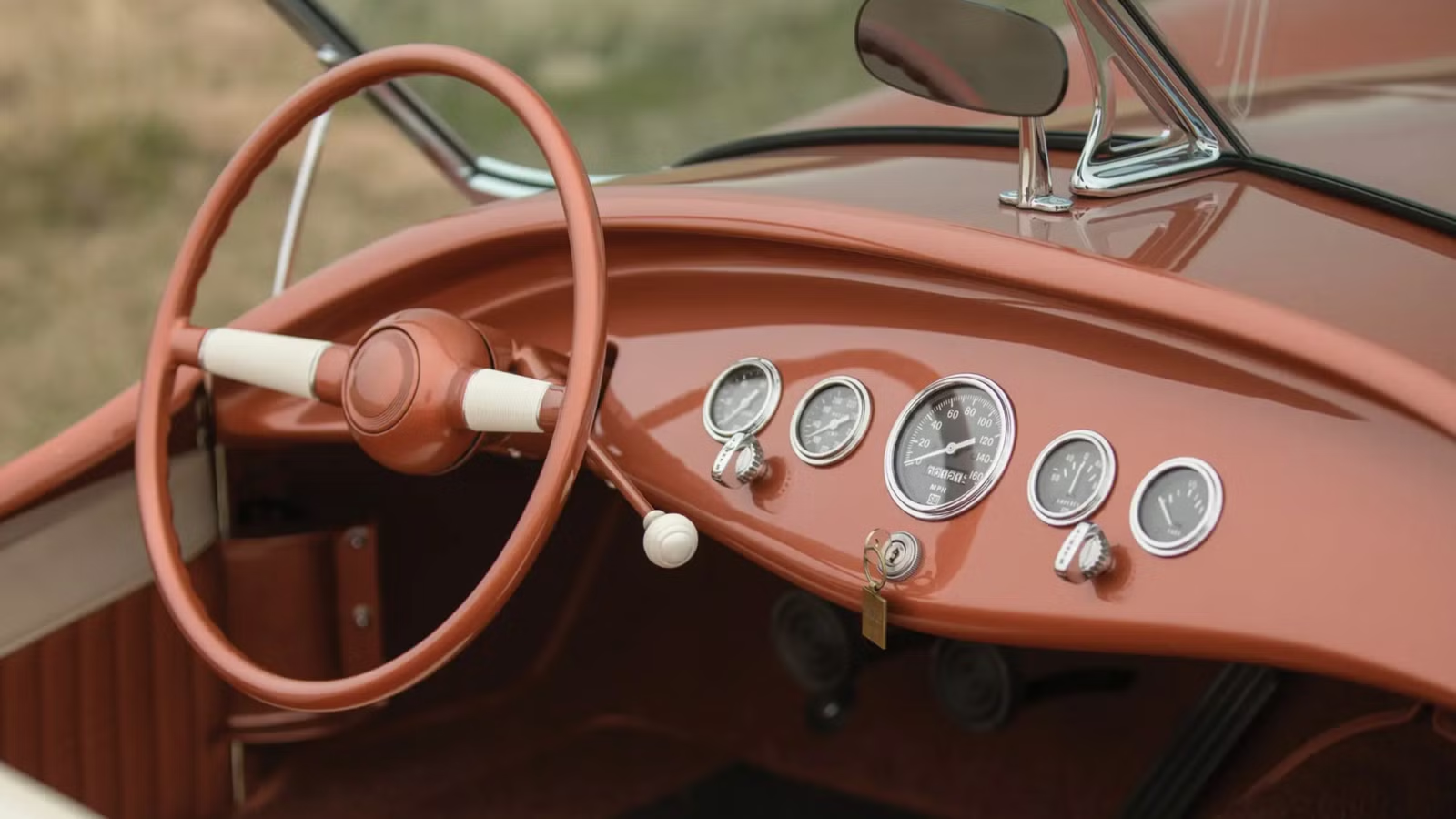
His name was Bill Tritt, and in 1949 he was not trying to change the car industry at all. Tritt ran Glasspar, a Southern California company that built fiberglass boat hulls, and he understood the material better than almost anyone in America. When his friend, Air Force Major Ken Brooks, started building a hot rod that year, Tritt convinced him that fiberglass was the ideal material for the body.
The project took far longer than planned, but the result was worth the wait. The finished car debuted as the Brooks Boxer at the 1951 Petersen Motorama in Los Angeles, where it was an immediate hit with the crowds. That means a fiberglass sports car body was on public display two full years before a production Corvette existed.

Tritt saw the reaction and modified the Boxer’s mold into a product he called the Glasspar G2. To be clear about what the G2 was, this was never a production car in the way the Corvette was. Glasspar completed at least 10 factory-finished cars at $2,950 each, undercutting the new Corvette by almost $550, while roughly 100 total examples were built through 1955 with most sold as kits.

That rarity has caught up with the market, and concours-quality G2s are now valued close to $100,000. A turnkey G2 was a rare, hand-built thing, while a Corvette was something a customer could order new from the largest automaker on Earth. By the mid-1950s, Glasspar was building 15 to 20% of all fiberglass boats sold in the United States, and the man Detroit never mentioned was the closest thing America had to a fiberglass authority.
GM’s Design Boss Took A Long Look At Tritt’s Work

Tritt’s next break came from an unlikely partner. The Naugatuck Chemical Company supplied the polyester resin Glasspar depended on, and it wanted a showpiece to prove the material’s potential to American industry. Naugatuck commissioned Tritt to build a complete fiberglass roadster for the International Plastics Exposition in Philadelphia in March 1952.
The car was called the Alembic I, and it caused a sensation well beyond the plastics trade. Life magazine featured Glasspar’s work in a piece titled “Plastic Bodies For Autos,” complete with a photo showing light passing through the translucent, unpainted body. A material most Americans had never heard of suddenly had a national audience.

One member of that audience mattered more than all the rest. Harley Earl, General Motors’ legendary design chief, arranged to borrow the Alembic I in 1952 and evaluate it himself. Sports Car Market identifies the car as a direct source of inspiration for the Corvette EX-122, the prototype that became the production Corvette.

According to project logs, Harley Earl committed to the material in June 1952 after inspecting the Alembic I, leading to a formal September directive for Chevrolet’s Parts Fabrication Department to begin building the physical fiberglass bodies.
The Corvette’s fiberglass story did not begin inside a Detroit styling studio. It arrived from a boat shop in Santa Ana, passed through the desk of GM’s most powerful designer, and reappeared wearing a bowtie.
Tritt Built The Kaiser Darrin’s Body Too

The Corvette was only half of the story, because the car that beat Chevrolet to the public stage was also a Glasspar product underneath. When designer Howard “Dutch” Darrin developed his sports car in early 1952, he turned to Tritt to transform his clay mock-up into a running fiberglass prototype. The shop that inspired GM was simultaneously building for Kaiser.
According to MotorCities, the Kaiser Darrin’s fiberglass body came from Glasspar, which it credits as a pioneer in fiberglass for specialized cars and boats. Glasspar engineered and built the Darrin’s early bodywork, applying lessons learned on the G2 to a car wearing another company’s badge. Kaiser eventually took over more of the work as production scaled up, but the body that stunned crowds in the fall of 1952 was Tritt’s handiwork.

Kaiser built 435 production Darrins, which means Tritt’s client ultimately outproduced the roughly 100 examples Glasspar ever managed of its own G2. The Darrin’s dramatic rise and fall is a separate story we have covered before, and it deserves its own telling.
The pattern by this point is hard to miss. Every car in the “first fiberglass sports car” argument either came out of Tritt’s molds or was directly inspired by one that did, and that makes him the common denominator in all three claims.
The True America’s First Fiberglass Sports Car

The honest answer is that three different cars won three different races. Tritt pioneered the material, putting a fiberglass sports car body in front of the public with the Brooks Boxer in 1951. The Kaiser Darrin was the first announced production sports car in fiberglass, revealed as a running prototype in the fall of 1952.

The Corvette’s crown is the one Chevrolet actually earned. With 300 units built from June 30, 1953 onward, it was the first fiberglass sports car a customer could buy new from a major manufacturer. Glasspar’s roughly 10 factory-finished G2s never came close to that standard.

But the idea that Chevrolet originated the fiberglass body sports car is false. Tritt won the race, but no one was keeping score. His fiberglass creations sat under or behind all three claims to the title, and his is the only name history dropped. The man remembered for boats fathered the American fiberglass sports car.
Sources: Hemmings, Hagerty, RM Sotheby’s

Related posts


Latest Post


No Comments