
The Cruiser With Honda Reliability And Ducati Character
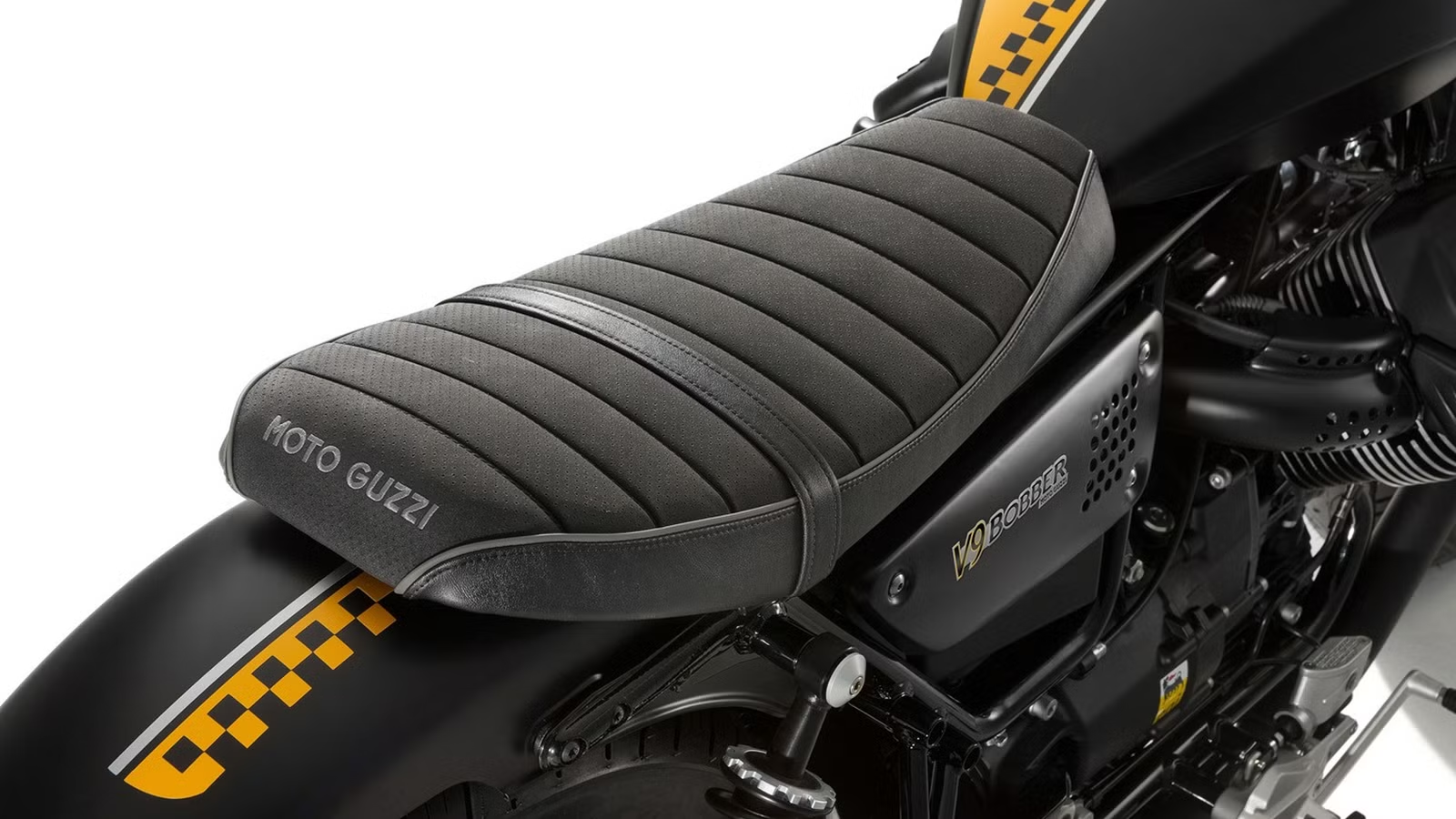
Motorcycling has always been a world full of compromises. There are plenty of bikes that have performance, reliability, head-turning style, and practicality, but finding all of them in the same package is the tricky part. It’s a challenge that the middleweight cruiser market has tried to solve for decades, and one which this bike may well have succeeded in.
Why Riders Keep Chasing The “Perfect” Middleweight Cruiser

Middleweight cruisers — typically those between 500 cc and 1100 cc — are a fiercely contested segment thanks to something that their larger contemporaries don’t offer: balance. In motorcycling, it’s not always the biggest engine, the most aggressive styling, or even the fastest speed that wins over customers; riders instead look for a bike that’s comfortable enough for daily riding, capable during a weekend away, and affordable enough that upkeep doesn’t break the bank. These, on their own, aren’t huge challenges, but manufacturers tend to specialize in just one area.
Japanese brands have built a reputation on reliability, creating bikes that can take you wherever you want without fear of breakdowns or high running costs. European manufacturers are more known for distinctive styling, charismatic engines, and a ride that feels more emotional than it does clinical. Which a rider prefers is entirely up to their sensibilities, though it’s a divide that has shaped the market for decades. Dependability is great, but a bike that always performs as expected can feel too mechanical and devoid of personality. On the other hand, a higher-maintenance bike is a more demanding ownership experience, particularly on a rider’s wallet. This is where balance comes in. A mixture of both precision and personality sounds perfect, but how does one achieve that?
Can A Cruiser Feel Italian Without Becoming A Maintenance Project?


Italian motorcycles are renowned for expressive styling, addictive engine character, and for making every ride feel like an occasion. Brands like Ducati, Aprilia, and MV Agusta have all helped forge Italy’s loyal following of enthusiasts with rich exhaust notes, engaging power, and unmistakably Italian styling. These are brands that, for some, represent quintessential motorcycling. But with these comes the perception of a more demanding bike. One that, while arguably more characterful than a Japanese bike, needs more frequent maintenance, more servicing, and an ability to overlook the odd quirk.
It’s a reputation that has been somewhat earned. Older Italian bikes were certainly guilty of putting feel over function, producing café racers that made people fall in love with motorcycling, while Japan focused on making exceptionally reliable workhorses. That reputation has softened now, with modern manufacturing dramatically improving reliability across the board, but it has been a hard thing to shake. It gave riders in the cruiser market a question: dependable and mechanical, or soulful but highly-strung? Or at least, that was the question until one Italian bike came out and offered the best of both worlds, surprising everyone in the process.
Meet The Moto Guzzi V9 Bobber: An Italian Twin That Breaks The Rules

First launched in 2016, the Moto Guzzi V9 Bobber was the latest in the brand’s air-cooled, transversely-mounted 853 cc V-twin-engined bikes. This transverse mounting means the engine sits sideways in the frame, with the top of each cylinder protruding from each side of the tank, giving the bike not only a distinctive look but an entire identity. As the pistons sit diagonally and push to and from each side, the bike has a slight sideways rock under power that Moto Guzzi has become known for, and which gives it a mechanical personality it simply wouldn’t have with a conventionally-mounted engine.
It’s not the most powerful bike in the world, though 65 hp and 54 lb-ft of torque aren’t exactly small figures. Besides, it’s not made for ultimate top speed runs or light-to-light racing; it’s made for low-end pull and relaxed highway (or, in Italiano, autostrada) cruising. But while the bike may not be the fastest, it has something that both Moto Guzzi and Ducati exemplify: an understanding that a bike is far more than a simple machine. When made with Italian engineering, it’s something that has character, personality, and a feel all of its own. It’s what turns a machine into a partner, and turns everyday rides into adventures. But Moto Guzzi didn’t do this at the expense of reliability, as the Genoa-based brand also has a reputation for making simple, sturdy bikes that don’t suffer from the issues of their compatriots.
Part of Moto Guzzi’s reliability comes from its drivetrain. By doing away with chains in favor of a shaft drive, Moto Guzzi eliminates the need for messy chain adjustments and replacements and gives the bike fewer points of failure. There’s also no liquid-cooling system which, for some, is a negative. However, it again means that there’s less to go wrong with the bike. The engine is also commonly cited as understressed, meaning that it’s not operating near its limit and further improving the bike’s longevity. The cylinder heads also sit outside of the bike, making inspections far simpler than alternatives where the engine is inside the bike itself.

Reliability is something that Moto Guzzi has worked on for decades. This transverse layout isn’t new, but it is something that has been refined since the brand’s first V-twin (the Moto Guzzi V7 700) in 1967, some four years before Ducati launched its first production V-twin in 1971 with the 750 GT. It’s not exactly on the same level as your Hondas, your Suzukis, your Kawasakis, or your Yamahas, but it’s not supposed to be. And if that’s what you’re looking for, you’re more than welcome to go for one. The V9 Bobber exists to sit in the middle ground of Italian passion and Japanese precision, providing the best of what both nations have to offer.
Why The V9 Bobber Delivers More Than Its Numbers Suggest

On paper, the V9 Bobber isn’t exactly groundbreaking. 65 hp puts it behind Japanese competitors like the Honda Rebel 1100 (86 hp), and Italian competitors like the Ducati Scrambler (73 hp). But numbers are cold and impersonal. The magic of the V9 Bobber lies in what it makes the rider feel.
The bike’s low seat height, wide handlebars, and mid-mounted footpegs give a comfortable, commanding riding position, while the torquey engine delivers peak torque at 3,000 RPM on the original models, or 5,000 RPM on those from 2021 onward. More torque means less time shifting gears and more time focusing on riding, while the shaft drive requires far less maintenance.
The styling of the bike also plays into its aura. Chunky tires, blacked-out finishes, and minimalist bodywork give it a certain presence. It’s a striking-looking machine that clearly backs up its style with substance. Unlike other cruisers, it isn’t trying to appeal to the US market, but instead is something all of its own.
The Cult Classic That Deserves More Recognition

The V9 Bobber has never reached the sales success of more popular cruisers from the likes of Harley-Davidson or Honda, but it doesn’t really need to. It’s the ultimate choice in a world of compromises, rewarding individuality and simplicity rather than punishing them. In an increasingly polarized world, it combines the best of both Italian and Japanese engineering into a distinctly pragmatic bike.
The V9 Bobber occupies a unique place in the cruiser market. It’s not the most advanced option, nor is it the most powerful, and at $10,790 it isn’t the cheapest. But it is the bike that bridges the gap between Italy and Japan, without any direct Japanese influence. It’s yet another reminder that, while numbers grab headlines, how a bike feels grabs riders’ hearts.
Sources: Moto Guzzi

Related posts


Latest Post


No Comments