
Kawasaki’s Underrated KR-1 Was Outbuilt More Than 10-To-1 By Honda’s NSR250R
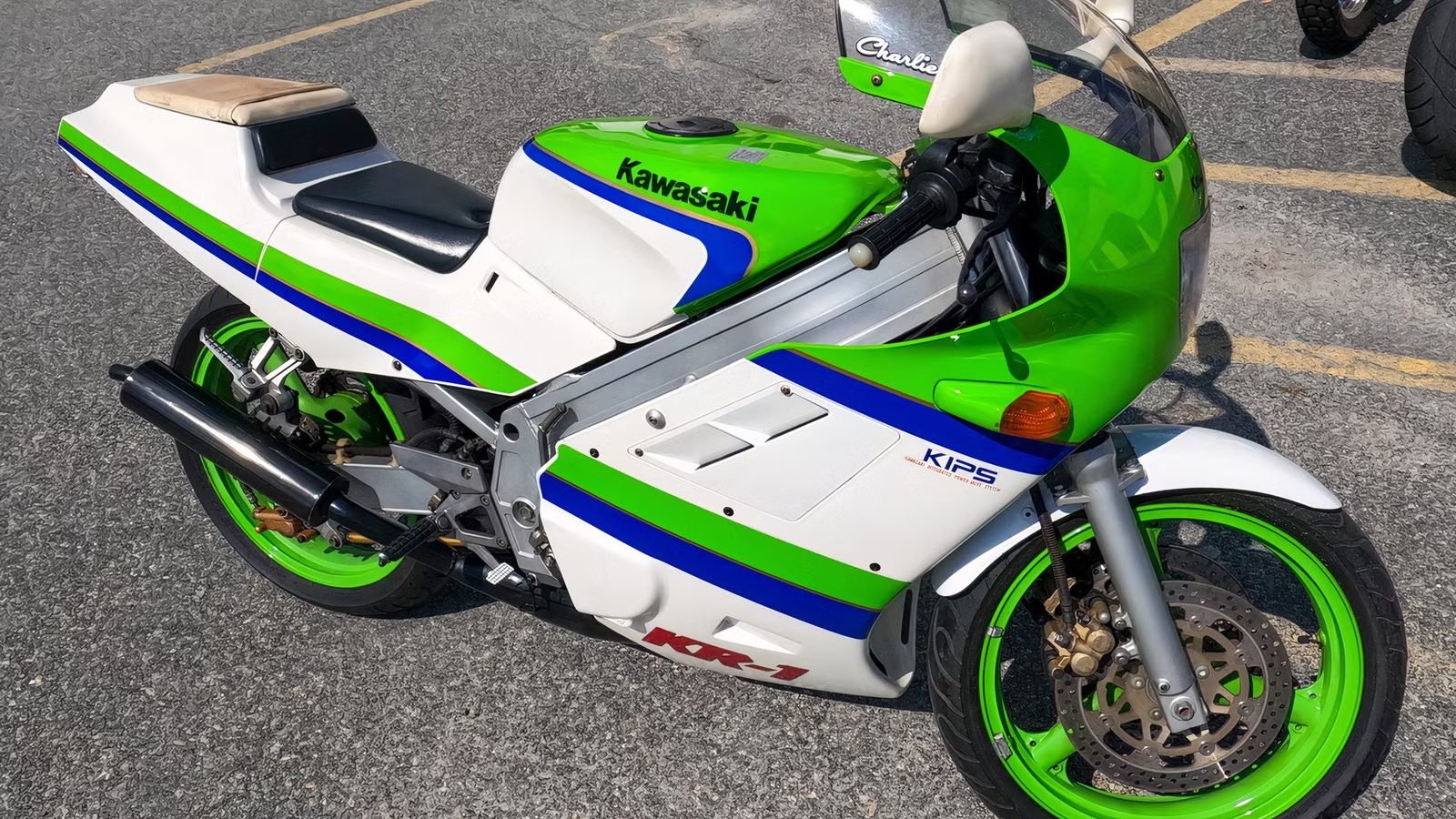
Bonneville Salt Flats, Utah. 1990. Somewhere in that vast stretch of white salt, a tiny 250cc motorcycle managed to hit 171.928 mph. Yes, a 250. To put that into perspective, that’s proper big-bore superbike territory, especially when the same motorcycle could barely manage around 139 mph in showroom guise. That’s quite something, isn’t it?

But wait, there’s a catch. The salt turned nasty real quick. Deteriorating conditions meant the team couldn’t launch the return run. The mandatory return run never happened, which meant the speed couldn’t qualify as an official two-way record. Today, this insanely fast quarter-liter sits as an unofficial legend tucked away in an auction listing.
A 250cc Two-Stroke Took On Bonneville’s Biggest Speed Machines
Bonneville isn’t particularly kind to little motors. You’re sitting with the throttle wide open for miles, wind resistance is choking what little power you have, the thin air hurts, and the rear tire is constantly spinning on a whole lot of nothing ahead of you. That’s a lot to take for a modest 250. And that’s exactly why this whole thing is so damn cool.

Getting to why a 250 two-stroke was out on the flats means jumping back to Japan in the late 80s, when the 250 class was total warfare. The big four were all spawning race replicas: light, screaming two-strokes that looked like actual GP bikes and sounded like angry hornets. The recipe was the same across the board: a small-capacity engine, a skinny chassis and very little weight to haul around. Nobody was building these to be sensible.
The Kawasaki KR-1 Nearly Became A 172-Mph Record Holder

Kawasaki’s fighter in that dogfight was the KR-1, sold from 1988 to 1992 with a 249cc parallel-twin two-stroke. It was built to take down the big three: Honda’s NSR250, Suzuki’s RGV250, and Yamaha’s TZR250, and it was properly ambitious right out of the gate.
The bike in question here is an 1989 model. The listing on Iconic Motorbike Auctions says an Oklahoma City dealer imported it straight from the UK, then headed out to Bonneville with factory backing. That year, it locked down two official records: a two-way average of 129.874 mph in Production, and another pass at 128.530 mph in M-AG-250. Both were officially stamped and sealed with proper backup passes.
Then came 1990. After another round of factory tuning, that same bike laid down a 171.928-mph run, over 40 mph faster than its earlier marks. Let that massive jump sink in, because that’s where things get really crazy.
How A 250cc Two-Stroke Reached 171.928 MPH

There’s no paperwork showing what actually went on inside those cases. However, the auction description says that factory wrenches did the cylinders, reworked the carbs, tweaked the pipes, and cast one-off heads. What we do have is a few figures to compare. The listing quotes the motor at 59 horses and around 30 lb-ft of torque. Those figures interestingly line up fairly closely with what Kawasaki published for the KR-1S, though it’s worth noting there’s no third-party dyno run to back up this specific build.
The whole thing weighed just 123 kg dry. Stock speeds are much lower, with the base KR-1 maxing out near 131 mph and the KR-1S doing 139 mph. That leaves the salt pass roughly 33 mph clear of the fastest showroom model. It is also worth noting that a modest power bump just doesn’t explain how a 250 does that kind of speed, which makes the missing engine specs a real puzzle. As for why it didn’t count, Bonneville requires a two-way average. You make a pass, turn around, run back, and average the two to eliminate wind or track gradient.
So, the 171.928 mph run remained a single-pass achievement rather than an official two-way record. That is an important distinction because the motorcycle’s 1989 achievements were backed by two-way averages of 129.874 mph. The auction listing also says the original timing slips and record certificates accompany the motorcycle.
Kawasaki’s Fastest 250cc Two-Stroke Was Also A Commercial Failure

Here’s the awkward bit. For all that salt-flat glory, the KR-1 didn’t sell. Fewer than 10,000 were built across the B, S and R models. Honda’s NSR250R, by comparison, topped 100,000. That’s better than ten to one, and no amount of Bonneville bravado closes a gap like that.
Reliability didn’t help. There are reports of piston failures and seizing power valves (Kawasaki’s KIPS system), tied to misaligned barrels. American buyers didn’t get an official showroom version of the KR-1, either. Production numbers were already slim for the standard KR-1, while the sharper KR-1S was even tougher to come by. The hardcore KR-1R sits on another level of rare, with estimates suggesting only about 180 units ever left the factory. Back in the day, nobody viewed the KR-1 as a prize for collectors, yet a 1988 model with 10,233 miles on the clock recently fetched $8,723 at auction.
So what did that 171.928-mph pass actually prove? Honestly, it wasn’t an official record. Still, it made a clear point about how far the chassis and engine could actually be pushed. It proved Kawasaki was serious enough to put real factory backing into the effort, showing that a bike with a reputation for being fragile could briefly perform way beyond what the brochure promised. The salt might have wiped out the logbooks, but the speed was ‘real’.

Related posts


Latest Post


No Comments