
7 Vintage Sportbikes Cheaper Than A New Kawasaki Ninja 400
By the early 80s, speed had become something of an obsession within the motorcycle industry. Motorcycles capable of doing over 150 MPH had become more affordable than ever thanks largely to the Japanese manufacturers who had realized how marketable speed was. Having the fastest motorcycle within their stable wasn’t just about bragging rights, it sold motorcycles.

As a result, we got one incredible sportbike after another all the way through the decade. Some of which have gone on to become collectible classics, and others remain affordable. The bikes on this list can all be found for less than a new Kawasaki Ninja 500, which has a list price of $5,399, and in some cases make around three times as much power.
1985 Honda VF750F
Price Range: $3,000 – $5,000
Some purists may not consider the VF750F a fully-fledged sportbike thanks to the fact that it is a semi-faired bike, but it was most certainly a precursor to the fully faired machines. All the Honda V4 bikes that follow owe this particular model a debt of thanks, not for laying a solid foundation, but rather for its spectacular failure. These bikes were plagued with cam failures in their first couple of model years (1983 and 1984).


By 1985, Honda had resolved the “chocolate cam” issue, but can still be found for next to nothing thanks to their reputation. In response to this embarrassment, Honda over-engineered the subsequent VFR750F model (pictured above). It earned a reputation for being one of the most reliable sportbikes on the market back when it came out, and would eventually evolve into the VFR800 – one of the most reliable sport tourers ever produced.
1986 Yamaha FJ1200
Price Range: $1,000 – $3,000

Yamaha’s big bore offering is another semi-fared bike that was never particularly “sporty.” It was not the fastest, nor the most powerful, and its handling is nothing to write home about. But, it was still very fast. Even by modern standards, it is a quick bike, and comfortable enough to ride all day.
Naturally, most riders used these bikes as sport tourers, and by the 00s Yamaha rolled out the more dedicated FJR1300, which was effectively its spiritual successor. The air-cooled FJ remains one of the best used bikes for anyone after a budget-friendly sport tourer. High mileages are to be expected at this end of the market, but that is not a deal-breaker.
1987 Honda CBR1000F Hurricane
Price Range: $3,000 – $5,000
By the second half of the decade, fully faired sportbikes had very much arrived, and Honda took it a step further by giving these liquid-cooled inline-fours fully enclosed fairings. At the time, it seemed like the next logical step in aerodynamic efficiency. Unfortunately, these early designs proved to be a little too efficient, and didn’t allow enough air to flow through the radiator, which means they get a little warm in traffic!

Ironically, the CBR600 Hurricane (pictured above) is actually worth a little more these days. The big bore Hurricane was significantly more powerful than the 600 class bike, but it was never that much faster thanks to how much heavier it was. Today, neither bike handles particularly well by modern standards, so any argument for the 600 being “more dynamic” doesn’t hold much water.
1987 Ducati Paso
Price Range: $3,000 – $5,000

We can’t be sure who copied who because both bikes came out at more or less the same time, but we can say for certain that giving the Paso a fully enclosed fairing was a terrible idea. All the other bikes on this list we feel comfortable endorsing, but the original Paso is most certainly cheap for a reason. Anyone willing to spend this little on an Italian bike already knows what they are doing.
While the Paso looks fantastic, it was already unreliable from the factory (largely thanks to the fact that Ducati fitted the wrong carb). These old air-cooled twins would get pretty hot on a normal day without a big enclosure restricting air flow, so overheating is very much on the cards if you live in a hotter climate.
1988 Kawasaki Ninja ZX-10 Tomcat
Price Range: $4,000 – $6,000

With a top speed of 165 MPH, the Ninja ZX-10 Tomcat was at one point in time the fastest production motorcycle on the planet. It was one of the more dedicated speed queens, and never promised much in the way of handling, but it is still a fast motorcycle, and well worth a look at this price point.
Like all the bikes here, the price indicated is for a bike in good running order, and while there will be several of these bikes going for less, they will most likely need a lot of love. The one thing you don’t want to end up doing, and the same is true for all the bikes on this list, is getting a project that will just end up costing more in the long run.
1989 Yamaha FZR1000
Price Range: $3,000 – $5,000

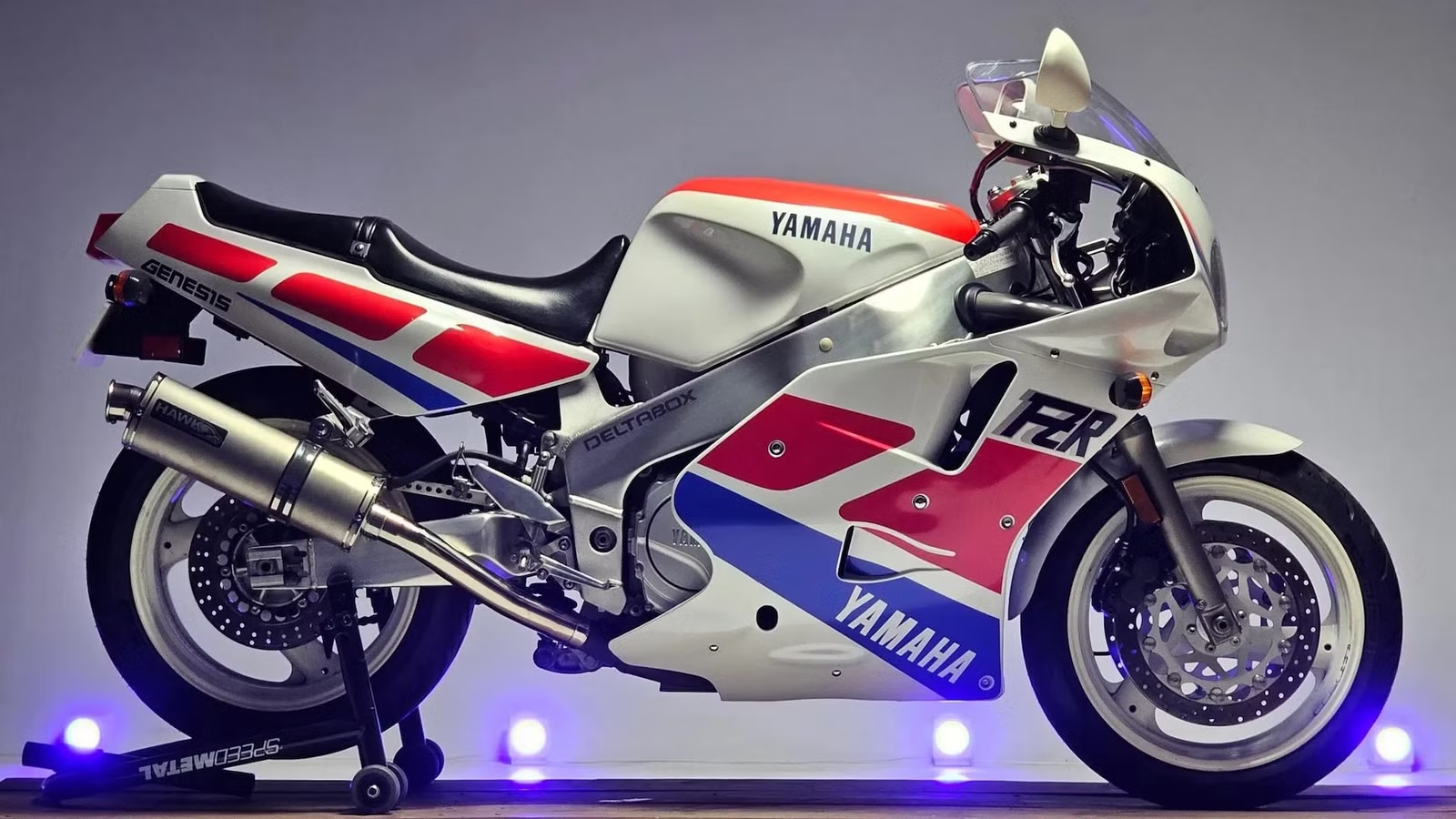
While the other three Japanese manufacturers were embarking on a quest to build the fastest possible production motorcycle, Yamaha were more interested in offering bikes that could also handle. The FZR1000 was one of the first big movers in this regard, mostly thanks to its lightweight Deltabox frame.

With a wet weight of well over 500 pounds, it is still pretty heavy by modern standards, but it was significantly lighter than any of the other big bore sportbikes of the era. It also looks quite fantastic with its dual headlights and this red, white, and blue speed block livery. Oh, and it had the same 150 horsepower engine as the YZF-R1 (pictured above) which came out almost a decade later …
1990 Kawasaki Ninja ZX-11
Price Range: $3,000 – $5,000

Upon its release back in 1989, it was immediately crowned the world’s fastest production motorcycle with a top speed of over 170 MPH. A crown it held for another seven years before it was dethroned by Honda’s Blackbird in 1996. It proved to be an enormously popular model, and for that reason alone, remains affordable.

We need to stress the fact that spending more on one of these bikes is prudent. They have been a blue-collar hero pretty much since day one, and while there is a lot to love about an accessible speed machine, they do tend to get abused more than any of the other bikes listed here. Having said that, even in poor condition, it will still be faster and more reliable than the Paso!
Source: Kawasaki

Related posts

Latest Post


No Comments