The Corvette Generation That Quietly Became The Smart Buy
10 minutes reading
Sunday, 26 Jul 2026 21:00 0 73 autotech
Modern V-8 performance has never been more capable—but it has also never been more expensive. A 2026 Ford Mustang GT is now a $46,800 car, and that doesn’t sound like a bargain to us. Between soaring new car prices, dealer markups, and rising insurance costs, enthusiasts searching for an affordable driver’s car are finding themselves looking to the used market instead. The challenge is separating genuine bargains from aging sports cars that become financial sinkholes. Somewhere between outdated classics and newer high-dollar machines sits one generation that quietly solved the equation years ago, delivering modern performance, dependable engineering, and remarkable value in one package.
Finding affordable V-8 performance has become significantly harder over the past decade as horsepower and pricing have climbed together. That has forced buyers to rethink what constitutes the smartest enthusiast purchase rather than simply chasing the newest model.
Modern Horsepower Is Expensive
Close-up shot of 2025 Ford Mustang GT engine bay showing V8Ford
Performance cars, especially those with V-8 engines, have never been more unattainable than they are now. We mentioned that a new Mustang GT, once known as the go-to budget performance car, starts at $46,800. That’s a lot of money just to have a V-8-powered experience, but what is even more remarkable is that the GT is actually the cheapest new V-8-powered car you could buy today. The next most ‘affordable’ option? The 2026 Chevrolet Corvette Stingray, which starts at a whopping $72,495. Both of these American V-8-powered sports cars are, without a doubt, remarkable machines, but they cost far too much.
It’s no surprise that the enthusiast segment is shrinking, as most enthusiasts are completely priced out of all the cool options. Once you really think about the ongoing battle with the dealer markups, financing, and insurance premiums, the math doesn’t make sense anymore. However, being a car enthusiast and owning a Toyota Prius as your only vehicle is a significant compromise. This is why there is a growing shift toward used performance cars that still offer the naturally aspirated V-8 character that so many of us desire.
Buying a used performance car can be a double-edged sword. On one side, you have the luxury of nearly infinite options to suit your wants and needs, and on the other side, you have no way of knowing whether you are getting in over your head with a car you are likely to have limited firsthand experience with. The horror stories of car purchases gone wrong are too numerous to even count. A purchase may feel good at the moment, but in six months, when the transmission is leaking, the dash no longer works, and you realize suspension bushings are a repair that costs four figures, regret sets in quickly.
So how exactly do you identify a ‘smart buy’ on the used market if you want a sports car that provides the full analog driving experience without being an ownership nightmare? First, you want something that is modern enough to feel daily-drivable. As appealing as a good deal on a 1960s Mustang is, it is not a realistic daily commuter. You want something with proven reliability, meaning a powertrain that is known for its durability and longevity. You want something with strong aftermarket support and plentiful replacement parts, so when something breaks, you can get it fixed affordably and efficiently. Most importantly, of course, you need a realistic purchase price that works within your budget.
Breaking Down Market Valuations
Front 3/4 shot of 1963 Chevrolet Corvette parkedBring A Trailer
Looking strictly at asking prices only tells part of the story. The real value comes from measuring how much engineering, performance, and long-term ownership confidence buyers receive for every dollar spent.
The Current Dynamics Of The Used Corvette Market
Front shot of 1991 Chevrolet Corvette ZR-1 parkedBring A Trailer
Few performance cars actually satisfy every requirement in terms of being a potential smart buy. If there is one clear outlier, it is the Chevrolet Corvette. However, not every Corvette generation is created equal. The most natural approach is to consider each Corvette generation as distinct price tiers. The C1 through C3 generations are all amazing, but these rare vehicles are collectors’ cars, not smart buys. So the search truly begins in the C4 generation of the mid-1980s and early 1990s, which has an average one-year sale price of $21,059, according to Classic.com data. While this is an attractive entry price, the C4 is built on an archaic chassis, with a dated interior and older small-block engine architecture. The C4 generation is good, but not great.
Rear 3/4 shot of 2010 Chevrolet Corvette ZR1 in red parkedBring A Trailer
Let’s consider the C6 generation of the mid-2000s and early 2010s, which has an average one-year sale price of $44,887. Relative to the C4, the C6 offers a massive leap in performance to the point where the two are barely comparable. The 6.2-liter LS3 V-8 engine in the 2008-2013 base C6 is perhaps GM’s greatest ever performance engineering feat. While not exactly up to modern standards, drivability and the quality of the interior are significantly improved. The only issue is that you are going to have to pay about twice the price, placing it in an entirely different price bracket that most enthusiasts cannot even consider. Realistically, you are getting diminishing returns on the quality of the overall driving experience once the purchase price climbs this high.
The Champion Of Value: The C5 Generation
Side 3/4 shot of 2001 Chevrolet Corvette Z06 In yellow Posing on drivewayBring A Trailer
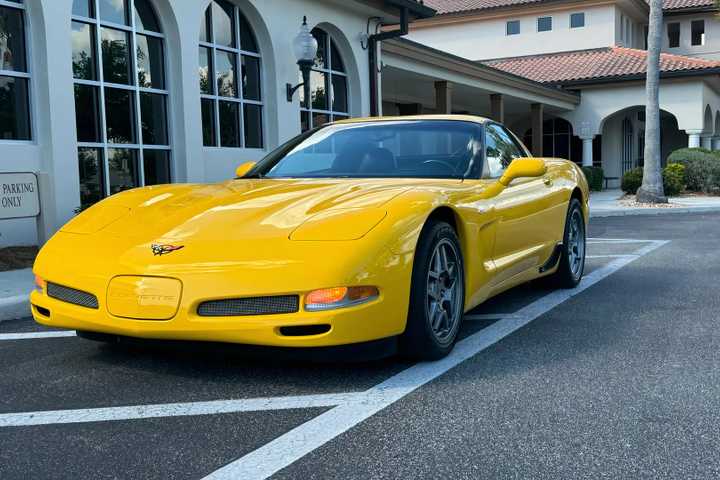
This is why the C5 generation of the late 1990s and early 2000s is the standout value among Corvette generations. Classic.com data states the average one-year sale price for a C5 is $24,144, which is only about $3,000 more than the average C4 while being roughly $20,000 cheaper than the average C6. The C5 generation offers everything you could want out of the Corvette experience: pop-up headlights, curb weight around 3,100 pounds, the LS1/LS6 engine, the balanced transaxle layout, and a T56 six-speed manual transmission. The C5 generation, without a doubt, represents the largest performance-per-dollar jump anywhere in Corvette history. At its current price, the C5 occupies the sweet spot where affordability and capability overlap almost perfectly. The numbers become even more compelling once you examine how much value you are actually getting for the price you pay.
The Mechanical Triumph Of The C5 Generation
A front 3/4 shot of a 2000 Chevrolet Corvette Coupe parkedMecum
The C5 wasn’t merely another Corvette update—it fundamentally reinvented the platform. Nearly every major component was redesigned with performance, durability, and balance in mind, creating a foundation that still feels modern decades later.
The LS1 And Transaxle Revolution
Close-up shot of 1998 Chevrolet Corvette Coupe engine bayBring A Trailer
The C5 Corvette debuted the first-ever LS-based Chevy small-block engine, the naturally aspirated 5.7-liter LS1. This V-8 engine produced 345 horsepower and 350 pound-feet of torque, which is just about the perfect amount of horsepower for the street. Over the decades, the LS platform has become known for its exceptional durability and is the default option for bang-for-buck performance engine swaps. The aftermarket support for LS engines is among the strongest of any engine platform on the market, and nearly every maintenance item and common issue is well-documented. Being a domestic engine, the LS1 has affordable replacement parts that can be purchased in any auto store nationwide. The huge tuning potential makes the LS engine even more attractive, despite the fact these engines have more than enough power even in stock configuration.
The rear-mounted transmission, also known as a transaxle, was just as important to the C5 Corvette as the LS engine. This redesign dramatically improved the handling and weight balance of the Corvette, as the changes enabled a 50-50 weight distribution. Additional benefits included an overall increase in traction due to more weight being over the rear wheels, which also led to better cornering balance. Compared to the Corvette chassis of old, the C5 was a revolution, not an evolution, and this architecture still earns praise from enthusiasts today.
Improving Upon The Established Formula
Rear 3/4 shot of 1998 Chevrolet Corvette Coupe parkedBring A Trailer
The improvements of the C5 generation did not stop there, however. The hydroformed frame allowed for a level of lightweight rigidity that had never been possible in a Corvette chassis. The C4 was notorious for how floppy the chassis felt, and the issue was only exacerbated in convertible form. This new frame was dramatically stiffer, quieter, and safer, and it also improved suspension control. The C5 generation became the clear favorite for value because of the quality of its overall experience. With OBD-II diagnostics, affordable maintenance, and amazing aftermarket support, the C5 is one of the easiest older sports cars to keep on the road. However, outstanding engineering only matters if ownership remains practical over the long term.
Buying Strategy And Long-Term Outlook
A front 3/4 shot of a 2001 Corvette Z06Bring a Trailer
Close-up shot of 2002 Chevrolet Corvette Z06 interiorBring A Trailer
Today’s buyers still have multiple ways to enter C5 ownership depending on budget and intended use. Understanding which model to target and why can turn an already good purchase into an exceptional one.
Choosing Between Base Or Z06 Models
Chevrolet C5 Corvette Z06 profile shotChevrolet
Ask yourself an honest question: “How often am I realistically going to visit the racetrack on an annual basis?” If the answer is less than six track days a year, what you need is a base C5 coupe. A base coupe offers the lowest purchase price while still providing a removable targa roof and comfortable grand-touring capability. For daily usage, the base C5 coupe checks all the right boxes, while still serving as the perfect weekend warrior or canyon cruiser. If you don’t care much about the racetrack and can accept a bit less rigidity, a base C5 convertible can offer an even lower entry price than a coupe. As a pure lifestyle option, the convertible is the better pick.
If your desire is to have the ultimate C5 generation experience, then the Z06 model is the clear choice. There was no ZR-1 or GS model in the C5 generation, so the Z06 model is the cream of the crop. With its fixed roof, 128 pounds of weight reduction, improved suspension, revised gearing, and functional brake cooling, the Z06 is designed for track-day dominance. It is also worth noting the standout engine, the 385-horsepower 5.7-liter LS6, which was later bumped to 405 horsepower starting in 2002. Classic.com data states the one-year average sale price of a C5 Z06 is $28,362 with 62 confirmed sales, which is still a steal considering a C5 Z06 beats a base C6 Coupe around a racetrack.
Future Classic Potential And Bottomed Depreciation
A shot of the interior in a 2000 Chevrolet Corvette CoupeMecum
In terms of depreciation, the C5 generation has already hit rock bottom. Values have remained relatively consistent for years, and low ownership costs mean less financial risk. The widespread parts availability of the C5 generation makes keeping a C5 healthy for the next decade a non-issue. As an analog V-8-powered driving experience, the C5 is as good as it gets when considering performance per dollar. As with any desirable sports car from the past, the supply of clean, stock examples is only decreasing over time. The C5 represents one of the few enthusiast cars where you could realistically enjoy years of ownership with minimal depreciation while potentially benefiting from gradual appreciation as pristine examples become scarcer.











No Comments