
The Motorcycle That Makes Buying European Feel Optional
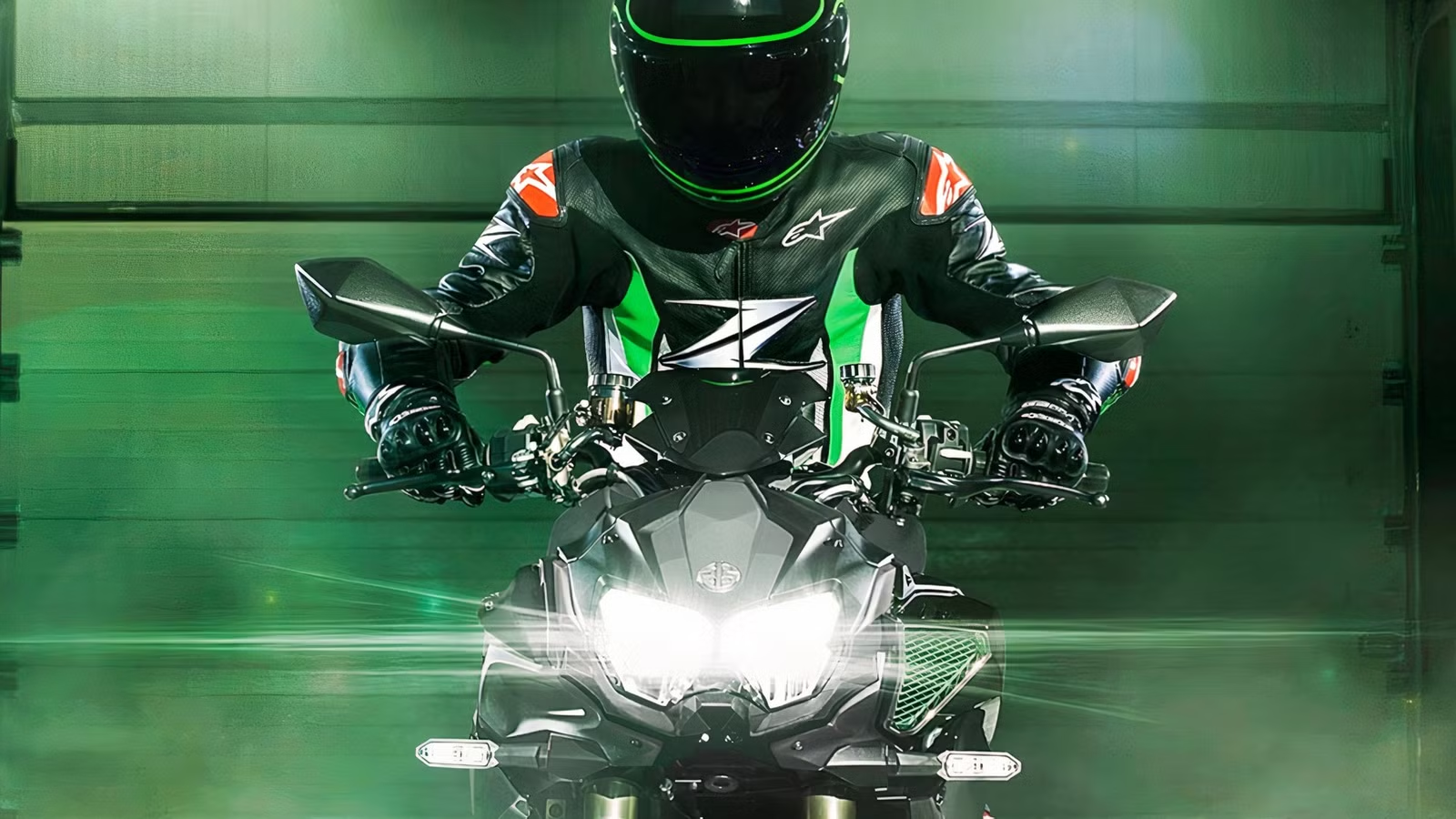
The high-performance naked bike market is led by European manufacturers. Rightly so, as these European companies lead the way in the superbike class, too. Ducati brings V4 drama, BMW turns superbike engineering into road-going insanity, and Aprilia has been making brutally fast naked bikes for years. If you want huge horsepower, fancy suspension, clever electronics, and something that makes an ordinary naked bike seem painfully reasonable, buying European almost seems like part of the admission price. However, do some market research, and you’ll find a Japanese naked that can keep up with all of these machines from the West. It even has a supercharger!
Premium Naked Bikes Focus On Tech And Mighty Power More Than Ever Before

The modern hypernaked isn’t simply a superbike that misplaced its fairings. The best examples now combine staggering straight-line performance with sophisticated electronics designed to keep that performance useful somewhere other than a drag strip. Six-axis IMUs, lean-sensitive ABS, traction control, quickshifters, launch control, adjustable power delivery, premium brakes, and increasingly sophisticated suspension have turned these bikes into rolling showcases for whatever a manufacturer can throw at them.
That’s partly why Ducati, KTM, BMW, and Aprilia have become such natural reference points. Riders shopping at this level aren’t buying horsepower alone. They want hardware that justifies the price, an engine with genuine character, technology they can actually use, and enough theater to make opening the garage door an event.
Exotic Doesn’t Have To Mean European


European manufacturers have found plenty of ways to create that sense of occasion. The recipe changes from company to company, but the underlying idea is similar. If you’re going to charge premium-bike money, the machine should offer something mechanically distinctive rather than simply adding nicer brakes and more menus to the dashboard. But there’s an answer from Japan, too. One Japanese manufacturer decided to build a streetfighter that simply breaks norms. This bike comes with a motorcycle-specific supercharger in-house, while also packing top-drawer components everywhere else.
The Kawasaki Z H2 Makes Buying European Feel Optional

That motorcycle is the Kawasaki Z H2 SE, and Kawasaki currently lists it at $21,999, before an $840 destination charge. That puts it firmly in premium territory, but the SE isn’t merely an expensive version of a regular Z. It’s Kawasaki’s flagship hypernaked, combining the company’s supercharged H2 engine architecture with electronically controlled suspension, Brembo braking hardware, IMU-based rider aids, and the sort of equipment normally associated with Europe’s top-shelf machinery.
A Supercharger Changes The Entire Personality

At its center is a 998cc liquid-cooled, DOHC, 16-valve inline-four with a Kawasaki-designed supercharger. Bore and stroke measure 76.0 x 55.0mm, compression sits at 11.2:1, and fuel arrives through 40mm throttle bodies. Kawasaki claims 197 horsepower at 10,500 rpm and 101 pound-feet at 8,500 rpm, with its own centrifugal supercharger compressing the intake charge without requiring an intercooler. That’s not some accessory bolted onto a conventional engine. The system was engineered as part of the motorcycle from the beginning.
Nearly 200 horsepower gets attention, but the 101 pound-feet figure arguably explains the bike better. Naturally aspirated liter-class fours are already absurdly fast, yet many save their most ridiculous behavior for higher rpm. The Z H2’s supercharger helps give it a broad, muscular delivery that makes the engine interesting long before you’re chasing the limiter. Kawasaki even tunes the intake experience deliberately, so that now-famous supercharger chirp becomes part of the bike’s personality rather than an incidental mechanical noise.

That engine feeds a six-speed dog-ring transmission inspired by Kawasaki’s racing work, with a sealed-chain final drive. Kawasaki Quick Shifter handles clutchless upshifts and downshifts, while an assist-and-slipper clutch reduces lever effort and helps control back-torque during aggressive downshifts. Electronic throttle valves also give the ECU precise control over power delivery, which becomes rather important when the thing they’re controlling happens to be a supercharged four-cylinder making superbike levels of power.
Kawasaki Didn’t Stop At The Engine
The chassis is a high-tensile-steel trellis design with 24.9 degrees of rake, 4.1 inches of trail, and a 57.3-inch wheelbase. The Z H2 SE measures 82.1 inches long, 31.9 inches wide, and 44.5 inches tall, with 5.5 inches of ground clearance and a 32.7-inch seat height. It isn’t pretending to be a featherweight, either. Kawasaki lists a 531.4-pound curb weight, alongside a 5.0-gallon fuel tank, so this is very much a substantial motorcycle built around a substantial engine.
What makes the SE particularly relevant here is its suspension. Up front sits a 43mm Showa SFF-BP inverted fork with 4.7 inches of travel, while the rear uses a Showa gas-charged shock with 5.3 inches. Both use Kawasaki Electronic Control Suspension, or KECS, with Showa Skyhook EERA technology to adjust damping in real time according to suspension movement, vehicle speed, acceleration, and braking forces. Spring preload remains manually adjustable, while the electronics handle compression and rebound damping.

Braking is similarly serious. Brembo Stylema Monobloc front calipers, a Brembo master cylinder, and steel-braided lines, with dual 320mm front discs and a single 260mm rear disc are included here. The bike rolls on 17-inch wheels wearing a 120/70 front and 190/55 rear tire. Kawasaki Intelligent ABS works with the IMU-based chassis electronics, giving the braking system information about what the motorcycle is doing.
Then there’s the electronics list, which reads exactly as ridiculously as you’d hope. Kawasaki Cornering Management Function coordinates various systems using IMU data, while Kawasaki Traction Control, Launch Control, Engine Brake Control, selectable Power Modes, and integrated riding modes let the rider tailor how all that performance behaves. There’s also electronic cruise control, an economical riding indicator, LED lighting, and an all-digital color TFT with smartphone connectivity through Kawasaki’s Rideology mobile app.
Maybe Exotic Should Describe The Motorcycle, Not Its Passport

None of this means the Kawasaki automatically defeats every European hypernaked. A Ducati Streetfighter V4 might appeal more to the superbike obsessive. A KTM 1390 Super Duke R has its own hilariously aggressive personality. BMW and Aprilia bring different combinations of weight, chassis sharpness, power, electronics, and prestige. The Z H2 SE doesn’t need to win every comparison test category, because approaching it purely as a collection of numbers misses why the thing is so interesting in the first place.
What it offers is something none of those rivals can really duplicate: a factory-supercharged 998cc inline-four inside a premium naked motorcycle you can simply walk into a Kawasaki dealership and buy. It’s not cheap at $21,999, nor is its 531.4-pound curb weight going to disappear because the spec sheet has lots of exciting acronyms. But exotic engineering doesn’t have to mean Italian carbon fiber, Austrian aggression, or a German badge. Sometimes it means a supercharger spinning furiously between your knees.

And that may be the Z H2 SE’s strongest argument. Buying Japanese at this level doesn’t necessarily mean picking the sensible alternative anymore. In fact, Kawasaki may have built the weirdest drivetrain in the entire hypernaked class, surrounded it with the suspension, brakes, electronics, and everyday equipment necessary to make it usable, and then given it a 12-month limited warranty for good measure. The Europeans are still incredibly tempting. The difference is that, with a motorcycle this wonderfully excessive sitting across the aisle, they’re no longer mandatory.
Source: Kawasaki

Related posts

Latest Post



No Comments