
Kawasaki H2 Mach IV: The Widowmaker Worth $55,000
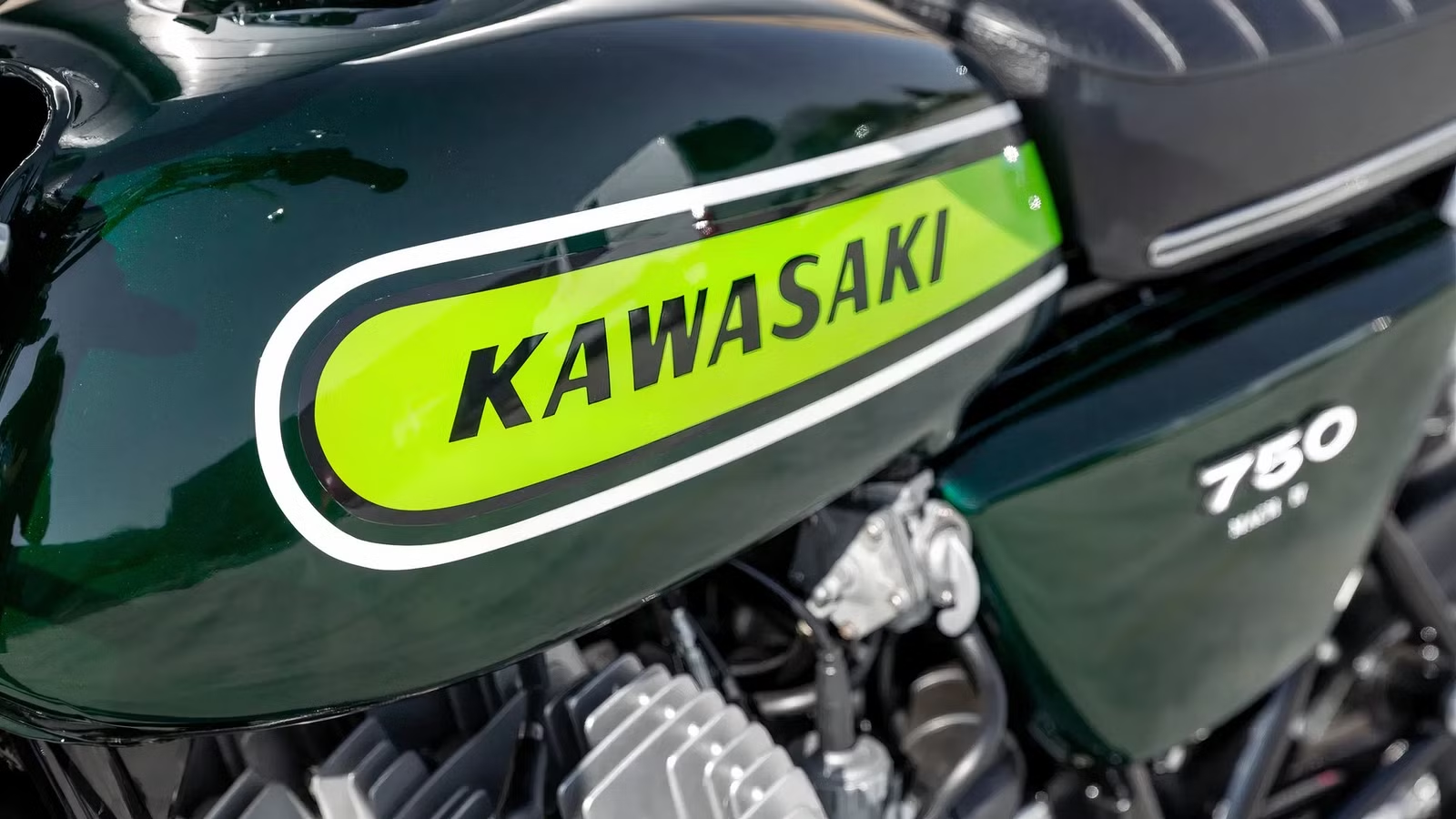
Kawasaki doesn’t shy away from building some insane bikes, with current models like the brutal Ninja H2 and its track-only H2R brother illustrating that performance-focused philosophy perfectly. But this tendency isn’t something new by any means, and the aforementioned Ninjas are just a couple of great examples of it taken to the absolute extreme. Flip back through the pages of motorcycling history and you will find many more going all the way to the early seventies, though, when Universal Japanese Motorcycles (UJMs) were taking over the world. That’s the era we’ll be revisiting for today’s discussion, seeking out one of the most fearsome Kawasakis ever made.
The 1970s Were A Very Exciting Time For Kawasaki

When you think about Kawasaki in the seventies, the first motorcycle that’ll likely come to mind is the Z1 — the legendary CB750 killer that took the performance game to the next level. Its fascinating story has been told time and time again, but the Z1 isn’t the model with the most fearsome reputation from that period. Because although it packed enough of a punch to become the world’s fastest production bike for a while, it was far more civilized and approachable than what resulted from Kawasaki’s two-stroke ambitions. Said machine didn’t just feel fast; it felt genuinely scary to ride due to its violent two-stroke character, and many riders learned to treat it with respect the hard way. But what did the two-stroke segment as a whole look like back in the 1970s?
Old Two-Strokes Could Be A Real Handful

Motorcycles in general used to be a lot harder to tame than they are today, and that is especially true for those of two-stroke heritage. By their very nature, the more powerful among them had the potential to become genuine death traps if you weren’t careful, being far less forgiving than their four-stroke counterparts. Machines such as the feared Suzuki RG500 Gamma or Yamaha’s RD500LC came later on during the eighties, though, so which Kawasaki managed to terrify riders during the previous decade to the point that it’s been dubbed The Widowmaker? Well, join us for a trip down memory lane, because that’s what we’re here to talk about today.

The Kawasaki H2 Mach IV Was Utterly Brutal

Whereas the Gamma and RD500LC were at least fitted with chassis componentry good enough to keep their power mostly in check, the earlier H2 Mach IV from Kawasaki was a different story. Released as a 1972 model and produced through 1975, it was the direct successor to the H1 Mach III, or essentially what happens when everything plays second fiddle to blistering acceleration. At its core, the H2 carried a 748cc triple-cylinder engine complete with CDI, three individual Mikuni carbs, and 74 hp on tap. If the four-stroke Z1 launched just a bit later on was something of a scalpel, then the H2 Mach IV was a lot more like a blunt instrument with its notoriously narrow powerband, strong propensity for unexpected wheelies and less-than-ideal chassis.
Now, 74 hp may not sound like much today, but it was truly impressive in the context of Honda’s CB750 and Kawasaki’s very own Z1 managing 67 and 82 hp, respectively. They delivered that force in a much smoother manner, too, while the H2’s engine behaved more like a sudden punch in the face which could easily catch you off-guard. Nonetheless, the H2 did reward skill, precision, and smooth inputs, so it was an absolute phenomenon in the right hands. It famously recorded a standing quarter-mile time of just 11.95 seconds at the Fremont Dragstrip in California, as reported by Cycle World. Top speed was rated at a stout 126 mph, but you’d be holding on for dear life at that velocity given the bike’s rudimentary frame and running gear.

Its frame was a spindly double cradle unit that would weave and flex when the Kawi was ridden hard, thus making it feel rather sketchy at high speeds. The suspension wasn’t much better, either, and managing the sort of power unleashed by the H2 was a very tall order for the tire technology available at the time. Stopping power was adequate at best, while the motorcycle’s considerable rear weight bias combined with a short wheelbase would have no problem sending that front wheel up into the air under hard acceleration. To be clear, though, the issue of an underdeveloped chassis wasn’t something specific to the Mach IV, but rather a common ailment plaguing just about every big bike back in the 1970s. The real hazard came from mixing all that with the H2’s peaky two-stroke power and an overly confident rider who lacked the skill to tame it, which was a recipe for disaster.
Kawasaki’s two-stroke missile was also an unapologetic gas-guzzler, as fuel economy clearly wasn’t on the development team’s list of priorities. Outright speed came before anything else, and the Kawasaki’s fuel consumption could reach a dismal 20 miles per gallon — or even worse — on its quest to achieve that at all costs. It was two-stroke UJM excess in its purest form, coupled with a potent dose of intimidation that would ultimately cement the Mach IV’s status as a true legend of its time. Kawasaki never published any official production numbers, though it is generally believed that just under 50,000 units have been built during the model’s brief lifespan. But why was the H2 killed off after such a short reign as the king of road-going two-strokes?
What Led To The Mach IV’s Demise?

Regulators weren’t happy with two-stroke engines and their blue exhaust fumes polluting the air, so the H2 came under increasing pressure from tightening emissions standards. Additionally, the oil crisis of 1973 wasn’t welcome news for a bike as thirsty as Kawasaki’s two-stroke, and the rise of four-stroke superbikes proved yet another nail in the coffin. All these factors combined led to the Mach IV’s discontinuation in 1975, though they clearly didn’t stop it from becoming a cult classic cherished by collectors and worth a small fortune. That being said, let’s see what The Widowmaker might cost you today.
The H2 Mach IV Today: A Two-Stroke Fan’s Wildest Dream

Pricing tends to vary quite a lot depending on the motorcycle’s condition, mileage and originality, but even the less pristine examples out there can fetch north of 10 grand at auction. In extreme cases, you’ll see unrestored specimens in mint condition going under the hammer for more than $30,000, while the most expensive H2 ever sold managed to rake in a mind-blowing $55k at Mecum Las Vegas in January 2024. The story gets even more interesting, because an anonymous buyer from Japan is rumored to be hoarding those Mach IVs and consequently driving up their value.
It will be interesting to see how the pricing trend on the original H2 will unfold over time, as it’s definitely worth keeping an eye on at least for curiosity’s sake. But if you’re tempted to get one for yourself, then you should act sooner rather than later since there are few reasons to think market values will drop for the foreseeable future, though there’s no telling for sure. Remarkably, H2s aren’t even rare by any stretch of the imagination, but they still command a significant premium when changing hands on today’s market. That’s a clear indication of just how much regard these machines command among dedicated enthusiasts and collectors.
Sources: Motorcyclist, Cycle World, MC News, Bennetts, Ultimate Motorcycling, New Atlas, Hagerty, Bring a Trailer

Related posts


Latest Post


No Comments