
Our 2028 Mitsubishi Evo XI Has An Unthinkable Powerplant, And Wants A Fight With Subaru All Over Again
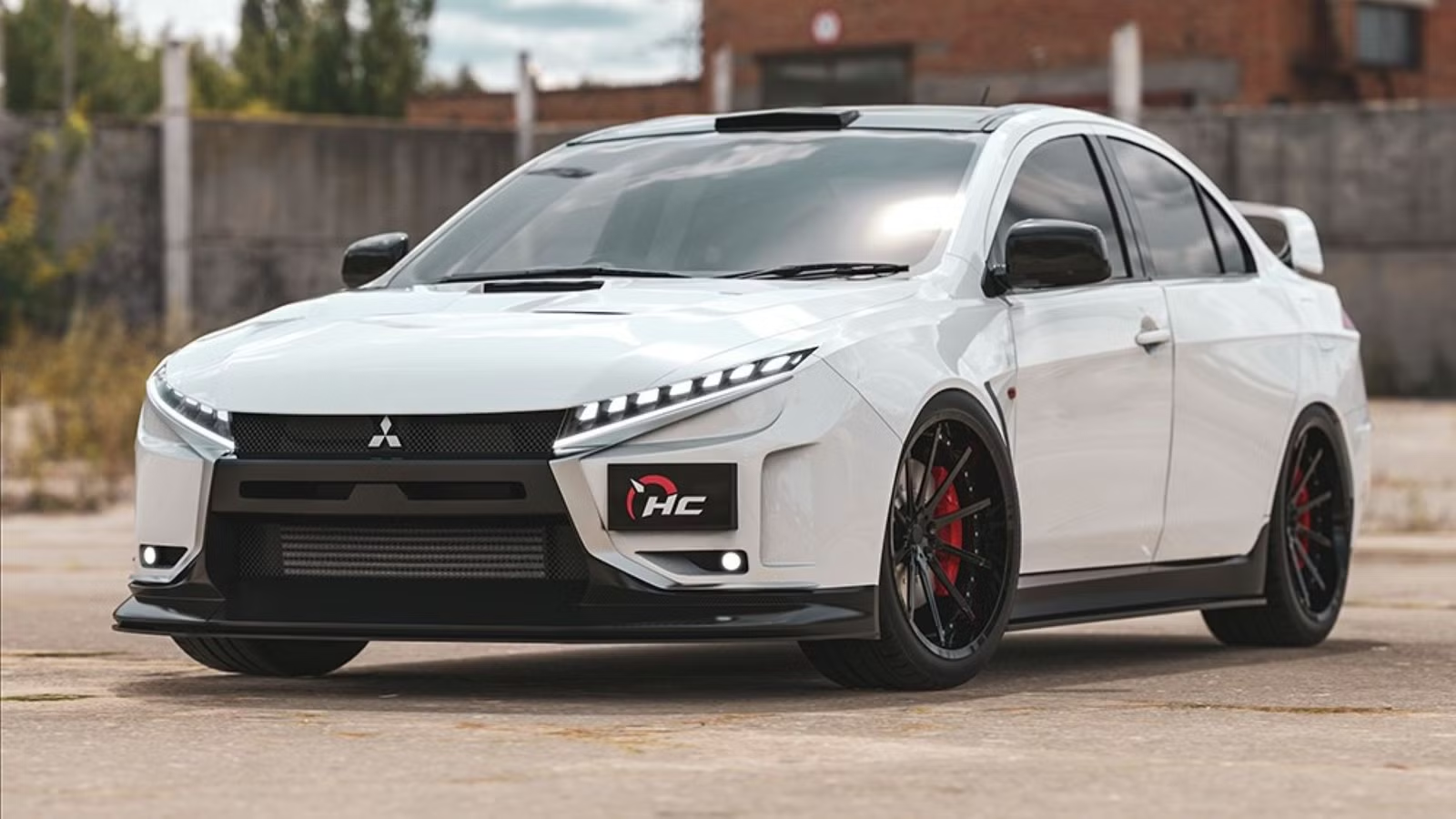
The Mitsubishi Evo is a much-loved super sedan that stuck to a simple formula of all-wheel-drive and a turbocharged four-cylinder. Anything else would be unimaginable. But with the Evo name disappearing ten years ago, any replacement would arrive into a very different world, marked by hybrid powerplants and EVs.

To stand a chance, the Evo would need to move with the times, and that would mean ditching the four-pot for an electric drivetrain. Sacrilege? Perhaps. But it could result in a return of one of the greatest rivalries in the history of performance cars. And we are down for that.
An All-Electric Evo Could Be A Gamechanger
True, EV performance cars aren’t exactly selling like hot cakes. The Charger Daytona wasn’t exactly a huge sales success for Dodge, with the brand largely pulling back from performing EVs for the time being. Meanwhile, electric supercars are failing to capture the imaginations of enthusiasts, and carmakers like Lamborghini pushing on with V12s. So this wouldn’t seem like a great time to launch an EV Mitsubishi Evo, as seen in our exclusive HotCars render.

Not exactly, but it makes a lot of sense. Muscle cars are traditional, with V8s and rear-drive, so making them electric doesn’t really work. But the Mitsubishi Evo (and its Subaru Impreza rival) has always been about cutting-edge technology, whether that is trick engine tech or chassis fine-tuning. The forward-thinking nature of an Evo can open the door to the very latest electric powertrain, coupled to clever all-wheel-drive from motors fore and aft.

Hopefully you are still with us, as things are going to get pretty interesting. The Mitsubishi Evo XI Lancer concept reveals what an EV version of the rally homologation model could look like. The car takes a lot of inspiration from the Evo X, which bowed out in 2016, but pulls its design language into the next decade. So, while the X was blocky and purposeful, the XI uses the slim front LED design from the Outlander and Eclipse Cross, blending it into a curvier sedan design.
There is still a trademark scoop on the bonnet, this time feeding air to the Brembo braking system. The roof scoop feeds cool air into the cabin. At the rear, the lights are slender and the two vertical sections give a similar appearance to the new 2027 Hyndai Elantra N. Multi-spoke gloss black wheels fill the wheel arches and the rear spoiler is neatly integrated, with a small lip spoiler on the trunk.

The tailpipes at the rear of our render are something of a red herring, working in the same way as Dodge’s Fratzonic Chambered Exhaust system to emit the crackle and pop of a true rally car. The Evo XI, in fact, wouldn’t have an engine at all, instead using a similar powertrain as the new Alpine A390, through the Renault–Nissan–Mitsubishi Alliance. Much of the underpinnings could come from the new Alpine sport fastback, but while that car is agile and quick, the Evo XI would be tuned to be far more aggressive.

The powertrain uses F1 know-how and consists of a triple-motor drive setup and 89kWh battery. The front axle houses the first electric motor, and a bespoke aluminum rear cradle houses another two motors, both with output of 125 kW. Drive is to all four wheels, and the top end configuration (used in the A390 GTS) has 470 hp. That equates to 60 mph in less than four seconds, and a top speed of 138 mph. All of these stats are in line with what we have come to expect from Evos.
Active Torque Vectoring from the three motors would emulate Evos of old. The Evo XI could be fitted with a drift mode for controlled oversteer and feature launch control. A more aggressive custom chassis set up would make the Evo XI devastating on winding roads, with active aero providing downforce. While purists may be turned away by electric power, the Evo could prove that it can equate to a highly efficient cross-country pace.
How An Electric Evo Could Take Us Back To The ’90s

As buyers drifted away from fast turbocharged JDM models in the 2000s towards SUVs, the world of rally-bred Japanese cars started to disappear. These days there is huge interest, with good Evos and Subaru Impreza WRX STIs selling for huge prices. Rather than hanging on to ICE for a new Evo, Mitsubishi may have a chance with an EV.
What is interesting is that Subaru has the same thought. The company unveiled the Performance-E STI concept at the Japan Mobility Show in Tokyo last year, showcasing its vision of a fast EV for the future. An electric Evo would go head-to-head with this Subaru, bringing back the old rivalry that was played out of rally stages across the world. With the tuning of EVs now becoming big business, these cars could take us into the future, while reminding us of the past.

Related posts

Latest Post


No Comments