
Jeep’s Wild Concept Breaks A Rule Wrangler Fans Know By Heart
If you’ve spent the last couple of decades taking Jeep Wranglers into the wild, fawning over their iconic status, or following how Jeep has managed to pile new tech into Wranglers while holding onto old-school SUV guts, you’ll know that there is a certain feature that they all share.

Now, though, Jeep is toying with the idea of changing this long-used feature in its new concept vehicle, the Jeep Wrangler Scrambler SRT. How will the Wrangler faithful take to it?
Jeep Is Building A Wrangler For High-Speed Desert Runs
Jeep is arguably one of the best brands to buy for off-road prowess; you have the likes of the Wrangler Rubicon, the old-school Cherokee XJ, and the Grand Cherokee Trailhawk. However, what Jeep doesn’t have is a Bronco Raptor equivalent: something that can tear up desert dunes at high speed.

SRT (Street and Racing Technology) has been lurking in the shadows for the last few years, but Stellantis has revived the badge with quite the concept: the Wrangler Scrambler SRT. This beast is designed to take the desert-racing fight straight to the Bronco Raptor.
Desert Racing Demands More Than Traditional Trail Hardware

I’ve driven a Wrangler TJ with a manual gearbox through some pretty boggy ground in the U.K., and it scampered and crawled its way up whatever I threw at it; I’ve also driven a fair few soft SUVs, and they did what was required. I wouldn’t have wanted to take them anywhere with soft sand and dunes, though, and certainly not at speed.
That’s why desert specialists like the 2026 Bronco Raptor get serious suspension: FOX Live Valve dampers, 13 inches of front travel, 14 at the rear, 37-inch tires, and locking differentials, letting it fly across rough ground without getting unsettled. This kind of off-road driving calls for a rather different approach to traditional 4×4 engineering.
The Jeep Wrangler Scrambler SRT Ditches The Solid Front Axle

Jeep has released some information about the new Wrangler Scrambler SRT, and aside from the impressive pictures and how good it sounds on paper, many of us immediately noticed that Jeep has decided to drop the solid front axle. The solid front axle has been a mainstay on models since the original CJ and the Wrangler YJ.
Independent Front Suspension Brings Better Control At Speed

Jeep has broken one of its oldest rules and replaced the Scrambler SRT’s front suspension with an independent front suspension (IFS). However, Jeep isn’t borrowing one from a road-going SUV and bolting it on.
Developed with off-road racing champ Casey Currie, the bespoke high-travel setup builds on the Striker concept, which Currie campaigned in his modified Gladiator, winning its class in the NORRA 500. So, there’s proper competition experience behind the hardware, not just marketing fluff.
Why could IFS work here? Each front wheel can move independently, instead of being tied to the opposite wheel by a solid axle. That means the suspension can soak up bumps and whoops without throwing the steering.
There should be 14 inches of front travel, which will give the tires room to follow the contours of the terrain while keeping the vehicle composed at speed. If you are a fan of solid axles, you may wince a little, but charging across Baja is a very different job from picking your way over Moab’s rocks.
A Trophy-Truck-Style Rear Setup Completes The Package


Out back, Jeep has gone for a trophy-truck-inspired rear axle. By doing this, the Scrambler SRT concept appears to be designed with strength and suspension travel in mind, rather than the articulation-focused approach of a traditional trail rig.
It is built to absorb repeated, high-speed hits without being knocked off line. Some reports have put rear suspension travel at 15 inches, which, working alongside the bespoke front setup, will keep the tires planted over rough terrain.
Jeep Brings Back The Scrambler With A Wild New Twist

As it stands, the largest stock tires you can get with a Wrangler are 35-inchers when you opt for the Xtreme Recon Tire Package on some trims of the Rubicon or Willys. Jeep is proposing fitting the Scrambler SRT with 37-inch BFGoodrich off-road tires as standard.
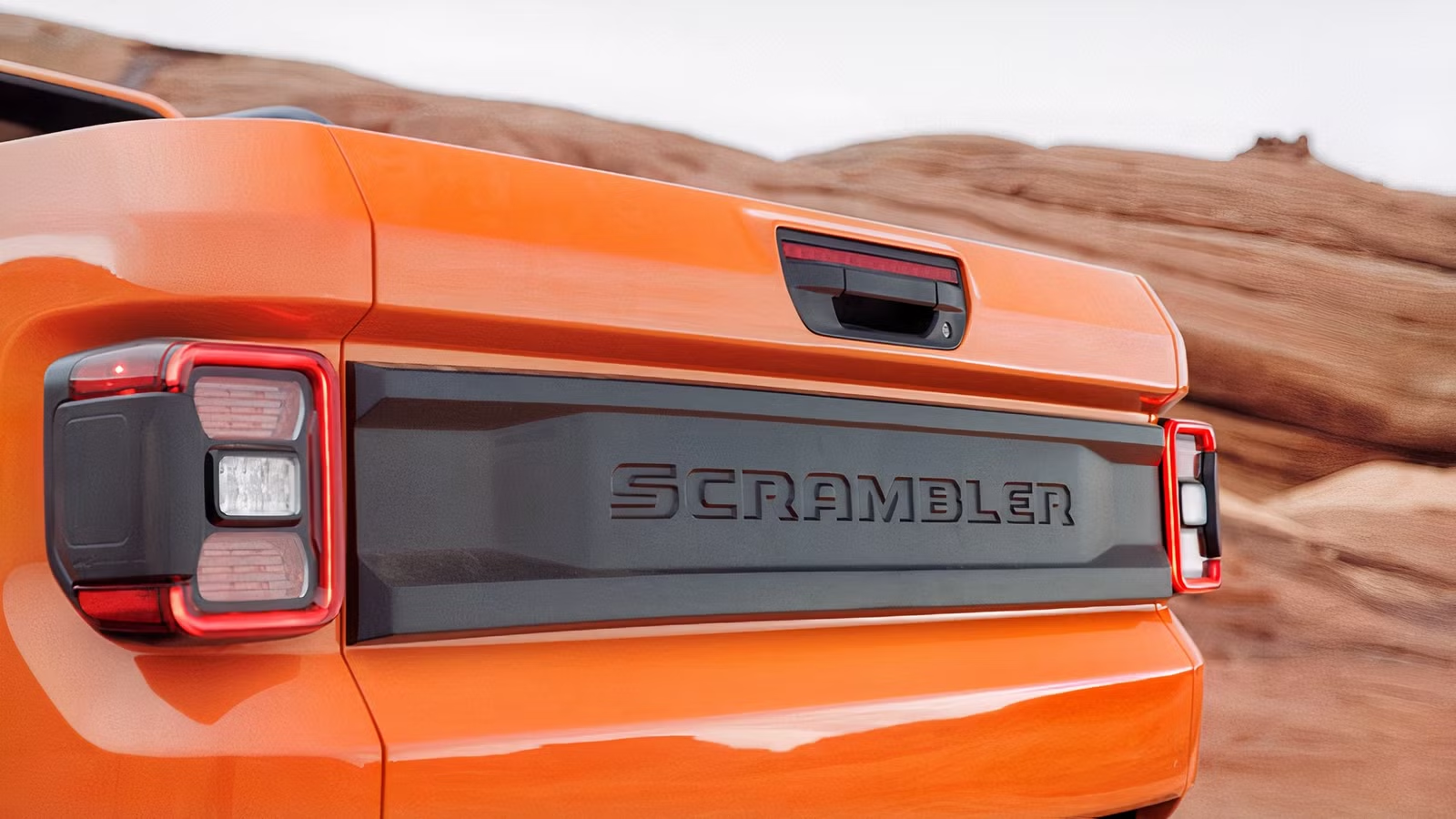
The concept desert racer also gets 17-inch bronze-painted beadlock wheels; the wide stance is enhanced by the lifted suspension and unique fender flares, and the integrated pickup bed gets a durable spray-applied liner. The tailgate is also redesigned with a structural roll cage, giving it a much more dedicated look than a few Wrangler accessories bolted on.
CJ-8 Heritage Meets Modern SRT Engineering


Jeep hasn’t yet confirmed axle ratios or what four-wheel-drive system it will have, but it is clear that this concept takes the original CJ-8 Scrambler idea (1981 to 1986) and gives it a modern makeover.
Jeep has reshaped the Wrangler from its A-pillars backwards, adding longer doors, bespoke bodywork, and the integrated bed. It looks like a cross between a chopped-up Wrangler and a pickup, but Jeep describes it as an SUV.
The rear seats clip onto floor-mounted hooks and can rotate 180 degrees to face backwards, or can be removed entirely. So, it is designed to either carry two passengers in the rear for an open-air desert dash or haul the tools you need out in the desert.
A V8 Gives The Concept Serious Muscle

The current Bronco Raptor has a 3.0-liter twin-turbo EcoBoost V6 good for 418 horsepower at 5,750 rpm and 440 pound-feet of torque at 2,750 rpm, with power routed through a ten-speed SelectShift automatic transmission to all four wheels via a two-speed transfer case.
To really compete with the Bronco Raptor, Jeep is deploying a weapon of an engine. They say the Wrangler Scrambler SRT will have a naturally aspirated 6.4-liter HEMI V8 that puts out 470 horsepower and 470 pound-feet of torque.
This Radical Scrambler SRT Is A Concept, Not A Production Promise

When the new Wrangler Scrambler SRT concept was unveiled at the 2026 SEMA Show in Las Vegas, Jeep made a bold statement. It is clearly testing how far it can push the Wrangler formula without entirely abandoning the old-school heritage of the Wrangler.
Some traditionalists will argue that losing the solid front axle takes away part of what makes a Wrangler a Wrangler. That’s fair, but this concept isn’t chasing rock-crawling records. If Jeep can turn this into production reality, it could give the Bronco Raptor a proper fight and start something new for the badge.
Sources: Jeep

Related posts




Latest Post


No Comments