
The Roadster That Feels Better Every Time You Ride It
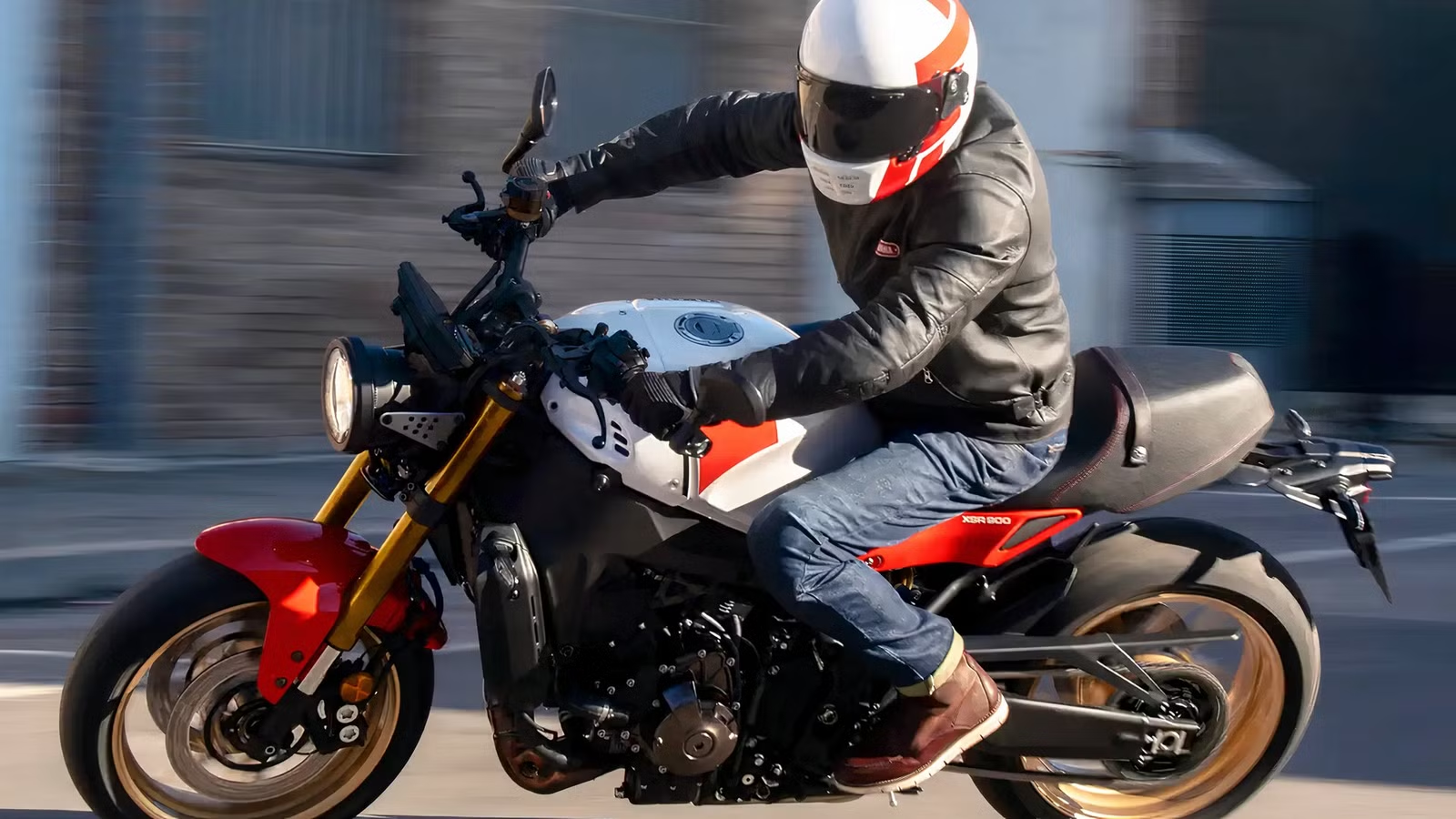
Motorcycles don’t all reveal themselves completely right off the bat. Yes, there are some that make the biggest impact even before you thumb the starter, but some take their time. Riders ease themselves into these bikes, letting miles pile up while the experience becomes more and more enjoyable. Naked bikes are good at doing this. They teach their owners how to ride rather than requiring them to come with a certificate from a racing school. Roadsters stretch this further with easy engines and perfect capabilities that let you learn slowly but get faster over time.
When A Roadster Becomes More Than A Naked Bike
The Roadster And Naked Aren’t Quite The Same Thing

The terms “roadster” and “naked” are often used interchangeably. Now, there is plenty of overlap between them. Both typically ditch the full fairing of a sport bike, put the rider in a more upright position, and prioritize a balance between performance and everyday usability.
In the UK, people generally refer to bikes with older, retro designs as roadsters, while the more modern styling cues go on naked bikes. In the US, the difference is more subtle: the roadster puts greater emphasis on the riding experience rather than aggression, and when you look at some of the retro-themed bikes out there, you’ll know what we mean.
Why Neo-Retro Motorcycles Keep Winning Riders Over

The neo-retro movement has added another ingredient to that formula: personality. Instead of simply recreating motorcycles from decades ago, manufacturers have started borrowing the visual language of classic machines while sprinkling bits and pieces of modernity into the design. Beneath this bodywork, however, you will find thoroughly updated mechanicals and engines that older bikes cannot match.

The class has no shortage of competition either. Triumph’s Speed Twin 900 leans heavily into British heritage while Kawasaki’s Z900RS combines classic Z styling with modern performance, and Honda’s CB650R takes a more minimalist approach to the neo-retro formula. Yamaha, too, offers the XSR900, the topic of our story today, because, of those four, the XSR900 does something the others don’t — it actively gets better the more miles you put on it. Here’s why.
The Yamaha XSR900 Finds The Sweet Spot
The XSR900 Is Equally At Home Cruising Or Carving — That’s The Whole Point

Yamaha describes the XSR900 as a machine inspired by the company’s racing heritage, but beneath that heritage styling is the company’s CP3 engine and a chassis equipped with fully adjustable suspension, Brembo brakes, decent seat height, upright riding position, and a wheelbase that allows fast straights and tight corners. The XSR900 has real performance credentials, but the broad engine character allows the bike to stay interesting even when the pace is low. And that’s what you want to see from a bike that changes depending on how you want to ride.
The XSR900’s 890cc Triple Has A Personality Of Its Own

At the heart of the XSR900 is Yamaha’s 890cc liquid-cooled inline three-cylinder engine that produces 117 horsepower at 10,000 rpm and 68.5 pound-feet of torque at 7,000 rpm. The inherent character of this engine, between explosive peak power and low-end grunt, is what makes this bike interesting. For someone who has just picked up the bike from the showroom and is taking it slow, the bike feels manageable. It’s only when the rider gains more confidence and picks up the pace that the XSR900 brings out its colors.
Yamaha pairs the engine with an up-and-down quickshifter and ride-by-wire throttle, and this is where the modern bits truly come in. The quickshifter allows you to change gears both ways without using the clutch. Of course, you need to be revving harder than you normally would, and that, again, you get to decide. Do you want hard acceleration with seamless upshifts and downshifts, or do you want to cruise at a leisurely pace without putting any strain on the engine?
The XSR900’s Chassis Is Built To Be Ridden Hard

To complement the engine, Yamaha has put in a chassis that is considerably more serious than the styling might suggest. It uses a compact aluminum frame produced with its Controlled Fill die-cast process, and is paired with a box-section aluminum swingarm. This means the chassis itself is fairly lightweight even while rigidity is kept under control. Wheelbase measures 58.9 inches, and the rake and trail measure 25 degrees and 4.3 inches, respectively, giving you an idea of how agile this bike really is.

Suspension is equally serious, with 41 mm KYB inverted forks offering 5.1 inches of travel and full adjustment, as well as a KYB monoshock at the rear with full adjustment and 5.4 inches of travel. Adjustability is important if you want to change the way the bike feels every day. You could be ready for a blast around a mountain pass one day and ready to relax on a highway cruise the next.
The XSR900’s Styling Is A Deliberate Jumble — And It Works
Round Headlamp, Retro Tail, Modern Tank — The XSR900 Borrows From Every Era

The XSR900’s shape is an odd mix of modern and retro styling cues. Where you have a round LED headlamp up front, the fuel tank’s overall design seems more modern. The tail section, again, takes its cues from old sport bikes with big boxy rear ends. It is a jumble of worlds, but it stands out significantly in the crowd.
Bar-end mirrors and exposed mechanical components complete this puzzle of amusement and nostalgia. For the more technical aspects of the design, you have a 31.9-inch seat height, which may be a little on the tall side for some, but the slightly narrower seat and 425-pound curb weight make it plenty manageable for the vast majority.
Beneath The Retro Shell: A Six-Axis IMU, Cruise Control, And A Full Electronics Suite

Here’s another place where the XSR900 stops pretending to be old-school. As part of the electronics package, the XSR900 gets a six-axis IMU that manages traction control, slide control, lift control, and brake control. There’s also a back slip regulator designed to reduce rear-wheel lockup during aggressive engine braking. Yamaha’s Ride Control system also allows selectable and customizable riding modes, cruise control, and a five-inch color TFT to display metrics and settings. Smartphone connectivity comes via the company’s Y-Connect app.
The Yamaha XSR900 Is The Roadster You Grow Into
$300 More Than The MT-09 Buys You The Most Head-Turning Bike In Any Parking Lot

There is a small temptation to judge motorcycles by their first impression. Loud exhausts, big engines, and aggressive styling usually win that contest. But motorcycles are so much more than their visual appeal suggests. The Yamaha XSR900 has the ingredients to earn its place in a rider’s life.
The 890cc inline triple provides enough character to remain exciting, while the 425-pound weight keeps the physical package manageable. At $10,599 MSRP, the XSR900 is just $300 shy of the MT-09, a bike that is identical to the XSR in everything but shape. The reason you go for the XSR900, though, is that it will turn more heads than any other motorcycle you ride with.
Source: Yamaha Motorsports

Related posts



Latest Post


No Comments