
Jaguar Built A 550-HP Supercharged Sedan To Humiliate Overpriced Supercars
The late 2000s transformed the luxury sedan into an unlikely performance battlefield. Executive four-doors no longer competed only on refinement, craftsmanship, or technology; horsepower became the newest measure of prestige. Every launch seemed to raise the benchmark, narrowing the gap between practical family sedans and exotic machinery. Yet outright performance still belonged to Ferrari, Lamborghini, and Porsche, whose badges carried an aura no luxury sedan could realistically claim. Then a traditional British marque set out to challenge that assumption without abandoning the qualities that had defined it for decades.
Luxury Sedans Weren’t Supposed To Outrun Supercars

For most of automotive history, executive sedans and supercars occupied entirely different worlds. One prioritized serenity over speed, carrying executives across countries in near silence. The other accepted compromises in comfort because outright performance was the entire point. Buyers rarely expected one car to excel at both.
That distinction began to erode as Germany’s premium manufacturers discovered there was commercial value in building increasingly powerful flagship sedans. BMW M, Mercedes-AMG, and Audi RS pushed outputs beyond 500 horsepower, while rapid advances in electronics helped transform immense performance into something remarkably approachable. By the early 2010s, the numbers on a luxury sedan’s specification sheet were beginning to resemble those of contemporary supercars.
Despite that escalation, perception remained stubbornly unchanged. Even the quickest executive sedans were often viewed as astonishingly fast luxury cars rather than genuine alternatives to exotic performance machines. Their role was still to complement a sports car, not replace one.

One British luxury manufacturer believed that limitation existed more in buyers’ minds than in engineering.
Jaguar Chose Brute Force Instead Of Downsizing

As emissions’ regulations tightened around the world, manufacturers increasingly embraced turbocharged, downsized engines. Smaller displacement promised improved efficiency without sacrificing headline performance, and the industry rapidly accepted that formula as the future of high-output road cars.
Jaguar refused to follow that path. Instead of chasing efficiency through smaller engines, its engineers continued refining a large-displacement supercharged V8. The decision wasn’t driven by nostalgia. It reflected a belief that a grand tourer should deliver instant throttle response, effortless acceleration, and unwavering composure at sustained high speeds rather than explosive bursts of boost.
That philosophy demanded accepting compromises. A supercharged V8 consumed more fuel and carried greater weight than many emerging turbocharged alternatives. In return, it delivered the smooth, linear power delivery that had long defined the brand’s sporting road cars and distinguished them from rivals whose performance increasingly depended on electronics and forced induction strategies.
The result became the fastest production sedan the company had ever offered—a car intended not simply to join Germany’s horsepower war, but to challenge its underlying philosophy.
It’s The Jaguar XFR-S That Packed Supercar Power

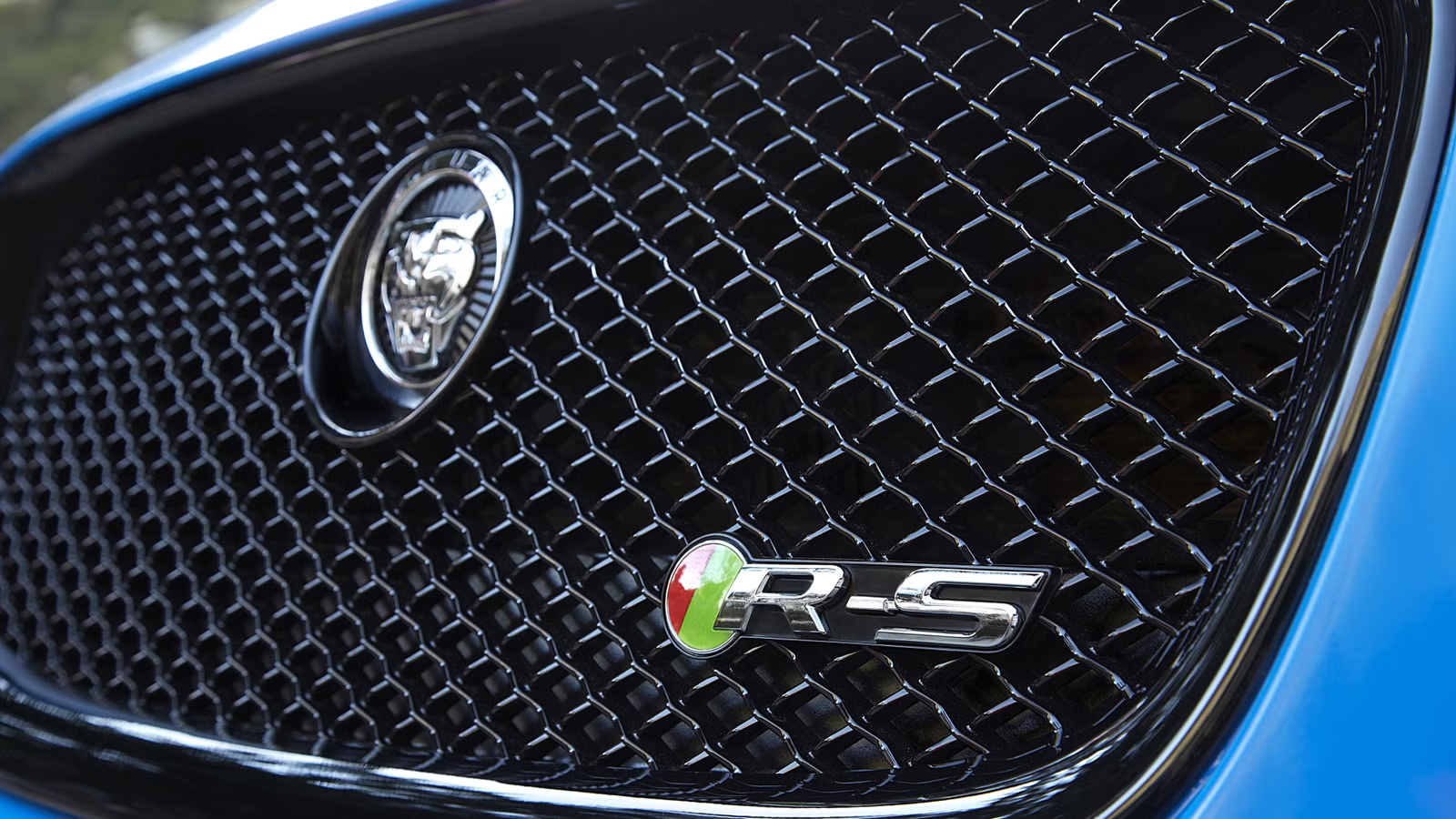
The answer arrived in the form of the Jaguar XFR-S, developed by Jaguar Land Rover’s specialist Engineered To Order division as the ultimate evolution of the first-generation XF. Rather than creating a stripped-out halo model, Jaguar sought to build the definitive expression of its performance-sedan philosophy: immense pace delivered with the refinement expected of a luxury grand tourer.
Its credentials immediately justified that ambition. Beneath the hood sat Jaguar’s supercharged 5.0-liter AJ-V8, producing 550 horsepower and 502 lb-ft of torque. Power flowed exclusively to the rear wheels through an eight-speed ZF automatic transmission, allowing the XFR-S to sprint from 0 to 60 mph in 4.4 seconds before reaching an electronically limited 186 mph. Those figures placed it among the fastest production sedans on sale anywhere in the world.
The hardware alone, however, wasn’t what made the XFR-S remarkable. Jaguar deliberately retained its supercharged V8 because it complemented the brand’s grand-touring identity better than a downsized turbocharged alternative. Engineers valued the engine’s immediate response, broad torque curve, and effortless delivery, believing those characteristics created a more rewarding high-speed companion than chasing ever-higher peak outputs through smaller, more highly stressed powerplants.
That decision also defined the XFR-S’s character. Jaguar wasn’t trying to build another BMW M5 or Mercedes-Benz E63 AMG. It was proving that a British luxury marque could challenge Germany’s finest performance sedans while remaining unmistakably true to its own identity.
It Was Engineered Like A Four-Door Grand Tourer, Not A Muscle Car

Extracting another 40 horsepower from the already potent XFR was only part of the challenge. The harder task was ensuring that additional performance never overwhelmed the car’s character. Jaguar’s engineers weren’t interested in building a sedan that demanded constant corrections from its driver. They wanted one that inspired confidence, whether cruising across a continent or approaching its electronically limited top speed.
That objective shaped every significant chassis revision. The XFR-S received recalibrated Adaptive Dynamics dampers, stiffer suspension components, revised steering calibration, and a retuned electronically controlled active differential to improve traction without diluting the rear-wheel-drive balance enthusiasts expected. Rather than masking the extra power with all-wheel drive, Jaguar chose to refine how the chassis communicated with the driver, preserving the progressive handling that had long defined the brand’s sporting saloons.
The aerodynamic package served the same purpose. A deeper front splitter, larger air intakes, redesigned side sills, rear diffuser, and discrete decklid spoiler collectively reduced lift while improving cooling for the engine and transmission during prolonged high-speed driving. None of those changes existed to make the XFR-S appear more aggressive in a showroom. They existed because aerodynamic stability becomes just as important as horsepower when a luxury sedan is capable of nearly 190 mph.
That philosophy explains why the XFR-S never felt like a traditional muscle sedan with luxury appointments. Its performance was substantial, but it arrived with the composure, refinement, and long-distance comfort expected from a Jaguar grand tourer rather than the relentless aggression that characterized many of its contemporaries.
The Germans Sold Better, But They Didn’t Always Feel More Special

On paper, the XFR-S entered one of the toughest segments in the industry. Buyers considering a high-performance executive sedan could choose the BMW M5, Mercedes-Benz E63 AMG, or Audi’s RS models, each supported by decades of motorsport success, expansive dealer networks, and carefully cultivated performance reputations. Jaguar had to convince customers that engineering merits could outweigh brand familiarity. It often couldn’t.
The XFR-S possessed the performance credentials to compete with its German rivals, yet many buyers never looked beyond the established hierarchy. Jaguar’s reputation remained rooted in elegant luxury and grand touring rather than uncompromising performance, while BMW M and Mercedes-AMG had spent years convincing enthusiasts they represented the benchmark. Winning that perception battle proved considerably harder than matching acceleration figures.
Looking back, however, the qualities that limited its showroom success have become some of its greatest strengths. The supercharged V8 delivers a distinctly linear surge of acceleration, the rear-wheel-drive chassis remains engaging without feeling intimidating, and its comparatively low production ensures the XFR-S is rarely mistaken for anything else. It never chased the German formula. Instead, it offered an unmistakably British interpretation of the modern super sedan.
Time Has Made The XFR-S One Of Jaguar’s Most Underrated Performance Cars

Performance cars often earn greater appreciation once the conditions that created them disappear. The XFR-S benefits from exactly that shift in perspective. It arrived before downsized turbocharged engines became the industry’s dominant solution and before electrification fundamentally changed expectations for high-performance luxury sedans. Today, its large-displacement supercharged V8 feels less like an outdated engineering choice and more like the closing chapter of a disappearing era.
Its rarity has reinforced that appeal. Produced in far smaller numbers than its principal German rivals, the XFR-S remains an uncommon sight on the road and an increasingly desirable one among enthusiasts who value character as much as outright speed. It also represents the final evolution of Jaguar’s supercharged V8 sports-sedan philosophy before changing regulations and corporate priorities pushed the brand toward a different future.
History has a habit of rewarding cars that remain true to themselves. The XFR-S never became the segment’s sales leader, nor did it redefine the executive sedan in the way the BMW M5 had done years earlier. What it achieved was arguably more distinctive. At a time when much of the industry pursued similar engineering solutions, Jaguar demonstrated that a British luxury marque could build a four-door possessing genuine supercar pace without abandoning the refinement and grand-touring character that had always set it apart.
Source: Jaguar Media Center

Related posts



Latest Post


No Comments