
How BMW And Mercedes Invented The Sleeper Super-Sedan In The Same Year
By the late 1990s, high performance no longer had to come wrapped in flamboyant styling, towering rear wings, or aggressive bodywork. A new breed of performance machine proved that breathtaking speed could be hidden beneath the understated appearance of an executive sedan, allowing owners to enjoy supercar-level pace without attracting unwanted attention. It was a philosophy built around subtlety rather than spectacle.

Remarkably, two rival German manufacturers arrived at almost exactly the same conclusion within months of one another. Their independent interpretations established a formula that has shaped every truly great sleeper super sedan that has followed, proving that discretion could be every bit as exciting as drama.
Two German Rivals Arrived At The Same Formula At The Same Time
When the BMW E39 M5 arrived in 1998 and the Mercedes-Benz W210 E55 AMG followed in 1999, they did far more than launch two exceptionally fast executive sedans. Although developed independently and guided by different engineering philosophies, both cars arrived at almost exactly the same conclusion: serious performance no longer needed to wear an aggressive disguise. Instead, they combined executive comfort, everyday practicality, and supercar-challenging acceleration beneath understated styling that attracted little attention outside enthusiast circles.

That shared vision was no coincidence. It marked the birth of a new kind of performance car, one that blurred the lines between luxury sedan and sports car without compromising either role. Rather than competing to define the segment, the E39 M5 and W210 E55 AMG effectively co-authored it, establishing a blueprint that countless performance sedans have since refined. More than two decades later, their influence remains unmistakable across every discreet, high-performance executive sedan that followed.
Both Cars Perfected The ‘Wolf In Sheep’s Clothing’ Design

One of the biggest reasons the E39 BMW M5 and Mercedes-Benz W210 E55 AMG became legendary was how little they advertised their capabilities. At first glance, both looked remarkably similar to their standard executive sedan counterparts, with only a handful of subtle styling cues hinting at what lay beneath.
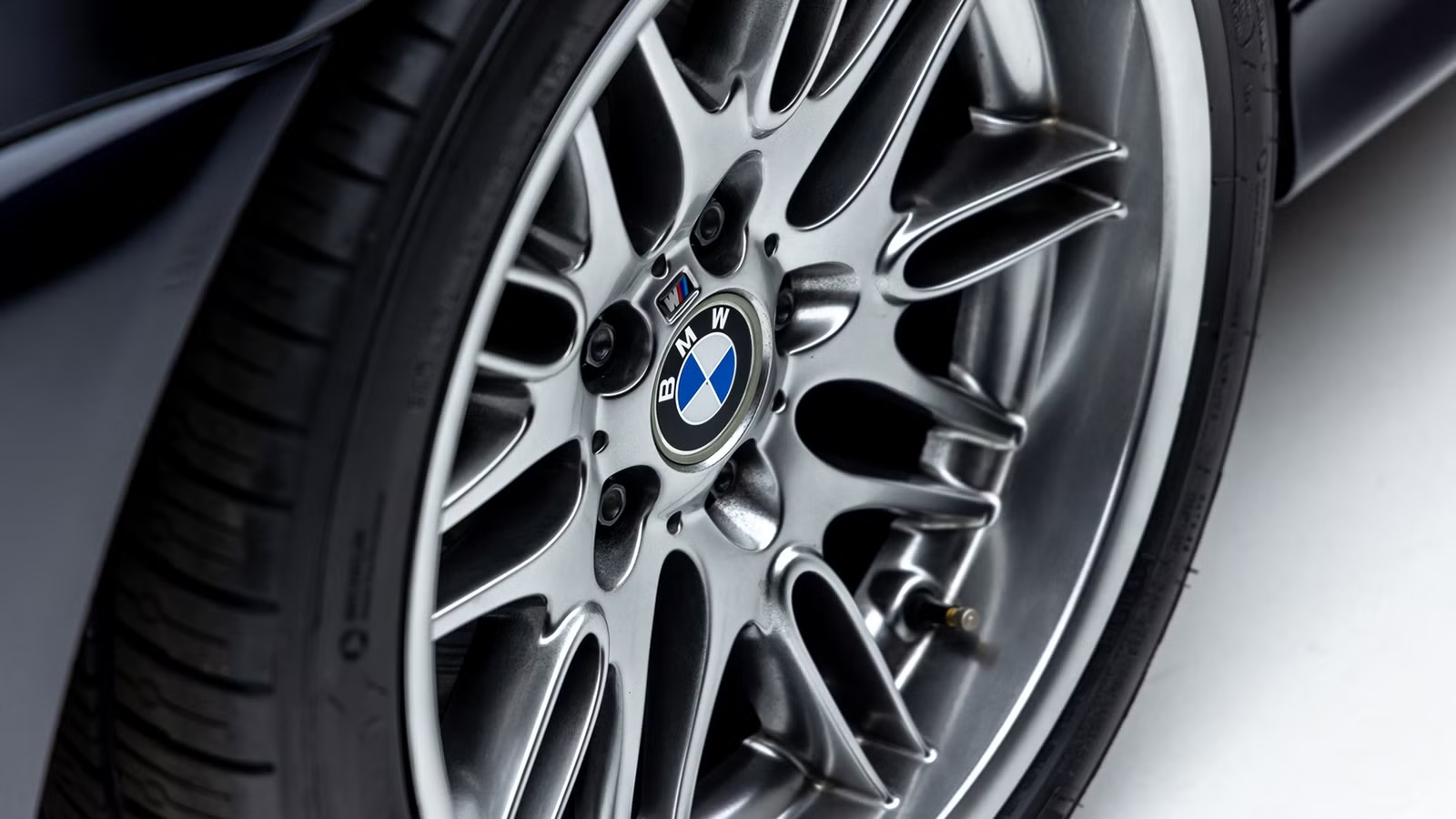
The M5 featured discreet 18-inch alloy wheels, slightly more aggressive bumpers, quad exhaust outlets, and a marginally lower stance, while the E55 AMG wore understated AMG wheels, revised front and rear bumpers, side skirts, and twin exhaust outlets. To the average passerby, they remained respectable business sedans rather than performance flagships.
That understated approach became their greatest strength. Owners could enjoy serious performance without attracting unnecessary attention, creating the blueprint for the modern sleeper. More importantly, they proved that genuine performance did not require exaggerated styling, a philosophy that continues to define the world’s best sleeper sedans.
BMW Built A Motorsport-Inspired Driver’s Machine

Rather than simply installing a larger engine into its executive sedan, BMW’s M division engineered the E39 M5 from the ground up as a true driver’s car. At its heart sat the bespoke 4.9-liter S62B50 V8, producing 400 brake horsepower through a combination of eight individual throttle bodies, double VANOS variable valve timing, and a high-revving character inspired by BMW’s motorsport experience.
Power was sent exclusively to the rear wheels through a Getrag 420G 6-speed manual transmission, ensuring maximum driver involvement at every speed. Just as important was the chassis. Precise steering, near-perfect weight distribution, and a finely tuned suspension gave the M5 remarkable balance, allowing it to feel equally at home on a twisting mountain road or a racing circuit.
Comfort was never sacrificed, but it was clear where BMW’s priorities lay. The E39 M5 delivered an engaging, analog driving experience that rewarded skill and precision, making it one of the most celebrated sports sedans ever built.
Mercedes Took A Completely Different Route To The Same Destination

While BMW approached the sleeper super sedan with a focus on driver involvement and motorsport-inspired precision, Mercedes-AMG created its own interpretation through effortless power and refinement. Beneath the understated exterior was a naturally aspirated 5.4-liter M113 V8 producing 354 bhp, paired exclusively with an automatic transmission.
Rather than chasing high revs or track-focused responses, AMG focused on delivering immense torque, smooth acceleration, and relaxed high-speed performance. The result was a sedan that could cruise quietly through the city before effortlessly covering long distances at autobahn speeds.
This combination of luxury, comfort, and muscle gave the E55 AMG its reputation as a European muscle car: refined enough for executive duties, yet powerful enough to challenge dedicated performance machines. It represented a completely different philosophy from BMW’s, but arrived at the same destination: a discreet sedan with extraordinary performance hidden beneath a conservative exterior.
Opposite Engineering Philosophies Produced Nearly Identical Performance

Although BMW and Mercedes-AMG followed completely different engineering philosophies, both arrived at remarkably similar performance figures. The E39 M5 and W210 E55 AMG could accelerate from 0 to 62 mph in 5.3 and 5.7 seconds respectively (official claimed times), while both featured electronically limited top speeds of 155 mph.
However, the way they delivered that performance could hardly have been more different. BMW’s approach relied on a high-revving V8, a manual transmission, and a chassis designed to involve the driver at every stage of the journey. It rewarded precision, commitment, and active participation behind the wheel.
Mercedes-AMG chose a more relaxed approach, using the V8’s abundant torque and automatic transmission to deliver effortless acceleration with exceptional refinement. One felt like a sports car disguised as a sedan, while the other felt like a luxury express with muscle car characteristics. Both proved there was more than one way to create the ultimate sleeper performance sedan.
They Created The Blueprint Every Modern Super-Sedan Still Follows

The influence of these two German performance sedans extends far beyond their own generations. Rather than replacing the original formula, later M5 and AMG E-Class models continued to refine the same basic philosophy: combine executive luxury, everyday practicality, and extraordinary performance in a package that remains visually understated.
While modern versions have gained turbocharged engines, advanced electronics, and significantly more power, the core idea remains unchanged. They are still designed to transport passengers in comfort while delivering acceleration and capability that would have belonged to exotic sports cars only a few decades earlier.
The greatest achievement of the original sleeper super sedans was proving that performance did not need to announce itself. Today’s fastest executive cars continue to follow that principle, offering discreet styling, premium interiors, and immense capability beneath a conservative exterior. The formula created in the late 1990s became a blueprint that manufacturers continue to perfect.
Collectors Finally Appreciate What These Cars Started

For years, the BMW E39 M5 and Mercedes-Benz W210 E55 AMG were simply depreciated used executive sedans, but collectors have since recognized their importance as the cars that defined the modern sleeper super sedan. The E39 M5 was produced from 1998 to 2003, with approximately 20,000 examples built worldwide, while the W210 E55 AMG remained far rarer, with only 10,073 produced from 1997 to 2002.
Today, exceptional examples are attracting serious collector interest. Recent auctions have seen E39 M5 values climb significantly, including perfect examples selling for as high as $100,000 to $140,000 on Bring a Trailer.
W210 E55 AMG examples have also crossed into collector territory, with clean cars selling around the $35,000 to $45,000 mark. Their appeal extends beyond rarity and values. Naturally aspirated V8 engines, analog driving experiences, and their role as the original discreet performance sedans have made them icons of a rapidly disappearing era.
Sources: Mercedes-Benz Public Archive, BMW Group Classic, Bring a Trailer

Related posts


Latest Post


No Comments