
The Roadster That Nails The Balance Between Comfort And Performance
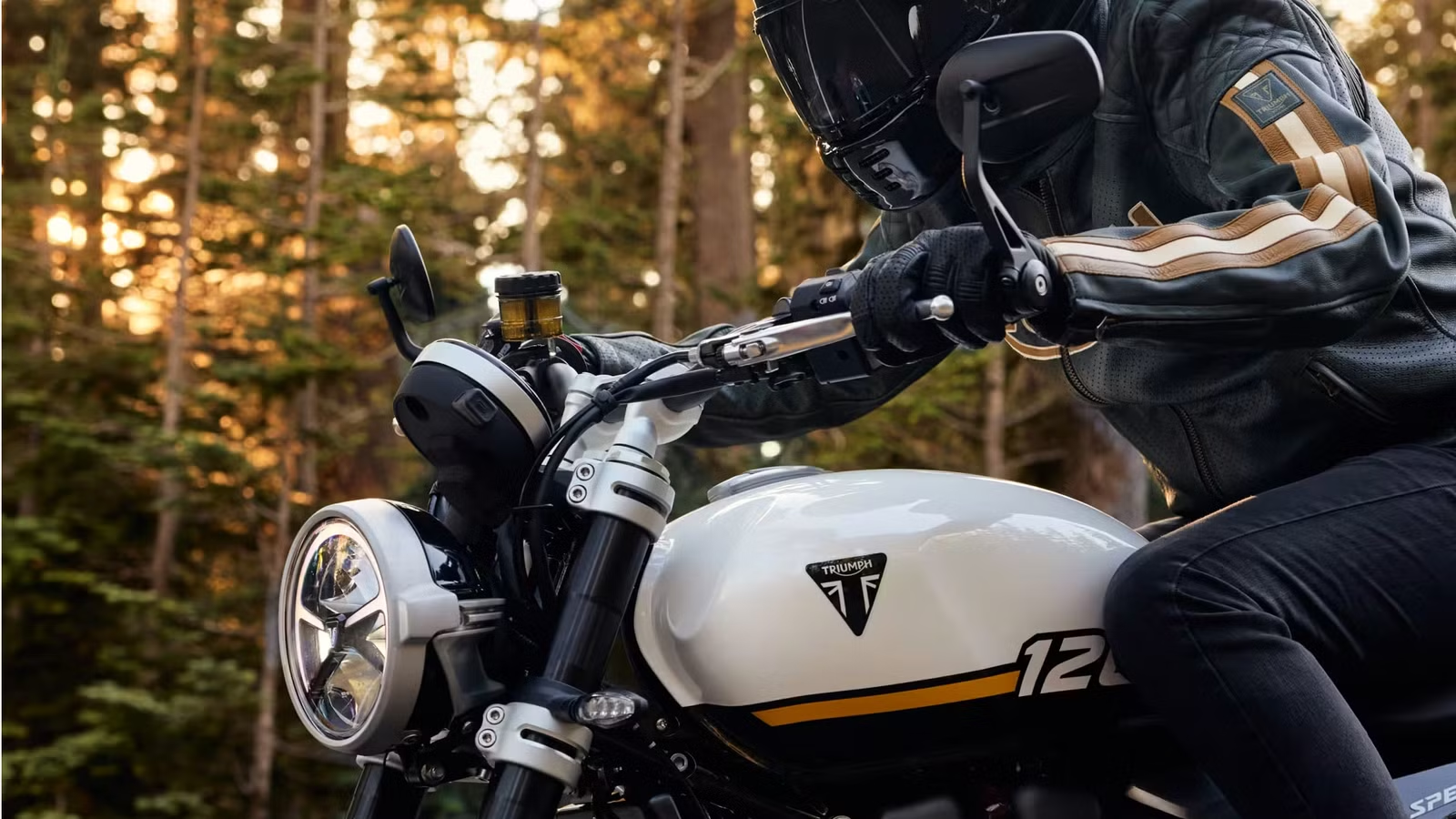
Today’s motorcycle showrooms are crowded with motorcycles boasting astronomical power figures that are usable only on racetracks, or massive touring motorcycles with features that cars would be proud of. You get a choice between aggressive riding postures that aren’t comfortable for anything more than a short ride, or big rigs that need assistance to back up and are extremely uncomfortable once the tarmac runs out. This begs the question of whether there’s something simple that’s powerful and comfortable without being an overkill. The answer is yes, and it’s a Triumph.
Neo-Retro Roadsters Often Struggle To Balance Form And Function

The industry saw the need for these uncomplicated motorcycles, which gave rise to the neo-retro wave of roadsters. However, some go too far into the nostalgia side, ditching the riding fun. Others can be too modern and not feel uncomplicated at all. For instance, Japanese manufacturers have a wave of high-revving inline-fours put into recycled chassis, creating a non-road-friendly roadster package.
The Europeans went in the other direction, offering specially engineered models with stunning aesthetics and great dynamics. All that extravagance comes at a cost, though, which is why they’re hard to attain for most of us. That gives customers the option of a parts-bin special or a hideously expensive motorcycle that one couldn’t risk thrashing on an everyday commute.
Traditional British Engineering Pioneered The Effortless All-Day Roadster

Between all that lies the British. They understood that a great everyday motorcycle needs low-end torque and a comfortable upright posture. Among these bikemakers, no manufacturer understands the balance needed from a roadster more than the brand from Hinckley. Triumph defined British performance nearly a century ago, and it decided to return to its roots in the modern era as well. Rather than dressing up one of its other models with retro looks, it decided to engineer a modern roadster with the DNA of the original. It has it all: massive displacement, a great chassis, a comfortable rider triangle, and of course, a parallel twin.

The Triumph Speed Twin 1200 Strikes The Ideal Balance Between Pace And Comfort

That model is the Speed Twin 1200, which is the purest realization of the modern roadster brief. It has siblings that chase more performance via a more aggressive posture for the rider and better-quality components, but the base Speed Twin 1200 focuses on what a rider needs in the real world, and it feels like a modern classic.

It does this with a 1,200 cc ‘High Power’ parallel twin with massive low-end torque, great suspension from specialists Marzocchi, and an electronics suite that allows for cornering functions. It also helps that it looks the part to a T. This motorcycle is proof that you can get the balance between comfort and performance right.
$15,395 Base Price Demands A Premium Over Japanese Middleweights

The Speed Twin 1200 has a base price of $15,395; this makes it firmly a premium purchase since there is just one European competitor that has a base price higher than it. There are options that can be added to the Speed Twin 1200, but they aren’t necessary since it’s a good base specification. The nice thing is that it has variants that have better chassis components as well — for example, the Speed Twin 1200 RS replaces the Thruxton — so future upgrades are also on the table for owners.
270-Degree ‘High-Power’ Parallel Twin Delivers Rich Low-End Torque

The entire Speed Twin range is powered by the same engine in the same state of tune, which means that the Speed Twin 1200 is the most affordable way to access this engine’s lovely character and power delivery. This is Triumph’s largest parallel-twin engine, with a displacement of 1,200 cc. It is liquid-cooled (despite the fins), fuel-injected, has four valves per cylinder, and a 270-degree firing order.

Add to that a high 12.1:1 compression ratio, and you get 105 horsepower at 7,750 RPM and 83 pound-feet of torque at 4,250 RPM, making it one of the most powerful retro-styled bikes today. The torque output is in the ballpark of liter-class superbikes, but at almost a third of the RPMs. This is sent through a six-speed gearbox with an assist and slipper clutch and a chain to the wheel. We would’ve loved a quickshifter here, but sadly, it remains absent.
Inverted Marzocchi Forks And Radial Calipers Elevate Everyday Handling

The chassis here is a tubular steel cradle type with a two-sided aluminum swingarm. Suspension specialists Marzocchi provide the 43 mm inverted front forks and the twin rear shocks with external reservoirs. The only adjustment available is preload at the rear, and there is 4.7 inches of travel available at the front and 4.6 inches at the rear.

There are twin 320 mm floating brake discs at the front with four-piston radial calipers, and at the rear, a single 220 mm brake disc is paired with a Nissin two-piston floating caliper. The aluminum alloy wheels, with a 17-inch diameter, have tubeless radial tires mounted on them. The base Speed Twin 1200 has competent chassis components that will handle everyday riding really well and almost make you forget about horsepower; however, the RS upgrades all the components to premium ones and is more suitable for fast riding.
A 55.1-Inch Wheelbase Provides Two-Up Comfort With Urban Agility
The Speed Twin 1200 is a full-size motorcycle, but it is not as long as a full-size cruiser, with a wheelbase of 55.1 inches. It is also just 30.9 inches wide, can hold 3.8 gallons of fuel in its tank, and weighs 476.2 pounds wet. The seat height is 31.4 inches, which is normal for this class of vehicle. However, this is a big parallel-twin engine, so the width will be noticeable, but it will be quite agile to ride in traffic.
A Six-Axis IMU And Cornering Safety Tech Sit Concealed Beneath Retro Lines

Triumph has now moved to a circular LCD/TFT combination instrument cluster that brings retro cool without the headaches. It certainly isn’t as sophisticated as the Yamaha XSR900’s 5-inch TFT display, but it provides all the information that you’ll need cleanly and has a USB-C charging socket on the side. The real magic happens when you toggle through and find usable rider aids. A ride-by-wire throttle and a six-axis IMU unlock two ride modes and cornering functions for the traction control and ABS.
Missing Cruise Control And A Non-Adjustable Fork Limit The Base Model’s Value

You cannot really fault the base Speed Twin 1200 for not having adjustable suspension (it is a base model after all), but at over $15,000, you would expect things like Bluetooth, sat-nav, and cruise control to be standard features. The quickshifter is also not available even as an option because of the footpeg placement of this particular variant, which is a shame. Still, it feels mechanical in the best way.
Established Japanese And European Rivals Offer Competing Retro Philosophies

The neo-retro roadster segment is a popular one and growing all the time, which explains why there is quite a lot of presence in it. The Yamaha XSR900 retails for $10,599 and is based on the lovely MT-09 naked bike, which means you get the characterful CP3 crossplane inline-three-cylinder engine, a wonderful electronics suite, and an extremely eager chassis. This bike is capable of everything: commuting, canyon runs, and cafe nights.

For a little more money, though, at $12,899, you jump up to the Kawasaki Z900RS, a roadster that never stops feeling special. This has an arguably more complete design, and Kawasaki has recently given it a six-axis IMU. With its smooth inline-four engine focused on torque, this is the roadster to have if you want the laid-back life.

However, if you want things to be a little more upmarket, there is the $17,245 BMW R 12 nineT. It might cost significantly more than the Japanese bikes, but for most, it is worth the upgrade. The longitudinal boxer engine gives it a unique flavor, as does the shaft drive. The upgrades are endless, and you are buying into the premium badge with this one. It fights for top honors as the sporty one among the competition with the XSR900.
Source: Triumph Motorcycles USA

Related posts

Latest Post


No Comments