
Hyundai’s New Tucson Looks Like It Costs Twice What It Actually Does
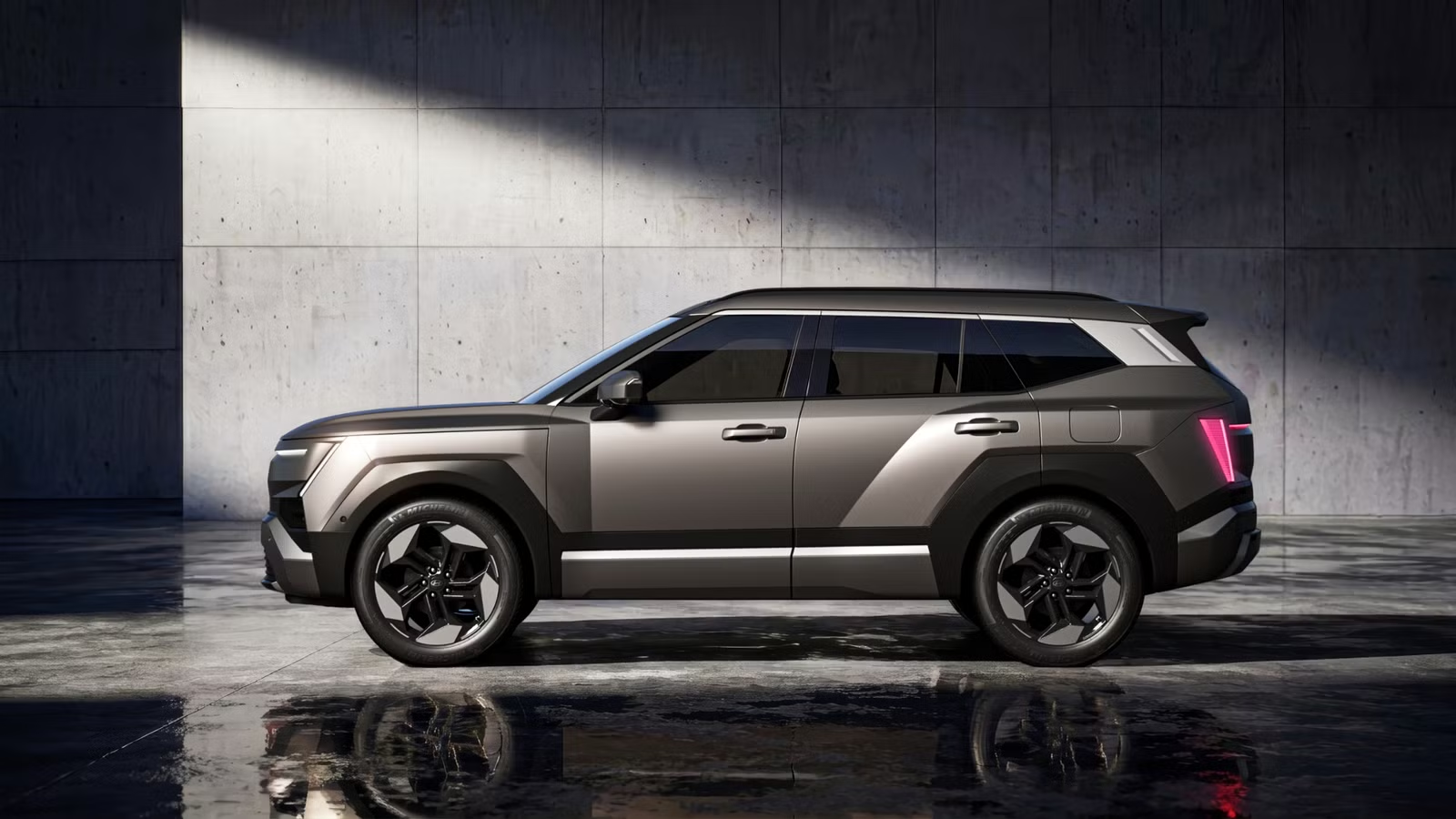
When the first-generation Tucson was introduced in 2004, it debuted as Hyundai’s chunky, entry-level SUV. However, over two decades later, the Tucson nameplate has evolved into the Korean firm’s best-selling global SUV, culminating in the fifth-generation, which represents the most luxurious iteration of the nameplate to date.

By donning sophisticated parametric styling, offering a technology-dense interior, whisper-quiet cabin acoustics, and high-end powertrain refinement, the new Hyundai Tucson blurs the lines between main-market practicality and luxury-brand sophistication.
Striking Exterior Styling And Architectural Presence
“Art of Steel” Design And Angular Silhouette
With the fifth-generation redesign, Hyundai completely abandoned the previous model’s curvy lines in favor of a bold new design language, dubbed “Art of Steel.” This new visual identity follows a mandate to completely redesign and reinvent the SUV’s appearance with each new generation rather than carrying previous details forward. As a result, the 2027 Tucson features an intensely angular, sculpted profile. Sharp body lines taper down toward the center from both front and rear fenders, adding physical dimension along the sides. Up front, an imposing clamshell hood sweeps across the nose, delivering a substantial, commanding presence on par with European luxury offerings.
Upmarket Proportion And Trim Details

The Tucson NX5 has grown overall by a couple of inches, creating a larger footprint. The fifth-generation Tucson adopts significantly more authoritative proportions, measuring roughly 185 inches in length and 75 inches in width on a longer 109.6-inch wheelbase. This represents an increase in length and width by 2.3 and 1.6 inches, respectively, compared to the outgoing model.
This extra length directly contributes to increased rear-seat legroom and an expanded cargo hold, offering up to 41.7 cubic feet behind the second row. While the height remains largely unchanged, with the exception of the XRT Pro which is equipped with an elevated 8.3-inch ground clearance, the wider body combined with a 1.1-inch longer wheelbase gives the new generation a more planted, and commanding luxury-SUV profile.
The broader, longer footprint is complemented by striking lighting details, including sharp, dramatic lighting accents that define the front profile, while intricate, prism-like taillights anchor the rear elevation. For buyers seeking a more rugged aesthetic, the new XRT Pro trim accentuates these upscale proportions with a raised ride height, aggressive approach angles, all-terrain tires, and integrated tow hooks.
A Minimalist, High-Tech Digital Sanctuary
Dual-Curved Panoramic Display

Inside, the 2027 Tucson undergoes a total digital revolution that moves it far beyond traditional compact crossover fare. The centerpiece is Hyundai’s new Android Automotive-based Pleos Connect infotainment system, anchoring a driver-centric cockpit that rivals the likes of the Tesla Model Y or BMW iX. Base models feature a generous 12.9-inch center touchscreen paired with a slim digital gauge display, while upper trims boast a massive, sweeping 17-inch curved display.
The Pleos interface adopts a Tesla-inspired layout, placing essential driver telemetry on the left while dedicating the right pane to customizable navigation, media, and vehicle settings. Operating alongside the hardware is Gleo AI (“Galileo”), Hyundai’s agentic voice assistant capable of parsing natural, multi-command queries, such as lowering windows and adjusting climate in a single breath, without digging through menus.
Ergonomic Center Console And Control Layout

To maximize open space across the front row, engineers relocated the gear selector from the floor console to a column-mounted stalk behind the steering wheel. This move opens up the center tunnel, creating a floating storage architecture complete with dedicated shelves in front of both the driver and passenger, as well as an expanded under-armrest bin.
The upper console pad houses available dual 15W Qi wireless phone chargers. Crucially, Hyundai avoided the trap of all-touch interfaces by keeping tactile, physical dials for temperature, fan speed, and audio volume directly beneath the screen, giving drivers low-distraction access to key functions on the move.
Premium Cabin Materials And Comfort Features
Luxe Upholstery And Tactile Finishes

Rather than making promises of “premium trim,” the 2027 Tucson uses specific, high-grade materials mapped logically across its trim lineup to challenge benchmark mid-size options like the Lexus NX 250 or Mazda CX-50.
Base SE trims use durable, tight-weave cloth, while the mid-level SEL upgrades to soft H-Tex synthetic leather with subtle accent piping. Top-tier Limited models introduce perforated genuine leather upholstery complete with contrast stitching along the bolster seams. Soft-touch materials cover the entire upper dashboard and door cards, while satin aluminum-look trim accents frame the air vents and floating center console.
First-Class Seating And Climate Experience

Dimensional growth directly enhances passenger comfort in the fifth-generation Tucson. Riding on a longer 109.6-inch wheelbase, rear-seat passengers gain generous legroom that easily accommodates adults over six feet tall, while rear doors now swing open nearly 90 degrees to simplify car-seat loading and entry. Cargo volume expands to 41.7 cubic feet behind the second row, comfortably outsized against competitors like the Toyota RAV4 (37.8 cu ft).
Further cementing its upscale ambitions, Hyundai incorporates heated glass technology into the windshield. Operating on a 48V power system, the invisible 20-layer metallic film generates heat directly across the glass surface to clear heavy frost or defog cabin moisture in under five minutes at temperatures as low as 64.4 degrees Fahrenheit, delivering rapid, tungsten-wire-free visibility without blowing harsh, drying air toward occupants’ faces.
Occupants on higher trims benefit from eight-way power front seats with three-stage heating and ventilation, available heated rear outboard seating, and an upgraded multi-air indirect ventilation system that diffuses airflow quietly without blowing harsh gusts directly at passengers.
Sophisticated Powertrains And Smooth Driving Dynamics
Refined Hybrid And Plug-In Hybrid Options

For the new Tucson, Hyundai has adopted a three-tier powertrain structure, comprising internal combustion, hybrid, and plug-in hybrid options. The gas-powered Tucson employs a 1.6-liter turbocharged inline-four, delivering 184 horsepower, available with a quartet of transmission choices: six-speed manual, seven-speed dual-clutch, eight-speed and six-speed automatic. Hyundai refined its electrified powertrain lineup for the fifth generation.
The pure-gas 2.5-liter engine has been phased out in favor of an all-turbocharged lineup centered around an upgraded 1.6-liter turbocharged four-cylinder hybrid system, paired with a 1.49 kWh battery and a six-speed automatic transmission. Total system output for the Tucson Hybrid rises to 233 horsepower, paired with enhanced regenerative braking designed to recover energy more efficiently under deceleration.
Front-wheel-drive hybrid models target an estimated 42 MPG combined. Hybrid models also introduce “Stay Mode,” a feature that leverages the high-voltage hybrid battery to power the vehicle’s climate control, Pleos display, and audio system while parked, allowing occupants to sit comfortably without idling the combustion engine. The all-new Tucson Plug-in Hybrid is equipped with a larger 17.1 kWh capacity pack and the brand’s HTRAC all-wheel-drive system. Combined power is rated at 288 horsepower.

The new Tucson underpins its powertrain upgrades with an upgraded chassis architecture. Standard hybrid trims feature Hyundai’s electronic HTRAC All-Wheel Drive, which monitors wheel slippage and throttle input to actively vector torque between front and rear axles.
The fifth-generation 2027 Hyundai Tucson marks a decisive departure from traditional compact crossover conventions. By abandoning its predecessor’s rounded styling in favor of the bold “Art of Steel” design language, expanding its exterior footprint, and introducing high-end technology like the 17-inch Pleos Connect display and Gleo AI assistant, Hyundai has created an SUV that punches far above its price bracket.
Sources: Hyundai, Edmunds

Related posts

Latest Post


No Comments