
Why Harley And Indian Riders Over 60 Refuse To Trade Their 900-Pound Baggers For A Gold Wing
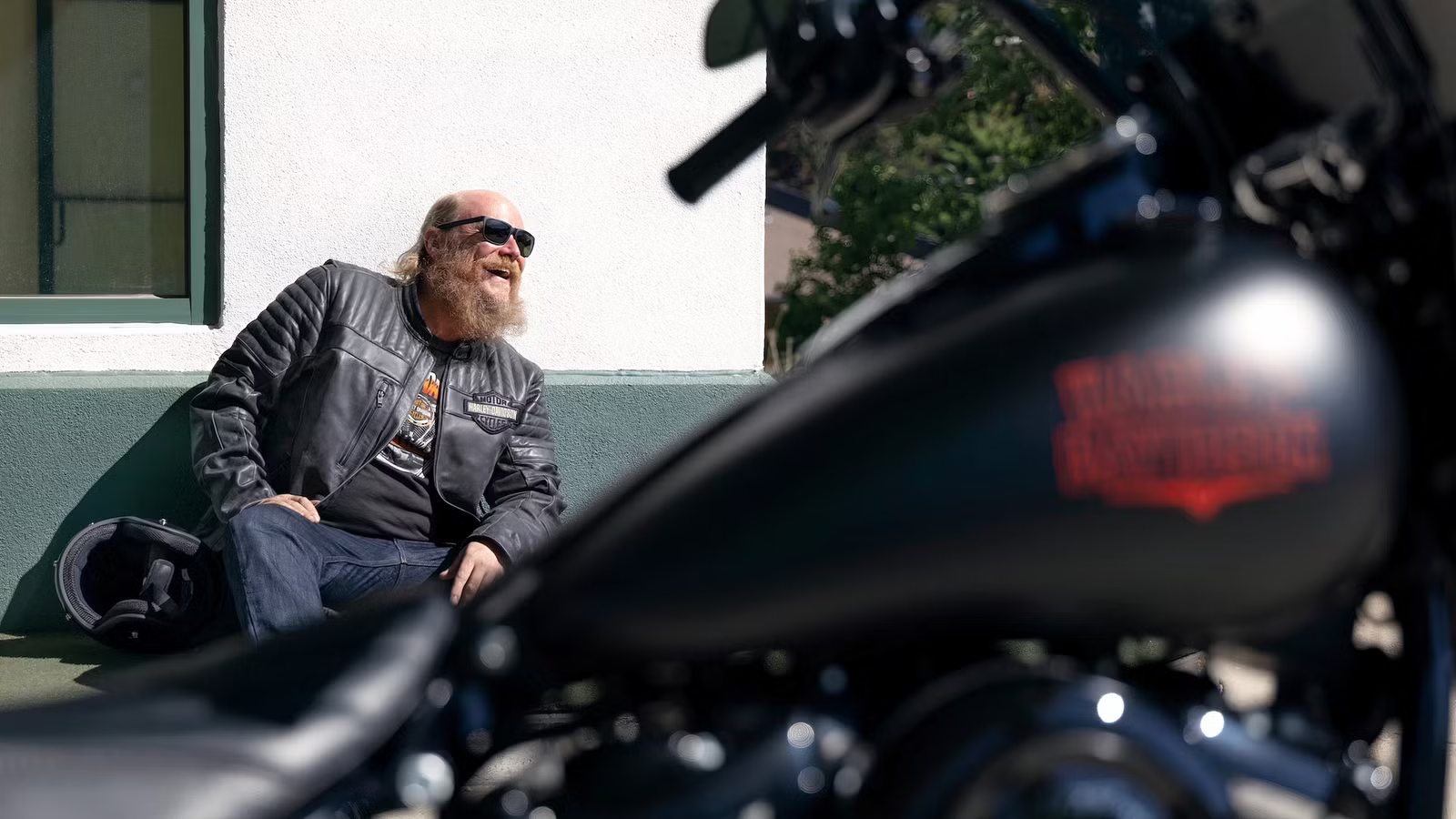
Old age is a lot like an old bike. It’s not at its strongest or finest, well past its prime, and asking it to do everything it did when it was new is asking for trouble. Yet, the love for motorcycles survives the years. It just has to evolve to keep being enjoyed. Later years are also the age when the charm of the open road and genuine exploration matters more than a quick commute or a canyon run, and that’s precisely what a big touring bike is built for.

But that comfort comes at a cost. These machines run anywhere from around 800 pounds to north of 900, and for a lot of riders, that weight, coupled with the allure and nostalgia of a roaring V-twin, is intertwined with their identity, and letting go of one seems like surrendering a piece of their youth. For others, it simply becomes too much weight to carry, both figuratively and literally.
What Sixty-Plus Riders Actually Lose Past Their Prime Riding Years
Riding techniques like canyon riding and even ones employed during general commutes hold up remarkably well with age. Reading traffic, judging a corner, and anticipating what a car three lengths ahead is about to do, all get better with decades in the saddle. That’s the benefit of experience. What declines is the raw physical strength that one enjoyed in the past decades. Muscle mass drops steadily past 60, grip strength goes with it, and reaction times slow down to a degree that no amount of seat time can reverse.


These factors don’t quite matter as much on an open highway, as there’s time to react to a situation ahead, traffic behavior can be predicted, and an experienced rider is more adept at gauging risks as well as avoiding or preparing for them beforehand. Plus, momentum and gyroscopic effects do most of the actual work of holding a motorcycle upright at speed. Where the factors matter enormously is in the rider’s ability to handle slow-speed situations like a parking lot, a stoplight, or crawling stop-and-go traffic — places where a hefty bike will not fail to make a rider aware of its enormity. And age, unfortunately, doesn’t make things any easier with these bikes.

And no amount of comfort features can fix it. A touring bike can boast of the most tech, like heated seats, a premium stereo, acres of luggage space, and enough electronics to rival a small car, but none of it makes the bike lighter or balance itself. And yet, thousands of riders in their 60s and 70s keep choosing the Electra Glide Standard and Indian Roadmaster over bikes specifically engineered to solve these problems — and they’re paying a real price for that loyalty.
The Harley-Davidson Electra Glide Standard And Indian Roadmaster Ask Owners To Carry The Cost Of Loyalty

The Harley-Davidson Electra Glide Standard and the Indian Roadmaster are the two machines riders in this cohort actually own. Harley discontinued the Electra Glide Standard after the 2022 model year, yet plenty of riders are still logging highway miles on it. At 820 pounds in running order, and priced from $19,429 when new, the Electra Glide is a rolling piece of motorcycling nostalgia. The Roadmaster remains in Indian’s current lineup at a heftier 919 pounds and $34,999, a full-dress tourer built around comfort.
Harley Stripped The Electra Glide Down To Essentials — And Priced It $8,000 Below The Street Glide Special

The Electra Glide Standard was Harley addressing the customer who didn’t want a Street Glide Special’s price or its loaded infotainment package. It ran a Milwaukee-Eight 107 V-twin and was wrapped in the classic batwing fairing, with hard bags holding just over 17 gallons of storage. It did still get features like cruise control and standard ABS layered onto the essentials. Harley’s own marketing described it as a bike for a rider who wanted to disconnect from the noise of the day-to-day, and at its price and weight, it undercut the Street Glide Special by $8,000.
Every Luxury Feature Indian Added Comes At A Cost Measured In Pounds

The Roadmaster is a feature-loaded tourer far from being stripped down. It’s powered by the 116 cubic inch Thunderstroke V-twin, has a full trunk and saddlebag setup, and boasts a 200-watt audio system built into the fairing. Indian’s Pursuit, a separate flagship tourer that sits above the Roadmaster in the current lineup, tops out at 937 pounds with the larger of its two engine options.
This extra weight buys even more full-dress comfort with more storage, a bigger fairing, and a passenger experience rivaled by none. It also means every rider who chooses either of the Indian models over something smaller is managing close to a thousand pounds with their hands and legs alone at anything under walking speed. So what does a machine actually engineered around aging riders offer that these two can’t — and why doesn’t it seem to matter?
The Gold Wing Solves Every Physical Complaint That Traditional Baggers Can’t

The Gold Wing Tour with the Automatic DCT starts at $30,500 and weighs 847 pounds, not dramatically lighter than the Roadmaster and heavier than the Electra Glide Standard. But it’s the way that weight is distributed that makes a difference against both rivals. A flat-six engine mounted low and a double-wishbone front end keep the center of mass closer to the ground instead of stacked up high in a traditional fork and upright cylinder arrangement. This makes the Gold Wing balance significantly better than a top-heavy alternative.

Then again, it’s still a heavy bike at walking pace, and Honda has thought that through. The Gold Wing Tour’s seven-speed DCT removes the clutch and shift lever entirely, and Walking Mode lets the bike creep forward or backward under its own power at a crawl. These two technologies, combined, take away additional input that a rider is already overwhelmed and trying to avoid a drop he does not need. And an aging body fatigues quickly from muscling a big V-twin even for a few moments of maneuvering.
The Numbers Don’t Lie: Big Bagger Loyalists Are Aging Out Faster Than New Riders Are Buying In

Harley-Davidson sold 132,535 motorcycles worldwide in 2025, down 12.4 percent from the year before, and Touring took the hardest hit of the categories the company sells. That’s a hard number for the segment, which lost ground faster than the rest of the lineup. The company also retired the Ultra Limited brand entirely for the 2026 model year, folding what remained of its full-dress touring range into two new models, the Street Glide Limited and Road Glide Limited. A brand name that carried Harley’s flagship touring buyer for years got retired for the simple reason that the number of riders willing to buy into the loyalty proposition got too small to justify.

Indian’s parent company, Polaris, faced a similar reckoning. Its own SEC filings put Indian Motorcycle’s trailing twelve-month revenue at $478 million through June 2025 and $467 million through September, a decline in a single quarter. The broader picture was worse as touring motorcycle sales on the whole fell 13 percent industry-wide in 2025, according to the Motorcycle Industry Council. By the fourth quarter, Indian’s own North America unit retail sales were down high-single digits. Polaris took $330.4 million in impairment charges for 2025 tied directly to classifying Indian as held for sale, then sold a majority stake to the private equity firm Carolwood LP in a deal that closed in February 2026.
Why Both Riders Are Still Making The Right Call

The rider who bought into the V-twin experience decades ago, who knows exactly what wrestling 800 or 900 pounds costs, is making a fully informed decision, just with a body that now demands more convenience for the task. The Gold Wing owner is making an equally intentional choice by swapping mechanical tradition for one that does part of the work and in turn buys them another decade or two of riding on easier terms.

Trikes are a great middle ground for aging motorcyclists and those riding with a passenger. But the sales numbers for the overall touring segment simply confirm that its core demographic keeps aging into its 60s and 70s every year, with no wave of new 25-year-olds buying full-dress tourers to reverse the trend. That makes this the shape of the touring market for the foreseeable future, more than a temporary dip — one that will keep defining which bikes actually get ridden versus the ones that get parked as the clock ticks away.
Source: Harley-Davidson, Indian Motorcycle, Honda Powersports

Related posts


Latest Post


No Comments