
Hyundai’s All-New TUCSON Combines Bold Design, 42-MPG Hybrid, And AI Smarts
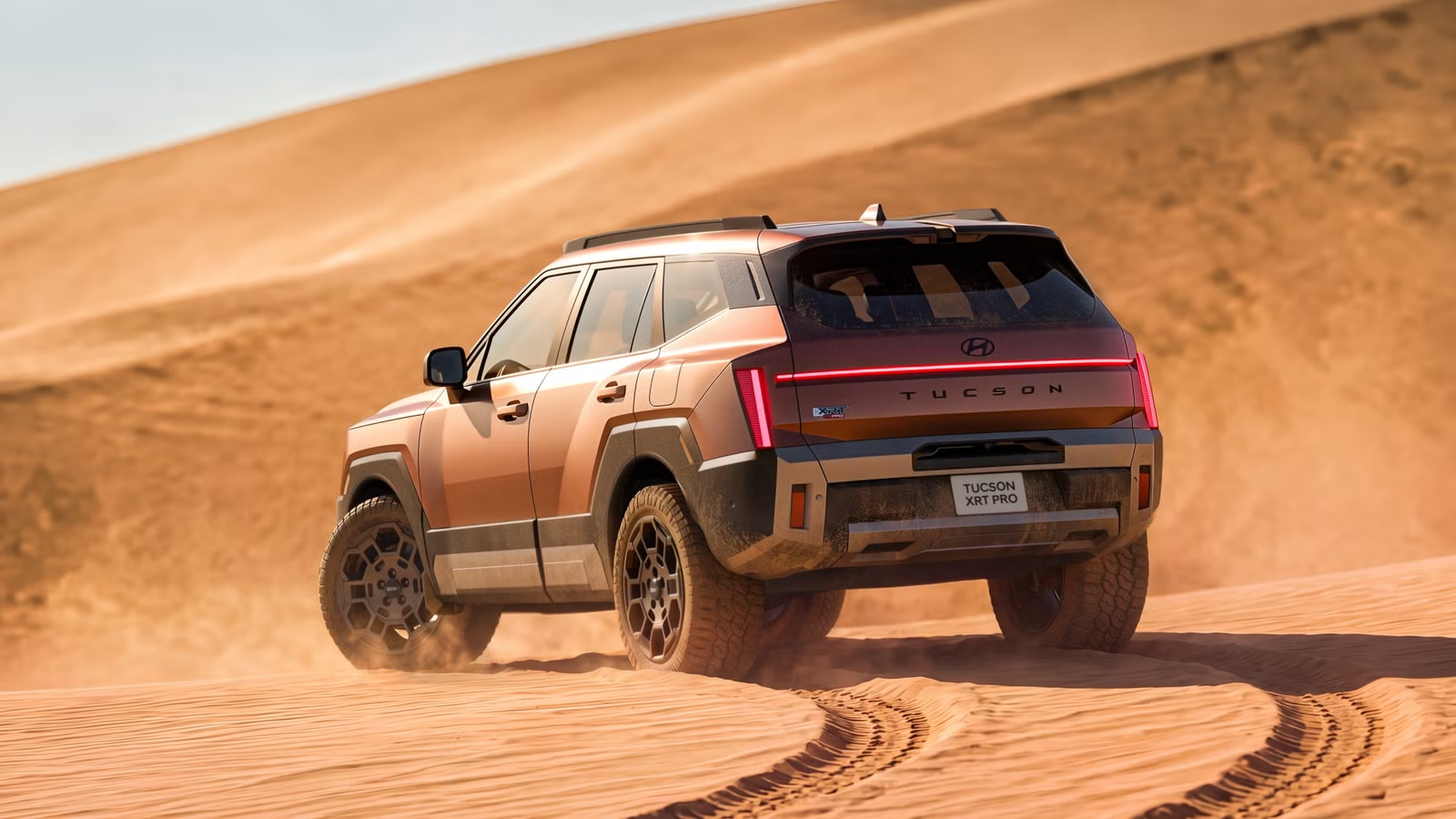
Hyundai pulled the wraps off the all-new TUCSON on October 1, staging the reveal against the Manhattan skyline to make its point: the world’s best-selling compact SUV just got a top-to-bottom overhaul. The redesign leans on three pillars Hyundai is calling the core of the car’s identity — a muscular new “Art of Steel” design language, a next-generation hybrid system targeting up to 42 mpg, and a Pleos Connect infotainment suite built around an AI assistant named Gleo.

The lineup also adds a rugged XRT PRO trim with Hyundai’s first Smart Terrain Assist system, a feature aimed at buyers who want their compact SUV to actually leave the pavement. Hyundai says the all-new TUCSON will reach Korea later this year, with North America and Europe following in 2027 — meaning this reveal is really the opening chapter for a redesign that won’t hit U.S. driveways for more than a year.
The Art Of Steel Design Makes The TUCSON Bigger In Every Direction
Hyundai’s “Art of Steel” design philosophy is built around pronounced, muscular fenders meant to show off the tension in the sheet metal, balanced against flatter door surfaces and crisper body lines. The long-wheelbase model grows in every dimension that matters: 4,700 mm long (+60 mm), 1,905 mm wide (+40 mm), and 1,685 mm tall (+20 mm) compared to the outgoing TUCSON. Hyundai says the width gain is the largest in the segment.

Up front, H-Edge lighting blends indirect center lighting with edge lighting to widen the TUCSON’s visual stance, while the rear gets sculptural Prism Rear Lamps designed to look like light caught inside a transparent lens. An available Micro Pixel Lighting system packs 25,600 individual LED pixels for precision beam patterns and animated welcome sequences. Door opening angles also grow from 73 to 83 degrees, which should make loading kids and cargo easier in tight parking spots.
A Cabin Built Around Furniture-Inspired Comfort
Inside, Hyundai is pitching the TUCSON’s cabin less like a cockpit and more like a living room. A two-layered instrument panel separates a clean upper display area from a deep open tray below for storage, and soft cushioning runs across the dash, doors, and console armrest. A Double D-Cut steering wheel pairs with a 9.9-inch driver display, while physical buttons remain for HVAC and audio controls so drivers aren’t forced to tap through menus.
Comfort options get serious upgrades too: dual 15W wireless charging pads, an available Ergo Motion seat with a seven-cell pneumatic massage system, and a Relaxation Comfort Seat that reclines to 10 degrees at the push of a button when parked. An available three-zone climate system lets front and rear passengers set their own temperatures, and heated glass can fully de-ice the windshield in 15 minutes while rejecting 60% of solar heat in summer.
The Hybrid System Chases 42 MPG Without Giving Up Pace
Hyundai’s next-generation hybrid powertrain is the mechanical centerpiece of the redesign. It targets up to 42 mpg while still hitting 0-60 mph in 8.5 seconds, a combination Hyundai frames around what it calls “Intelligent Efficiency.” An E-Traction system exclusive to hybrid models manages torque to individual wheels to cut slip in corners, and a class-leading HEV Stay Mode lets the air conditioning, heat, audio, and device charging keep running with the engine off — useful for tailgates or waiting around with kids in the back seat.
Buyers who want more power can opt for the 1.6T-GDI gas engine making 184 hp paired with an eight-speed automatic. A plug-in hybrid variant pairs a turbocharged 1.6-liter engine with an electric motor for a combined 292 ps and an estimated 81 km (about 50 miles) of all-electric range, enough for most commutes to run on battery alone. A 7.2 kW onboard charger speeds up home or public charging. In North America, hybrid models now tow up to 3,000 pounds, a 1,000-pound jump over the outgoing TUCSON.
Pleos Connect And Gleo AI Replace Menu-Diving With Conversation
The TUCSON’s new infotainment system, Pleos Connect, runs on Android Automotive OS and pairs a 17-inch or 12.9-inch touchscreen with that 9.9-inch driver display. Three-finger gesture controls and an expansive single-screen mode are meant to cut down on distraction behind the wheel.
The bigger shift is Gleo AI, an in-vehicle assistant built to handle natural conversation rather than rigid voice commands. Hyundai’s own example: a driver can simply ask to “find a hiking trailhead with parking within 30 minutes,” and the system pulls relevant results without requiring a trip through submenus. Because Pleos Connect is built on Android Automotive OS, it supports native third-party apps for entertainment and productivity without needing a phone plugged in, and the whole system updates over the air.
XRT PRO Brings Smart Terrain Assist To A Compact SUV
Hyundai is splitting off-road ambitions into two trims. The TUCSON XRT gets wide fascia-extending cladding, forged-carbon-inspired wheel arch accents, and a bolder bumper and skid-plate design for visual toughness. The XRT PRO goes further with all-wheel drive, all-terrain tires, front recovery hooks, and ground clearance raised to 210 mm, a 30 mm jump over the standard model.
The headline feature is Smart Terrain Assist, Hyundai’s first system of its kind, which reads traction and slip conditions in real time and displays a green, orange, or red “stuck score” to tell the driver how difficult the terrain ahead actually is. Target Speed Control handles acceleration and braking automatically between 2 and 25 km/h so drivers can focus purely on steering over rough ground. A Ground View Monitor adds a transparent view of the terrain in front of and beneath the vehicle, while Trailer Reverse Assist handles steering alignment when backing up with a trailer attached.
What’s Next For The TUCSON Nameplate

Since its 2004 debut, the TUCSON has sold more than 11.1 million units globally, and the U.S. alone accounts for roughly 20% of that total. Hybrid demand has been climbing fast stateside — hybrid TUCSON models made up 31% of U.S. sales in 2025, a number that explains why Hyundai is leaning so heavily on the new hybrid system for this redesign.
A sport-inspired TUCSON variant is set to debut at the Paris Motor Show on October 12, adding another configuration to the lineup before cars reach customers. Korea gets the all-new TUCSON first, later this year, with North America and Europe following in 2027 — a long runway that gives Hyundai time to roll out the XRT PRO, PHEV, and sport variants in sequence rather than all at once.

Related posts

Latest Post


No Comments