
Ford’s 550-HP Flop Finds Redemption 20 Years Later As Values Soar
In the early 2000s, Ford transitioned from its reputation of creating archaic performance cars and mundane sedans to more luxurious and aspirational models. The company expanded its Premier Automotive Group, aggregating foreign luxury marques to capture high-margin segments. At the same time, regional divisions operated with significant autonomy, designing localized offerings for distinct global markets.

Ford’s new decentralized model created redundant engineering costs, operational complexity, and fragmented platforms. Mounting financial pressure forced a mid-decade strategic pivot. Ford initiated divestitures of non-core luxury assets and unified global operations under a single plan. This transition emphasized standardized global architectures, shared components, and streamlined development to maximize scale.
Ford’s Revolutionary Engine Developments In The Early 2000s
During this era, Ford focused on modularity, international engineering joint ventures, and transitioning toward downsizing. Heavy reliance remained on the established overhead-cam V-8 architecture, utilizing flexible manufacturing tooling across multiple truck and performance applications. Simultaneously, the manufacturer expanded cross-brand development efforts. Global subsidiary relationships enabled the sharing of aluminum four-cylinder and double-overhead-cam designs, establishing standardized core propulsion units for high-volume global passenger vehicles.

Increasing regulatory requirements for reduced emissions and improved fuel economy accelerated a fundamental shift in technical strategy late in the decade. Engineers prioritized forced induction, direct petrol injection, and variable camshaft timing over larger naturally aspirated displacements. Replacing displacement with forced induction allowed smaller four-cylinder and six-cylinder platforms to generate the output of historical V-8 options while reducing engine weight and parasitic power losses. This developmental direction produced a scalable, turbocharged architecture that consolidated power delivery options, successfully bridging traditional large-capacity performance requirements with modern efficiency standards across global markets.
The 2005 Ford GT Pays Tribute To The Original GT40

Ford introduced the 2004 GT to celebrate the manufacturer’s centennial anniversary and showcase modern supercar engineering. The project resurrected the legendary spirit of the 1960s GT40, which famously secured four consecutive overall victories at the 24 Hours of Le Mans. The 2022 Ford GT succeeds this design principle.
Stylistically and structurally, the vehicle directly honors its historic predecessor. Designers retained the original low-slung profile, signature door cutouts extending into the roof, and unmistakable mid-engine proportions. However, engineers updated the package with modern lightweight aluminum chassis construction, supercharged performance, and advanced aerodynamics.
Production ran across three model years, spanning from 2004 through 2006. Over this total timeframe, Ford manufactured 4,038 units at specialized assembly facilities in Michigan. When sales officially commenced for the 2005 model year run, the vehicle carried an initial base MSRP of $139,995.
Used Examples Are Skyrocketing In Value

The 2004 to 2006 Ford GT experienced rapid value appreciation. Depreciation was short-lived; secondary market prices swiftly surpassed original MSRPs as collectors recognized the vehicle’s significance as a manual, supercharged analogue supercar. Over two decades, values transitioned from modest appreciation to record-setting collector tiers.
By 2026, baseline market values for standard production models range between $500,000 and $750,000, depending on mileage, condition, and factory options. Rare variants, particularly the 2006 Heritage Edition featuring Gulf livery, routinely command over $1,100,000 at top-tier auctions. Real-world sales demonstrate this trajectory. In March 2026, an original-owner 2005 model brought $545,000 on Bring-a-Trailer.
A low-mileage 2006 Tungsten Grey example fetched $735,000 at auction in July 2026, while a 2005 Centennial White unit achieved $815,000 in October 2026. Even high-mileage examples exhibit extraordinary value retention; a heavily driven 2005 model showing over 45,000 miles surpassed $500,000.
The GT’s Bespoke Supercharged V-8

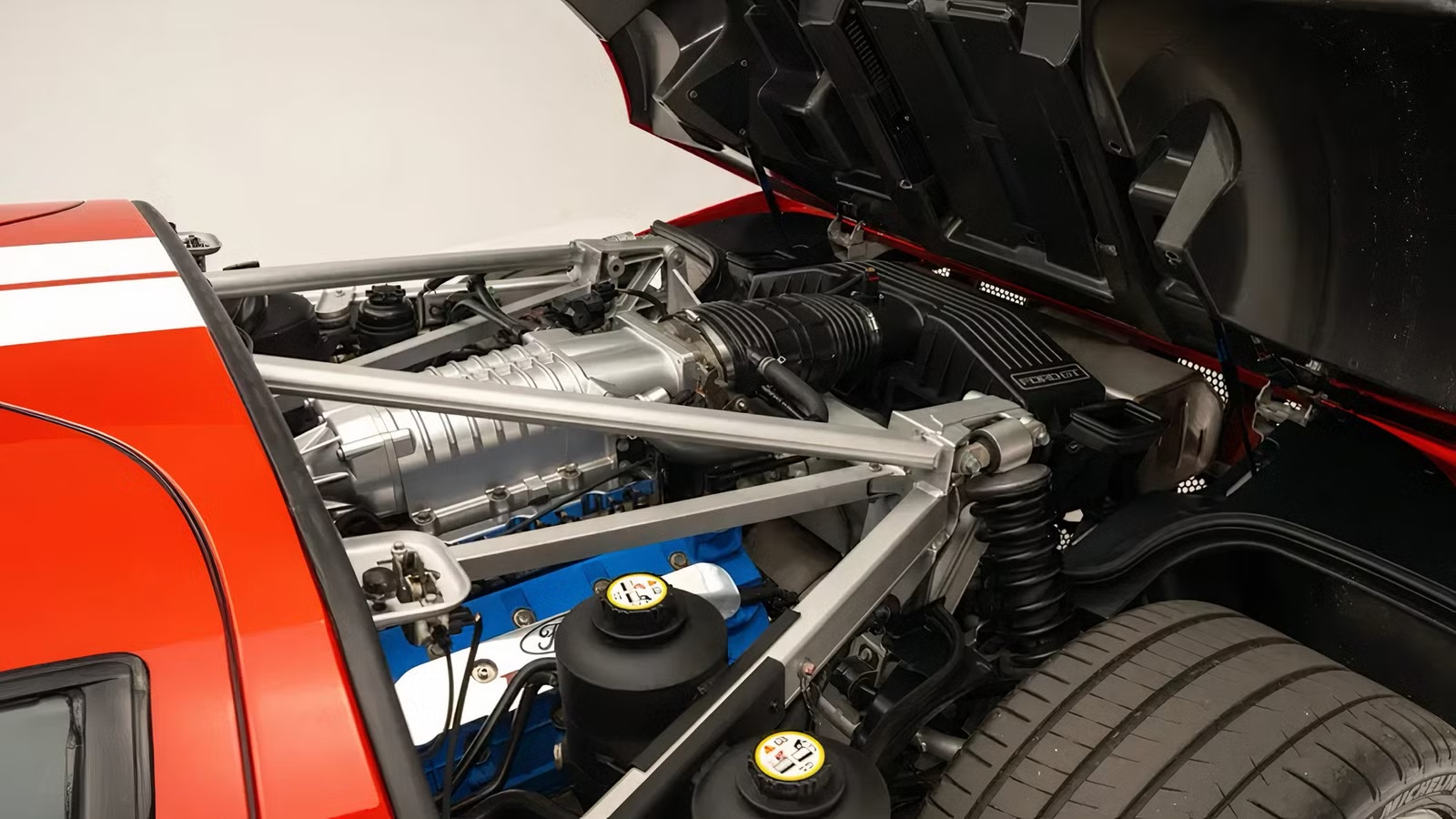
At the heart of the 2004 vehicle lies a mid-mounted, all-aluminum 5.4-liter supercharged V-8 engine featuring double overhead camshafts and four valves per cylinder. Boosted by an Eaton screw-type supercharger with an air-to-liquid intercooler, the powerplant produces 550 horsepower at 6,500 RPM and 500 pound-feet of torque at 3,750 RPM. Power routes exclusively to the rear wheels through a Ricardo six-speed manual transaxle equipped with a helical limited-slip differential, ensuring precise manual gear engagement and optimal torque delivery.
It does 0-60 MPH in approximately 3.3 seconds, and a quarter-mile in 11.2 seconds, crossing the line at speeds exceeding 130 MPH. Driven to its absolute limits, the supercar achieves a verified top speed of 205 MPH.
Ford’s Handbuilt Mid-Mounted Engine

Engineers crafted the 5.4-liter block from high-strength A356-T6 aluminum, incorporating cast-iron cylinder liners to endure extreme combustion pressures. A forged-steel crankshaft, held by six-bolt main bearing caps, underpins the reciprocating assembly. Connected to the crank are forged-steel H-beam rods attached to forged aluminum pistons, establishing a robust bottom end built for forced induction.
The cylinder heads feature cross-bolted main caps, four valves per cylinder, and dual overhead camshafts per bank, optimizing high-RPM airflow. High-flow fuel injectors and a dual-fuel-pump system ensure consistent delivery under full boost. A dry-sump oiling system prevents starvation during aggressive cornering while permitting low engine placement within the space frame.
A Space Frame Chassis Provides Supercar Performance

Ford constructed the platform around an all-aluminum space frame featuring extruded aluminum tubing, roll-formed frame rails, and friction-stir welded center tunnel sections. This advanced architecture provided immense torsional rigidity while minimizing overall vehicle mass. The super-plastic-formed aluminum body panels and a lightweight carbon-fiber inner engine cover further reduced weight while preserving structural integrity.
The suspension system utilizes independent double-wishbones at all four corners, utilizing cast-aluminum control arms and uprights to minimize unsprung mass. Monotube coil-over shock absorbers and hollow anti-roll bars control body roll and balance wheel movements across varying road surfaces. The front suspension incorporates an unequal-length A-arm setup designed to maintain optimum tire contact patches under heavy cornering loads, while the rear multi-link double-wishbone configuration maintains stability during severe acceleration and braking.
Braking performance relies on cross-drilled and ventilated Brembo four-piston monoblock calipers gripping large rotors at each hub. Wrapped around custom forged-aluminum wheels, Goodyear Eagle F1 Supercar tires deliver superior lateral grip and power transfer. This track-focused chassis geometry, combined with low roll centers and precise rack-and-pinion steering, yields predictable handling characteristics, immediate directional response, and exceptional high-speed balance across diverse driving environments.
The American Supercar Had Its Fair Share Of Problems

Despite its exceptional engineering, the 2004 to 2006 Ford GT suffered early production quality issues and recurring owner headaches. The most infamous early flaw involved the suspension control arms. Defects in the original semi-solid aluminum casting process left the arms susceptible to cracking under stress, prompting an immediate “do not drive” safety recall for early 2005 models until dealers retrofitted forged replacement components.
Engineers also struggled with oil leaks originating from the rear crankshaft main seal, requiring complex labor to rectify. Electrical glitches frequently plagued the interior. Gauge clusters regularly failed, giving erratic readings or dying completely due to faulty circuit boards. Additionally, factory paint imperfections, such as flaking or clear-coat blisters on aluminum body panels, frustrated meticulous collectors.
Mechanically, the transaxle shift cables were prone to binding, making gear engagement difficult under hard driving. The tight cabin ergonomics presented functional challenges, as the wide door tops extended deep into the roofline, making tight parking spaces and garage exits notoriously difficult. Like many mid-2000s performance cars, the GT was also caught in global Takata airbag inflator recalls. Despite these initial setbacks, strong aftermarket support and dealer campaigns resolved most mechanical issues over time.
Sources: Ford, Kelley Blue Book, Hagerty, Bring a Trailer, and J.D. Power.

Related posts






Latest Post



No Comments