
Hyundai Veloster N Used Prices Drop to $19K: Sleeper Buy Alert
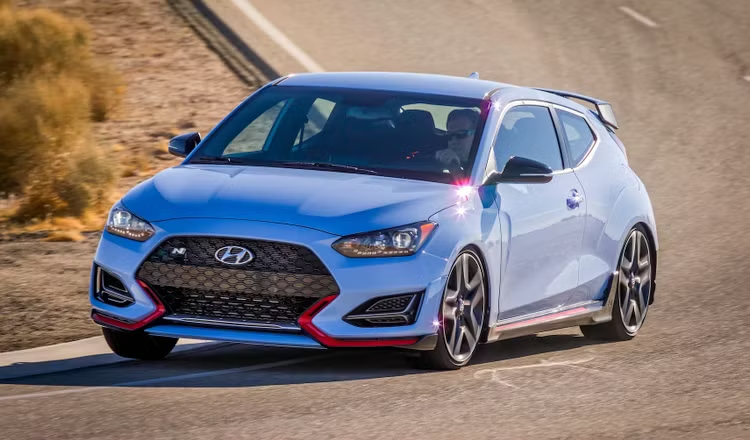
A used Veloster N now costs less than a new Toyota Corolla. That sentence would have sounded absurd when Hyundai launched its performance sub-brand, but CarBuzz‘s current market data puts 2019–2020 Veloster N examples at around $19,000—sometimes below that threshold—while new Corollas start north of $22,000. For buyers who’ve been eyeing the hot hatch segment but couldn’t stomach Type R or Golf R money, that gap has officially become too wide to ignore.

The Elantra N and Kona N tell a similar story. A 2022 Elantra N, which originally stickered at $32,150, now averages around $26,200 in the used market, with high-mileage examples dipping below $20,000. Kona N supply is thinner, but 2022 examples are trading in the high teens to low $20s. Meanwhile, a same-year Civic Type R averages roughly $39,600 and a 2019 Golf R runs about $29,200. That’s a $10,000-to-$13,000 spread between cars that were genuinely competitive at launch—and the Hyundai is the one that depreciated.
What You’re Actually Getting For The Money
The Veloster N wasn’t a budget hot hatch wearing performance clothes. Hyundai built the original i30 N—the platform underpinning the N lineup—with more than 100,000 miles of public road durability testing, plus mandatory stints on the Nürburgring Nordschleife, where one kilometer of track driving replicates five to twenty kilometers of open-road wear. The Kona N alone completed 489 laps of the Nordschleife, totaling over 10,000 kilometers, before it reached dealers.

The 2019 Veloster N launched at $26,900 with a turbocharged 2.0-liter four making up to 275 horsepower in Performance Pack trim. By 2021, Hyundai added an optional eight-speed wet dual-clutch transmission. The Elantra N followed for 2022 with 276 hp and 289 lb-ft of torque, an electronically controlled limited-slip differential, adaptive dampers, and N Grin Shift—a mode that temporarily spikes boost pressure for 20 seconds. The Kona N matched those numbers in a crossover body. None of these were stripped-down economy cars with a sporty badge. They were engineered seriously, and by 2021 Hyundai had sold more than 54,000 i30 N units worldwide to prove the market agreed.
The Durability Evidence That Makes This Buy Credible

MotorTrend ran a 2019 Veloster N through a two-year long-term test, the kind of extended evaluation that exposes patterns other reviews miss. The engine required no unscheduled maintenance. The interior held up impressively. More striking: the car’s 0-60 mph time actually improved from 5.4 to 5.3 seconds over the test period, suggesting the engine loosened up rather than degraded. There were minor issues—a clogged climate control evaporator drain and a one-off ECU reflash—but nothing that amounted to a mechanical failure.
That’s a meaningful data point for used buyers, and it tracks with what the broader N history shows. No pattern of catastrophic engine failures has emerged as mileage climbs on these cars. That doesn’t mean every example is trouble-free, and it’s still too early to call an Elantra N a guaranteed 150,000-mile car—the model simply hasn’t been on the road long enough to generate that evidence. But where data exists, it points in the right direction.
Two Recalls Every Buyer Needs To Check Before Signing

The N lineup’s used-market appeal comes with two recalls that aren’t dealbreakers but are non-negotiable due diligence. NHTSA campaign #22V-746 covers 2021–2022 Veloster Ns, certain 2022 Elantra Ns, and 2022 Kona Ns. The issue involves the eight-speed DCT’s high-pressure electric oil pump, which could cause the transmission to disengage its clutches and cut drive power. The remedy is transmission inspection, replacement if necessary, and a transmission control software update.
The second recall, #24V-528, is broader: it covers 2019–2022 Veloster Ns, 2022–2023 Elantra Ns, and 2022–2023 Kona Ns. Wear in the high-pressure fuel pump’s fuel control valve could allow excess fuel into the pump, causing rough running or a loss of power. The fix involves an engine control software update and fuel pump inspection or replacement. Run the VIN through NHTSA’s recall database before any purchase, and confirm a previous owner completed the applicable work. Both recalls are fixable—neither should kill the deal on a well-maintained example, but skipping the check would be a mistake.
The Honest Caveat Before You Start Searching Listings

Price alone doesn’t make a used performance car a good buy. N models that have seen track days, aggressive tunes, or deferred maintenance carry real risk that the sticker won’t reflect. The wet DCT in particular rewards proper fluid changes; neglect it and the repair cost can erase the savings that made the car attractive in the first place. Accident history and modified engines are the other flags to screen for—standard used-car homework, but more consequential here than on a grocery-getter.
The Civic Type R remains the front-wheel-drive benchmark for a reason, and the Golf R still offers all-wheel-drive traction and a more refined daily personality. Neither has fallen in value the way the N cars have, which is exactly the point. For buyers entering the used market rather than exiting it, Hyundai’s softer residuals are the advantage. The window may not stay open—supply of clean, low-mileage N examples is still thin, and prices that soft tend to firm up as awareness grows. Gearheads who’ve been waiting for the right moment to get into a genuine hot hatch for economy-car money are looking at it right now.

Related posts





Latest Post


No Comments