
How the K5 Blazer’s Origins Shaped Every Chevy Tahoe
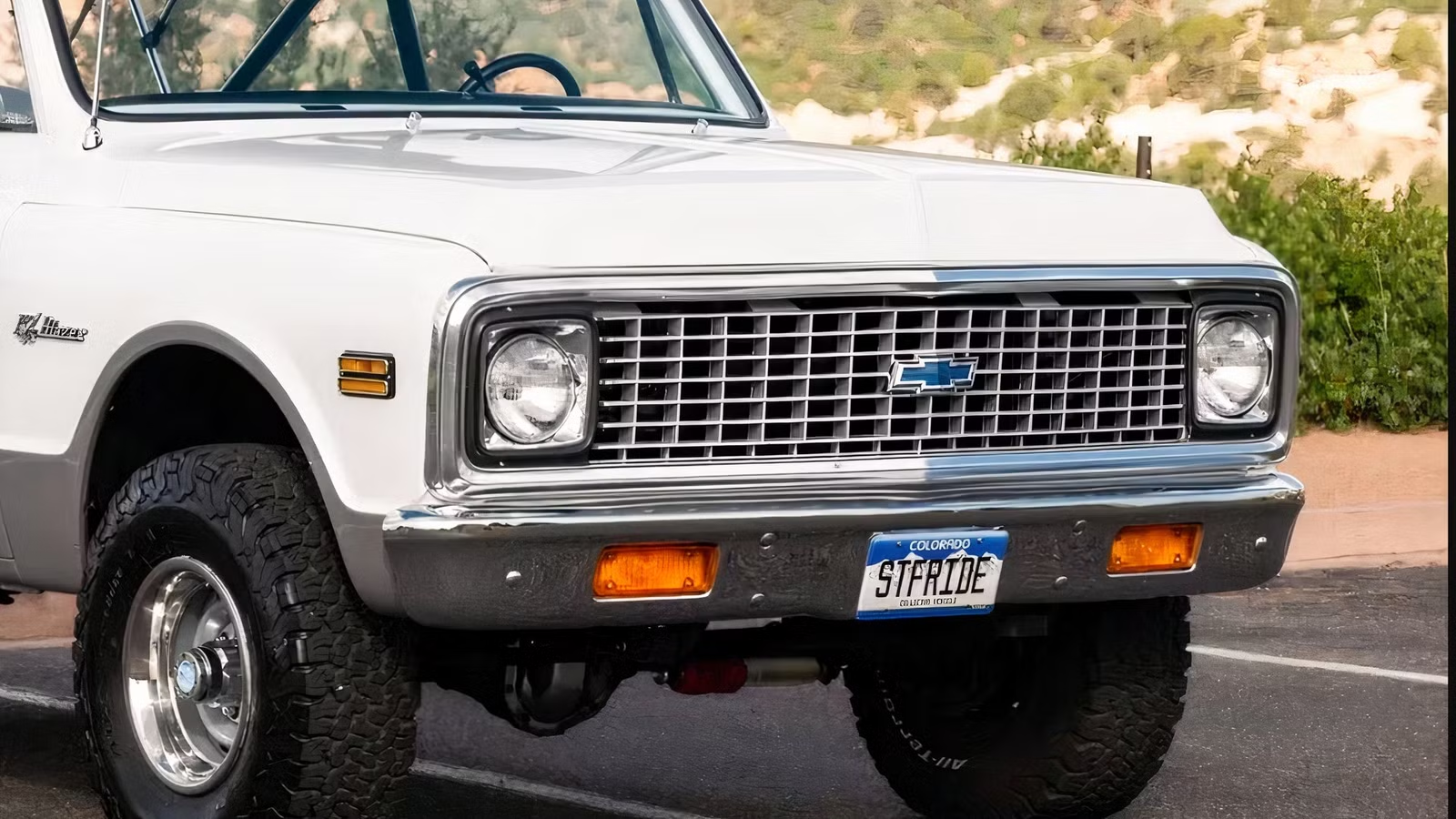
General Motors has sold more Chevy Tahoes and associated derivatives over the years than just about any other vehicle in the lineup. Its rock-solid combination of a truck-based full-size platform with the option of big V8 power is so potent, it’s like a siren’s call to anyone who wants a family hauler with some real grunt under the hood. Still, make no mistake, the Tahoe wasn’t the first Chevy SUV to rock a relatively short wheelbase, a V8, and family hauling potential. Almost 60 years ago at the time of writing this, the Tahoe’s formula was already being set in stone. Except, it was under a different name entirely.
The 60s and 70s: A Renaissance for SUVs as Well as Muscle Cars

Let’s paint the scene for you. It’s the mid-to-late 1960s, LBJ’s the president, the Beatles are all the rage, Elvis has traded live concerts for Hollywood, and right alongside the emerging muscle car wars, Detroit’s Big 3 and an assortment of smaller automakers are doubling down on 4×4 SUVs for the first time ever. International Harvester was the first to the party, offering the Travelall two-door SUV on the same chassis as its pickup trucks. Then, in 1966, Ford entered the fray with the timeless classic Bronco. Though not on a dedicated truck chassis like the rest of the competition.
Instead, the Bronco was based upon a bespoke 92-inch wheelbase platform aimed squarely at the insanely popular Jeep CJ-5 platform. A platform, mind you, that wouldn’t fall under Chrysler ownership for at least another two decades. Meanwhile, Chrysler and Dodge themselves were fairly late to the game, offering the D-100-based Ramcharger, complete with its iconic hood ornament, beginning in 1974. On their own, these three offerings represented the US auto industry’s first real attempt at offering turnkey off-roaders that didn’t require much modification to navigate trails with considerable skill.
That just left General Motors to cover, and in the late 1960s, the company could’ve chosen any number of options to fill that niche. The ever-present Suburban was around and going strong, but its commanding 127-inch wheelbase and heavy weight would’ve made it awkward and unwieldy out on the rocks and in rough terrain. They could’ve built a new, bespoke compact chassis, just like Ford, but preferred to invest its money elsewhere. In the end, that really left all but one option to give Chevrolet and GMC their first proper consumer-grade off-roader. What they came up with reflected equal parts engineering ingenuity and a degree of opportunistic pragmatism.

The C/K Half-Ton Pickup: GM’s Shortcut to a Hot Shot SUV

General Motors was arguably more successful and profitable than at any point previously, but that didn’t mean it could just throw money around indiscriminately. At least, not without a very serious immediate return on investment, it couldn’t. Knowing this, GM had to get creative, and get clever, to provide something approximating a Bronco rival at its own dealerships. Happily, the perfect fit already existed in the form of GM’s own half-ton trucks. The Chevy C/K was the archetypal workhorse truck, complete with a modest 115-inch wheelbase, a 79-inch track width, live axles front and rear, 12-bolt rear axles, Dana 20 front axles, and an NP205 heavy-duty transfer case. Massive tapered leaf springs, rugged crossmembers, and beefed-up Saginaw steering boxes made for a truck that absorbed punishment as readily as it burned through oil changes. Under the hood, a choice of stout inline-sixes and small-block V8s provided all the low-end torque a tradesman, rancher, or farmer could ask for, and with ground clearance of at least eight inches, there was serious off-road potential latent within this humble pickup. From this perspective, GM would have been almost foolish not to adapt the chassis into something fit for SUV service. Yet, how they did so almost reeked like phoning it in. At least, until people saw the results of GM’s efforts.
In effect, all GM did to optimize the C/K platform for SUV use was to take a second-generation K10 half-ton frame off the line and effectively remove 11 inches from its midsection. It wasn’t quite that rudimentary, but it really wasn’t that far off when scaled to production. The end result was a 104-inch-wheelbase paired with the same commanding 79-inch track width that made the C/K truck so capable out in the fields. When the curtain came up in 1969, perhaps GM itself didn’t realize it had set the tone for its full-size 4x4s for the next half century and more. At the moment, it was just a really nice-looking SUV.
The K5 Blazer: Off-Roading Perfection With a Bow Tie, or GMC Badge

Compared to the Bronco the K5 Blazer usually competed with, the GM side of things looked like a four-wheeled tank. Its 10.5 inches of additional width meant corn-fed American farmers could fit inside without touching shoulder to shoulder. It was far more stable as well, able to take corners on pavement without completely losing composure. Its heavy-duty drivetrain, the same as found in a Chevy full-size truck, along with the massively overbuilt chassis, was a winning combination in nearly every respect. The following year, GMC entered the fray, offering a rebadged variant all its own called the Jimmy.
As names go, Jimmy was a memorable one. Though, the changes and differences between the two were fairly minimal. Save for a quad-headlight front grille and GMC badging all over, the two really were identical. By 1970, a simplified two-wheel-drive Blazer/Jimmy was introduced, significantly lowering the price of entry and creating a vibrant subcategory of affordable, street-oriented variants in stark contrast to the 4×4 workhorses these SUVs were designed to be. In those first two years, GM sold just over 15,000 K5 units, whether badged as Chevy or GMC. Yet, by 1972, sales had absolutely exploded to upwards of 44,000 units. With optional extras like air conditioning, power steering and brakes, and far softer vinyl seat upholstery than one might expect, it’s not hard to see why.
Under the hood, Chevy offered a line of engines meant to rival the 289 and 302-cubic-inch small-block Ford engines that made the Bronco famous. On the GM side, the legendarily reliable 250 and 292-cubic-inch straight-sixes countered Ford remarkably well. At the high end, the fearsome choice of a 307-cubic-inch V8 gave some extra low-end grunt. For the more performance-minded, a 350-cubic-inch small-block V8, much the same as what you’d find in a C3 Corvette apart from some hardware changes, was also available. Paired with a TH-350 three-speed automatic gearbox and a torque converter, that extra power came in handy off-road. For three-pedal enthusiasts, a three-speed column-shift manual and a four-speed floor-shift manual were also available. In no uncertain terms, the K5 Blazer was an unmitigated success.
Setting The Stage For The Tahoe

The K5 Blazer platform would undergo a radical transformation in 1973, ushering in the era of the much-beloved squarebody design that defined GM trucks for the better part of the next decade. In those years, the platform evolved from a basic 4×4 with a removable fiberglass roof to something more akin to a high-class runabout for the suburbs. Clearly, the new formula was far different from the original, but that didn’t mean the same design practices that produced the K5 wouldn’t prove useful later. Move the clock forward to the mid-1990s, and GM was gearing up to pull a similar trick with the GMT400 platform.
Having reassigned the Blazer badge to the smaller Chevy S10 light truck platform, GM had to christen a new nameplate for the higher-end, V8-powered end of the spectrum. And so, the Chevy Tahoe and its GMC Yukon companion were born. Introduced properly for the 1995 model year, the GMT400-based Tahoe was the spiritual successor to the Gen-I K5 Blazers of old. Beneath the skin, the production practices really were quite similar: GM took a shortened full-size truck frame with all the essential hardware, added a high-torque V8, loaded the cabin with features, and effectively printed money for the next 30 years or so.
Today, the Tahoe is on its fifth model generation, with a sixth expected sometime after the current mid-cycle refresh. Even by K5 Blazer standards, that is a generational run worth celebrating. For Chevrolet, it helps keep the factory lights on, even in the midst of so much uncertainty.
Source: General Motors

Related posts



Latest Post


No Comments