
How One Overlooked Motorcycle Quietly Destroyed Its Competition
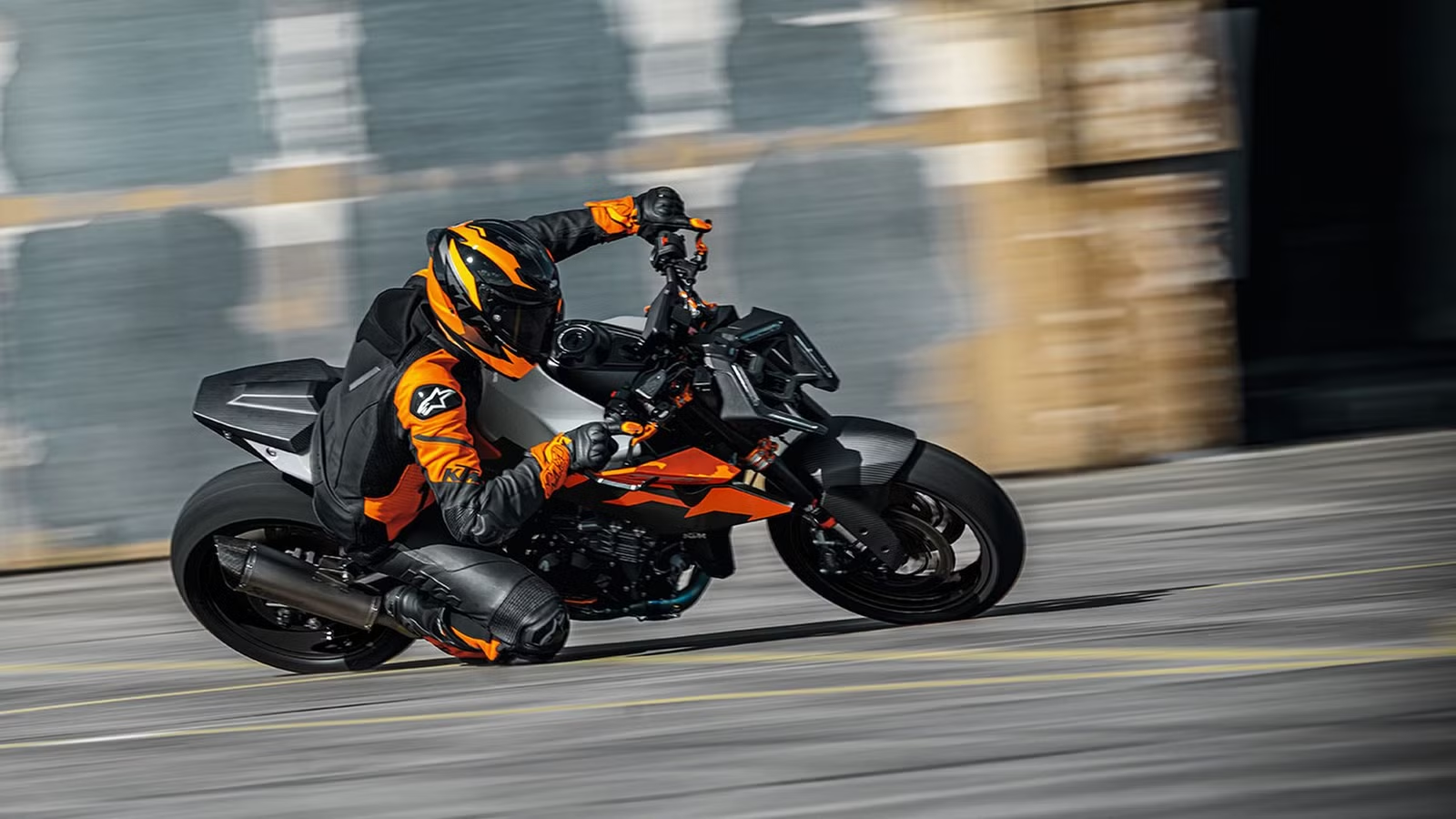
Streetfighters originated from sportbikes that fell one too many times, making it cost-ineffective to repair or replace the bodywork. They then became aggressive and stripped down motorcycles, with twitchy throttles and a sharp chassis that prioritized hooliganism over comfort. The adrenaline rush is great, but it can only last for so long before a rider realizes that a truly great naked bike cannot be one-dimensional. Modern customers want a machine that has that same edge, but layered with a sophisticated and refined chassis and driveline.
The Middleweight Segment Forces A Choice Between Budget And Luxury

The middleweight naked bike segment has always had an identity crisis. This is especially true at the premium end because it is a smorgasbord of budget-focused platforms that try to take sales away from the lower classes with very attractive price tags. At the other end are middleweights that rival liter-class streetfighters in price but offer an extremely premium experience through striking looks, exclusivity, and features that any liter bike would be proud of. KTM’s answer is a bike that doesn’t just split the difference between budget and luxury, but redefines what premium actually means at this price point. Here’s how it does it.
Refinement Without Giving Up Speed Is The New Premium

To outgrow your peers in the premium middleweight naked bike segment requires more than just a bigger engine or higher horsepower figures; it requires a feeling of maturity. That means changing a brute-force Duke into an extremely balanced, highly desirable product. When KTM upgraded its middleweight naked bike contender, it retained the sharp steering geometry, an extremely powerful engine, and low weight. At the same time, it added refinement and quality that would allow you to ride the bike slowly or daily and still come away happy.
How KTM’s Motorsport DNA Unlocked A New Kind Of Duke Rider

If you want a fast off-road bike, a KTM is a no-brainer, but the Austrian manufacturer has managed to translate that pedigree into tarmac products as well. While its Duke series remains as aggressive as ever, an as-yet-unseen level of sophistication has crept into the range, giving it better fit and finish along with class-leading electronics. This has widened the target audience for the Duke: it no longer requires you to ride flat-out all the time; instead, you can choose to be Dr. Jekyll or Mr. Hyde.

The KTM 990 Duke Has Matured, But Not Lost Its Fire

This evolution from the Austrian brand has been apparent over the last few years, and nowhere is it more prominent than in the base-spec 990 Duke. It has a sibling, the 990 Duke R, which blurs the line between sport and street bikes, but the base 990 Duke offers a less frenetic experience. It still delivers substantial midrange torque and a light, responsive chassis, but pairs them with creature comforts that make daily riding something to look forward to. This newfound maturity is why the 990 Duke has quietly outgrown its rivals.
A Sub-$12,000 Base Price Positions The Duke As A Premium Contender

The KTM 990 Duke is priced at $11,999. This places it firmly at the upper end of the premium middleweight streetfighter segment. The competition here is fierce, with some truly established names. It also competes with the value-based liter naked bikes from Japan. Unlike the competition, KTM offers Demo Mode, which means there is an additional cost after 932 miles if you want to keep all its premium features going.
The 121-Horsepower LC8c Engine Sets The Class Performance Standard

The 990 Duke has a 947 cc parallel-twin engine with a 270-degree firing order. The result is 121.3 horsepower and 76 pound-feet of torque. These are higher outputs than competitors with more cylinders. The parallel-twin configuration not only keeps it narrow and light, but it also offers significant torque through the rev range, which is why the 990 Duke is also easy to ride in traffic, either slowly or at warp speed. Little wonder that KTM calls it “the sniper”. The six-speed gearbox is smooth-shifting and is equipped with a PASC assist and slipper clutch. However, the two-way quickshifter is an optional extra. It becomes necessary if you ride it hard or at a track, simply because it is such an aggressive machine when pushed.
A Chrome-Moly Trellis Frame Delivers Scalpel-Sharp Cornering Agility

As with all the other Dukes in KTM’s lineup, the 990 utilizes a trellis frame made from tubes of chrome-molybdenum steel, which helps it balance power, agility, and everyday usability well. It also uses the engine as a stressed member. Both the subframe and the swingarm are made of die-cast aluminum; this combination results in a particularly low weight. This is paired with WP Apex 43 mm inverted forks at the front with compression and rebound damping adjustment.

A rear monoshock offers preload and rebound damping adjustment. The travel available is 5.51 inches at the front and 5.91 inches at the rear. To keep its performance in check, it is equipped with twin 300 mm front brake discs and a 240 mm rear brake disc. There are radial four-piston fixed calipers at the front and a single-piston caliper at the back. These are mounted on 17-inch wheels fitted with tubeless radial tires.
Compact Geometry And Low Weight Maximize Real-World Flickability
KTM doesn’t usually release length and width measurements of its products, but we do know that the 990 Duke is a compact machine judging by its 58.1-inch wheelbase. The seat height is 32.5 inches, which is a little high for the class, and ground clearance is 7.7 inches. Its weight is 394.6 pounds without fuel, and the tank can hold 3.91 gallons.
The net result of this is a high-power, high-torque motorcycle that is extremely compact and light for its class. The light weight negates the effect of the high seat. While it can be ridden docilely, this is the kind of bike that eggs you on to explore its limits, and it comes alive when you push it, thanks in no small part to its size and weight.
A Comprehensive Electronics Suite Establishes Class-Leading Tech Credentials

The 990 Duke has a five-inch TFT instrument cluster with Bluetooth and navigation, all-LED lighting with a split projector headlamp, and a USB-C charging port on the headlight bracket. There is a by-wire throttle and a six-axis IMU, which means the safety suite includes traction control and ABS with cornering functions.
The ABS can also be disabled at the rear and has rear lift mitigation. An interesting concept that KTM continues to push is that of the Demo Mode, where everything is unlocked for the first 932 miles and then needs to be activated via an extra payment. This is a software lock and can be done at the dealer upon payment.

These optional extras include the bidirectional quickshifter, cruise control, engine brake control (MSR), launch control, five-level anti-wheelie, Performance Mode which allows customizable settings, and Track Mode. The Track Mode offers custom throttle response, traction control adjustment on the fly, a lap timer, lean angle display, and telemetry. All of the optional extras are standard on the 990 Duke R, which makes sense as it is the most powerful KTM Duke under 1,000 cc.
Software-Locked Features And Softer Base Hardware Limit Out-Of-The-Box Value

KTM’s Demo Mode is unpopular for two reasons: customers aren’t used to being offered the full version of the product and then having features locked after getting a taste, and secondly, it drives up the price of the 990 Duke and makes it less of a value proposition, whereas the competition offers all these features at the stated price. As the lower-priced 990 Duke, it receives suspension and braking components that are not top-spec, which means the engine can sometimes seem to lack the support it requires from these two components.
Why The Duke Outpoints Better-Equipped Rivals Where It Actually Matters

The premium middleweight segment is a very popular one among manufacturers because the products straddle the line that divides practical performance and outright exhilaration quite well. There are some interesting options, like the Ducati Monster and BMW F 900 R, but the Ducati is too expensive and the F 900 R needs a little more performance and features at its base price. Value-driven liter-class naked bikes like the Honda CB1000 Hornet SP and Suzuki GSX-S1000 are also available at this approximate price point, but their size and weight mean they are not as agile as the KTM.

One of the most popular models in the segment is the Yamaha MT-09, which feels sporty without being demanding. For the price of the KTM, you can even bump it up to the MT-09 SP with the fully adjustable suspension from KYB at the front and an Öhlins rear monoshock with remote hydraulic preload adjustment.

The Kawasaki Z900 SE does not have as many electronics as the Yamaha or the KTM, but it punches above its price point and has an inline-four-cylinder engine. Like the Yamaha, it chooses an Öhlins monoshock with remote hydraulic preload adjustment, but pairs it with a Showa fork at the front.

Among the Europeans, the strongest competitor is the Triumph Street Triple 765 R. It has an aggressive starting price, a unique three-cylinder engine, and the quickshifter is standard.
Source: KTM USA

Related posts


Latest Post


No Comments