
2005 Dodge Ram Power Wagon: The Raptor’s Opposite
Modern off-road pickups love horsepower, jump shots, adaptive dampers, and Baja-speed heroics. But five years before the original Ford Raptor arrived, one heavy-duty pickup took almost the opposite approach: slow down, keep the tires working, and let mechanical traction do the ugly work.

That is what makes this truck so interesting. It looked close enough to a normal work rig, yet underneath sat the sort of trail hardware that would still make an off-roader stop and look twice today. And one low-speed feature explains the whole thing better than any drag race ever could.
It Looked Like A Work Truck, But Hid Serious Crawl Hardware
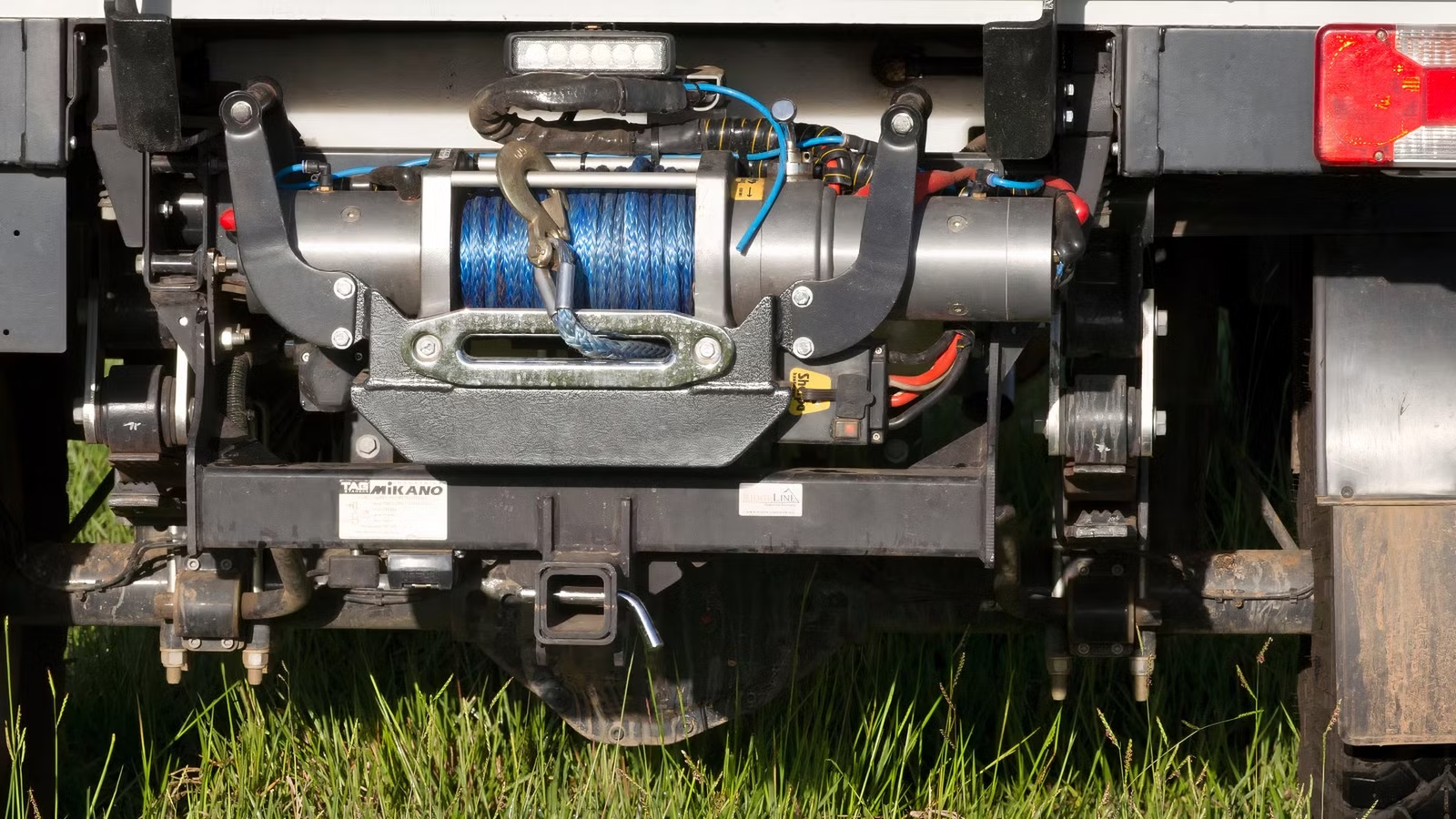
The equipment list reads less like a factory options sheet and more like a rock-crawler wish list with a VIN attached. You got electronic locking differentials at both ends, an electronically disconnecting front sway bar, 33-inch BFGoodrich all-terrain tires, Bilstein monotube shocks, skid protection, 4.56 axle gearing, and a bumper-integrated 12,000-pound Warn winch. Those numbers are worth pinning down because some summaries of the early truck mix its hardware with later versions, but period factory documentation supports the 4.56 gears and 12,000-pound winch.
The chassis underneath was gloriously old-school. A ladder frame carried a live front axle located by Quadra-Link leading arms, a track bar, and coil springs, while another live axle rode on longitudinal leaf springs out back. Forget an independent front suspension soaking up high-speed desert hits; this setup wanted axle movement. The front end could articulate as a unit, and disconnecting the sway bar gave it even more freedom when the trail started twisting the truck into shapes no paved road would ever ask for. The factory dimensions backed up the hardware, too: the Quad Cab had a 35-degree approach angle, 25.5-degree breakover angle, and 26.5-degree departure angle. This was no sticker package wearing chunky tires and an attitude.
Then there are the lockers, because an open differential can let the wheel with the least grip waste the torque, which is exactly what you do not want when one tire is hanging light over a rock. Lock the axle and both axle shafts are forced to turn together, giving the tire with grip a chance to keep the truck moving. The winch is the final layer of the same idea: instead of hoping wheelspin and momentum solve everything, the truck carried its own recovery tool behind the bumper; pair that with the sway-bar disconnect and you can see the philosophy: don’t skim over the problem, crawl through it. Later factory documentation describes the lockers as low-speed, extreme-off-road hardware intended to keep the vehicle moving when a wheel may lose contact with the ground.
The 18-MPH Cutoff Shows Why This Was Never A Raptor

The sway-bar disconnect is my favorite clue because it tells me exactly what the engineers had in mind for this truck. Disconnecting the bar gives the front suspension more freedom to articulate, which helps keep tires in contact with uneven ground. But once speed rises, that same extra freedom is exactly what you do not want for stability, so the system is built around low-speed trail use; contemporary coverage of the 2005 truck noted that the bar automatically re-engaged above 18 mph, while later factory manuals for the same system still use 18 mph as the threshold where it attempts to reconnect. Eighteen miles per hour is barely a jog by modern supertruck standards, and that is the point: this feature is there for the obstacle in front of you, not the horizon.
The Raptor came at off-roading from almost the opposite direction. Ford’s own history of the truck says the first generation arrived in 2010 with 2.5-inch internal-bypass shocks and long-travel suspension designed to let it maintain high speeds over rough terrain. Modern Raptors push that philosophy much further: the 2024 F-150 Raptor uses an independent double-wishbone front end, electronically controlled Fox dampers, and as much as 14 inches of front and 15 inches of rear suspension travel in standard form. Baja mode exists for a reason.

That does not make the Raptor a fake off-roader or mean it cannot crawl; Ford has offered Rock Crawl mode and serious traction hardware of its own. In fact, Ford explicitly describes Baja mode as its high-speed desert setting and Rock mode as the low-speed rock-crawling one. It just means the two trucks attack dirt from opposite directions: one wants suspension travel and damping control to absorb rough ground at speed, while the other leans hard on axle articulation, gearing, lockers, and mechanical grip when the trail gets slow. Calling them direct rivals misses the fun. One is a Thoroughbred; the other showed up wearing work boots.
The 2005 Dodge Ram Power Wagon Was The Truck Behind It

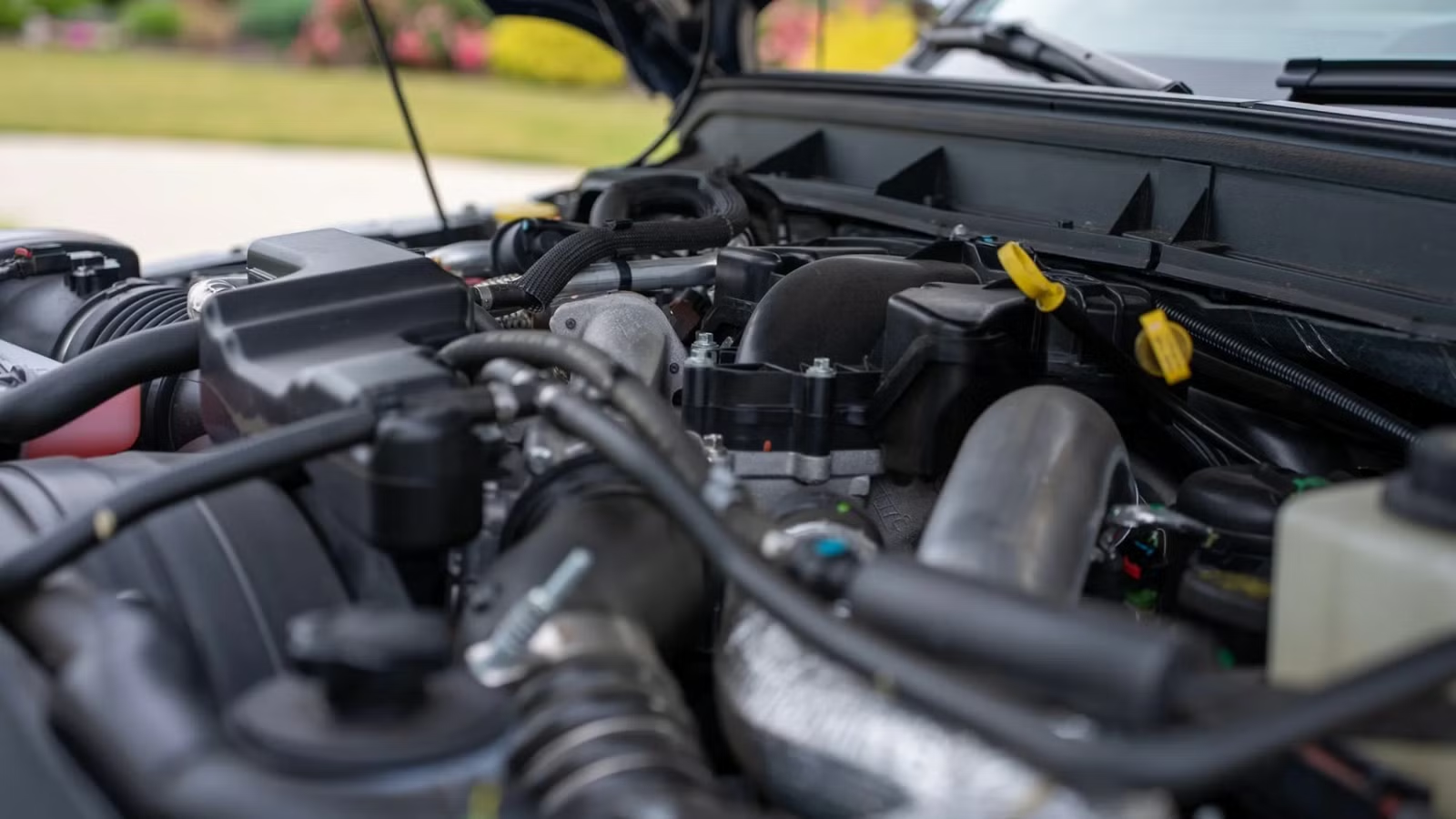
The truck is the 2005 Dodge Ram Power Wagon. Dodge revived the Power Wagon name for 2005 and built it on the Ram 2500 Heavy Duty platform, offering Regular Cab and Quad Cab versions with a 5.7-liter Hemi V8 making 345 horsepower and 375 lb-ft of torque. Buyers could choose a five-speed automatic or a late-availability six-speed manual, while a manually shifted NV271 transfer case added a 2.72:1 low range and 4.56 axle gears helped turn that Hemi torque into slow-speed grunt. The V8 had plenty of muscle, but the really interesting stuff was bolted underneath it.
Better yet, all that hardcore trail hardware came together from the factory instead of an aftermarket catalog. The Quad Cab automatic weighed 6,081 pounds at the curb, so calling it a 7,000-pound truck overshoots Dodge’s own figure. Still, three tons of Ram with lockers underneath and a winch buried in its nose was hardly subtle.

That package became the modern Power Wagon formula: front and rear lockers, an electronic sway-bar disconnect, serious tires, extra articulation, underbody protection, and an integrated winch. Ram’s 2026 Power Wagon still follows the same basic recipe with Articulink front suspension, 33-inch tires, a two-inch factory lift, and that familiar winch-and-locker mindset. Keeping that hardware alive came with a trade-off that helps explain why so few rivals followed it.
The Industry Chased Thoroughbreds And Left This Clydesdale Behind

The Raptor-style approach stole the spotlight. High-speed desert trucks look spectacular, horsepower gives everyone an easy number to argue about, and electronically controlled dampers can flatten rough terrain at speeds that would make an old-school solid axle very unhappy. Ram eventually joined that arms race with the TRX. The Power Wagon went the other way—a Clydesdale built to climb over the obstacle instead of charging past it.
That specialization comes with a real bill. The 2005 Quad Cab automatic could still carry 2,430 pounds and tow up to 10,750 pounds, but the modern trade-off is much harder to miss. Ram rates the 2026 Power Wagon for up to 1,570 pounds of payload and 10,530 pounds of gas towing, while the 2026 Ram 2500 Rebel reaches 3,320 pounds and 17,130 pounds, respectively. Another Ram release lists 10,590 pounds of Power Wagon towing, so the exact ceiling varies by source or configuration. Either way, those aren’t numbers you wave away with “but lockers.” A serious chunk of heavy-duty capability gets traded for articulation, traction, and trail hardware.
That is the bargain the Power Wagon has always made. It gives up some heavy-duty utility to keep the hardware that matters when the trail stops behaving like a road. Payload and towing numbers win plenty of spec-sheet arguments, but they don’t help much when one tire is hanging in the air and the ground underneath the others is falling apart. Out there, horsepower becomes background noise. Traction decides whether the truck keeps moving.

Related posts



Latest Post


No Comments