
Honda’s ‘Never Ready’ Racer Got Outclassed By Two-Strokes, Then Fathered The Interceptor
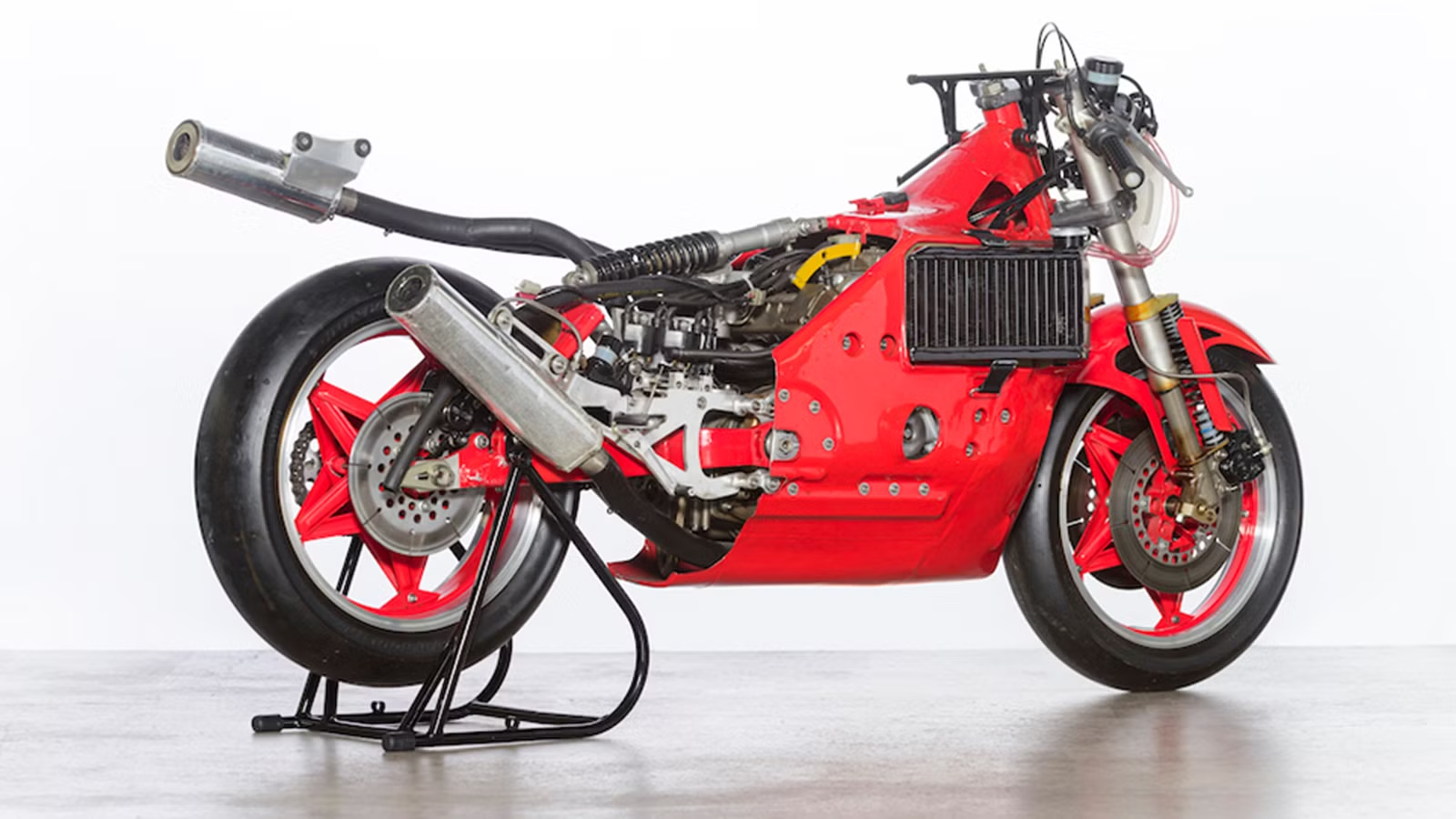
Honda has never been a manufacturer content to follow the crowd, and its history is full of engineering decisions that have both pioneered new technologies and found failure. But failure is all about framing, and even the biggest failures can turn into successes if given the right attitude. One particularly bold experiment failed spectacularly on the world stage, but its impact can be traced all the way to one of Honda’s most daring experiments.
The Grand Prix Era That Refused To Play By Honda’s Rules

Grand Prix motorcycle racing was a two-stroke battleground by the late 1970s. Bikes like the Yamaha YZR500 (OW23) and Suzuki RG500 were high-revving, lightweight machines to have, leaving their four-stroke counterparts in their wake. But while two-stroke was the way to go, Honda wasn’t going to simply follow the trend. It had built much of its reputation on four-stroke technology, starting all the way back in 1951 with the Dream E-Type, and it wasn’t about to abandon that philosophy.
Meanwhile, there was a regulatory challenge to consider: FIM (Grand Prix Motorcycle Racing’s governing body) rules limited 500 cc Grand Prix engines to four cylinders. A two-stroke produces power every rotation, while a four-stroke does so every two. This meant that Honda couldn’t just add more cylinders, and thus the already-tricky task became downright audacious.
When Racing Success Became An Obsession


While extracting more power from comparatively fewer revolutions wasn’t going to be easy, Honda didn’t shy away from the challenge. Instead, it created a team composed largely of young engineers with little or no Grand Prix experience, giving them the opportunity to bring fresh thinking to the project. The goals of that task, though, were remarkably aggressive: Honda wanted a 500 cc four-stroke engine capable of 130 HP at 23,000 RPM. Radical engineering would be the only way to achieve this, so Honda’s engineers started experimenting with ways of turning two cylinders into one. It was a huge gamble, but one that Honda hoped would pay off.
Honda’s NR500 Was The “Never Ready” Racer That Couldn’t Score A Single Point

Honda’s answer to the two-stroke dominance came in 1979 with the release of the NR500 — a machine that would live on in infamy from that launch. One of the most distinctive bikes Honda had created, it effectively tried to deliver the breathing capacity of a V8, but with half the cylinders.
The way it attempted this was by forgoing the conventional round positions, and instead opting for oval-shaped pistons, each with two connecting rods, eight valves, and two spark plugs. This unusual setup allowed engineers to fit more valve area into the combustion chamber, giving the engine more room to breathe when it was at the exceptionally-high revs Honda was targeting. It was a smart solution, sure, but it wasn’t without its issues.
Let’s go back to Honda’s initial target of 130 HP and 23,000 RPM from a 500 cc four-stroke V4. Suzuki’s RG500, which won the 1976 and 1977 500 cc world championships reportedly made 90 HP at 11,000 RPM. The Yamaha YZR500 (OW35K) made 120 HP at 10,500 RPM. Honda was asking its engine to produce roughly the same power at over double the revolutions and, unsurprisingly, the problems started quickly.

To begin with, there was power (or lack thereof). The 130 HP target was a struggle, even later in development, as figures were more commonly reported in the 115–120 HP range. There were technical issues, too, as reliability concerns and a steep learning curve — not helped by Honda’s deliberately inexperienced team — meant that it struggled to get on top of the bike while others refined their already fast two-strokes.
The results were worse than Honda could have expected. Five years of development and investment were put into the bike, yet not only did it not score a single point, it struggled to even reach the grid. This wasn’t for a lack of skill atop the bike though, as riders included 1977 350 cc champion Takazumi Katayama, Isle of Man TT winner Mick Grant, and even two-time champion Freddie Spencer. So bad was the bike that it earned the unflattering “Never Ready” moniker before being abandoned in 1981.
Although the NR500’s considerable failure on track is what people remember, it wasn’t all terrible. It explored innovations like the slipper clutch, inverted front forks, and unconventional radiator placement. It tried changing the shape of the pistons and cylinders themselves in a bid to find more performance, and it did show brief glimpses of promise at times. And while the bike may have been an oval peg for a round hole in its racing program, its learnings had applications elsewhere.
From A Winless Racer To Honda’s V4 Road Motorcycle Revolution

While the NR500 failed to deliver on the racetrack, the engineering it pioneered was still sound. Honda took the lessons it learned and used them in its road-going V4 bikes, first appearing in the VF750 Sabre and Magna in 1982, followed by the VF750F Interceptor a year later in what became the world’s first mass-produced liquid-cooled V4 motorcycles. This transition wasn’t without its issues either, though, as early VF models suffered from enough camshaft wear to earn them the unfortunate “chocolate cam” nickname. But even that wasn’t enough to deter Honda from the V4 concept, as it instead continued to refine and develop it into something extraordinary: the Honda NR750.
The Honda NR500’s Greatest Victory Was Its Legacy

The culmination of the NR500’s legacy arrived in 1992 with Honda’s NR750. More than a decade after the NR500 had tried, and failed, to change the racing world, this new bike showed that Honda’s ambitious oval-shaped pistons could be used not just as part of a road-going bike, but as the halo bike that represented the entire brand. And while the NR750 went on to become one of, if not Honda’s most technologically ambitious bike, its roots can be traced back to the race bike that never scored a point.
Sources: Honda, Motorcycle Specs

Related posts




Latest Post


No Comments