The Most Efficient Three-Row Hyundai You Can Buy In 2026
11 minutes reading
Saturday, 22 Aug 2026 18:01 0 56 autotech
Fuel efficiency, space, comfort, and reliability are what every brand in the family SUV market is now striving for. For the most part, with the release of countless hybrid SUVs and plug-in SUVs in recent years, the market has become very competitive for family SUVs. We tend to think about Toyota, Honda, Subaru, Chevrolet, and Ford models when we think of the best family SUVs, but another Asian marque is striking the best balance.
Hyundai has been quietly upping its game in recent years, and its 2026 three-row hybrid SUV offers not only exceptional fuel efficiency, but also comfort, storage and passenger space, and dependability.
Family SUVs Are Getting Bigger, But Fuel Economy Still Matters
Profile shot of 2026 Toyota Grand Highlander Hybrid parked by lakeToyota
Family SUVs have been on a rather serious growth spurt over the last decade. Look at almost any current model next to the one it replaced a generation or two ago, and you’ll find a longer, wider, heavier vehicle with bigger wheels and more equipment. The compact SUV has crept toward midsize territory, while three-row models have become genuinely massive.
That creates a problem. More metal, more weight, and more rolling resistance mean more fuel being burned, especially when you’re doing the sort of short, stop-start journeys that make up much of daily driving. You don’t want to spend all weekend hopping from one gas station to the next, just because school runs require something with a bulky build.
Rear 3/4 shot of 2026 Mazda CX-90 Towing A MotorcycleMazda
This is why hybrid power makes so much sense in this class. Electric assistance can do some work in traffic, regenerative braking recovers energy that would otherwise disappear, and the gasoline engine still gives you the range needed for road trips.
As family SUVs continue getting better, asking for better efficiency isn’t just a nice bonus; it has to be part of the build today. This is especially true because most brands are producing models that balance efficiency and space exceptionally well.
How The CR-V, Grand Highlander, Passport, Forester, And Suburban Keep The Family SUV Alive
Front 3/4 action shot of 2026 Honda CR-V Sport Touring Hybrid driving on roadHonda
Not every family SUV is built the same, but, for the most part, they understand what is needed: enough room for people and stuff without making every trip to the gas station a financial worry. The new Honda CR-V is the sensible one, offering hybrid power, useful cargo room, fuel returns of up to 40 mpg, and a manageable size that makes parking easy.
The 2026 Grand Highlander Hybrid goes a lot bigger, offering three rows of seating and a huge amount of space, while still achieving some of the best fuel economy for something of its size and weight. The new Subaru Forester takes a different approach.
Front 3/4 shot of 2026 Cherolet Suburban Parked By A HouseChevrolet
You get standard all-wheel drive, an outdoorsy look, and an efficient-enough powertrain that doesn’t punish you on the weekdays while being more than perky enough for a bit of off-tarmac fun. Honda’s Passport, especially the TrailSport, is more focused on adventure and capability, but its efficient-enough V6 means you can still juggle school runs, road trips, and weekends away. Then there’s the Chevrolet Suburban, which proves that efficiency is relative.
It is massive, measuring in at up to 226.3 inches in length by 81.1 inches in width, and tips the scales at up to 6,053 pounds, so you can’t expect Prius numbers. However, with the 3.0-liter diesel Duramax fitted, you can get up to 26 mpg on the highway. Each of them approaches family duty differently, whether it means hybrid efficiency, all-weather capability, off-road prowess, or sheer carrying power, and the common thread among them is that none of them makes you accept terrible fuel economy simply because you need a proper family vehicle.
The 2026 Hyundai Santa Fe Hybrid Makes For The Ideal Family Buy
Front 3/4 view of a 2026 Hyundai Santa Fe Hybrid CalligraphyIsaac Atienza | TopSpeed
With all this in mind, there is the new Santa Fe. The 2026 Hyundai Santa Fe Hybrid is available in four trims, with a low-end starting price of just $36,400. The ’26 Santa Fe Hybrid trims are the SE, the SEL, the Limited, and the Calligraphy.
The SE has the lowest starting price; the SEL has a starting price of $38,690; the Limited has a starting price of $45,700; andthe top-tier Calligraphy has a starting price of $48,700 . The Santa Fe is classed as a compact hybrid SUV, with dimensions of 190.2 inches in length by 74.8 inches in width by 69.7 inches in height, and rides on a 110.8-inch wheelbase.
36 MPG Combined
Close-up shot of 2026 Hyundai Santa Fe Hybrid grilleHyundai
There is just one powertrain option for the new Santa Fe Hybrid: a 1.6-liter turbocharged GDI inline-four paired with a 44.2-kW motor and a 1.49-kWh battery. Horsepower output is 231, and torque output is 271 pound-feet, with power routed through a six-speed automatic to the front wheels as standard, and to all four wheels via HTRAC AWD as an optional extra.
FuelEconomy.gov estimates that the FWD Santa Fe Hybrid can achieve 36 combined mpg (37 mpg city/36 mpg highway), and the AWD flavor can achieve slightly less at 34 combined mpg (35 mpg city/34 mpg highway). The estimated gas tank range is between 602 and 637 miles, and annual gas costs are estimated to be between $1,700 and $1,800. This translates to five-year fuel savings of between $2,000 and $2,500 compared to the average modern vehicle.
Three-Row Practicality Without A Huge Fuel Bill
Shot of 2026 Hyundai Santa Fe Hybrid interior showing front cabinHyundai
Despite the relatively small dimensions, the new Santa Fe Hybrid still offers three rows of seating. The SE and the SEL are equipped with a bench seat in the second row, which means seating for up to seven people, while the Limited is fitted with second-row captain’s chairs as standard, for seating up to six people, but you can add a bench seat for the higher seating capacity, and the Calligraphy is fitted with captain’s chairs.
You get 41.1 inches of front-row headroom, 40.6 inches of second-row headroom, and 37.7 inches of third-row headroom. Front-row legroom is very generous at 44.4 inches; second-row legroom is also impressive at 41.1 inches; and third-row legroom is present, but slightly on the tight side at 30 inches.
Shot of 2026 Hyundai Santa Fe Hybrid interior showing second rowHyundai
Shot of 2026 Hyundai Santa Fe Hybrid interior showing third rowHyundai
You also get a very impressive amount of storage space. Behind the third row is 14.6 cubic feet of storage space; with the third row folded down, 40.5 cubic feet; and with both rear rows folded away, 79.6 cubic feet. You also get a large center console, up to 16 cupholders, large door bins, and dual pullout storage drawers. The space and efficiency numbers make a strong case — but a family SUV has to hold up over years of school runs, road trips, and minor chaos. Here’s how the Santa Fe Hybrid performs on that front..
The Santa Fe Hybrid Brings More To The Table
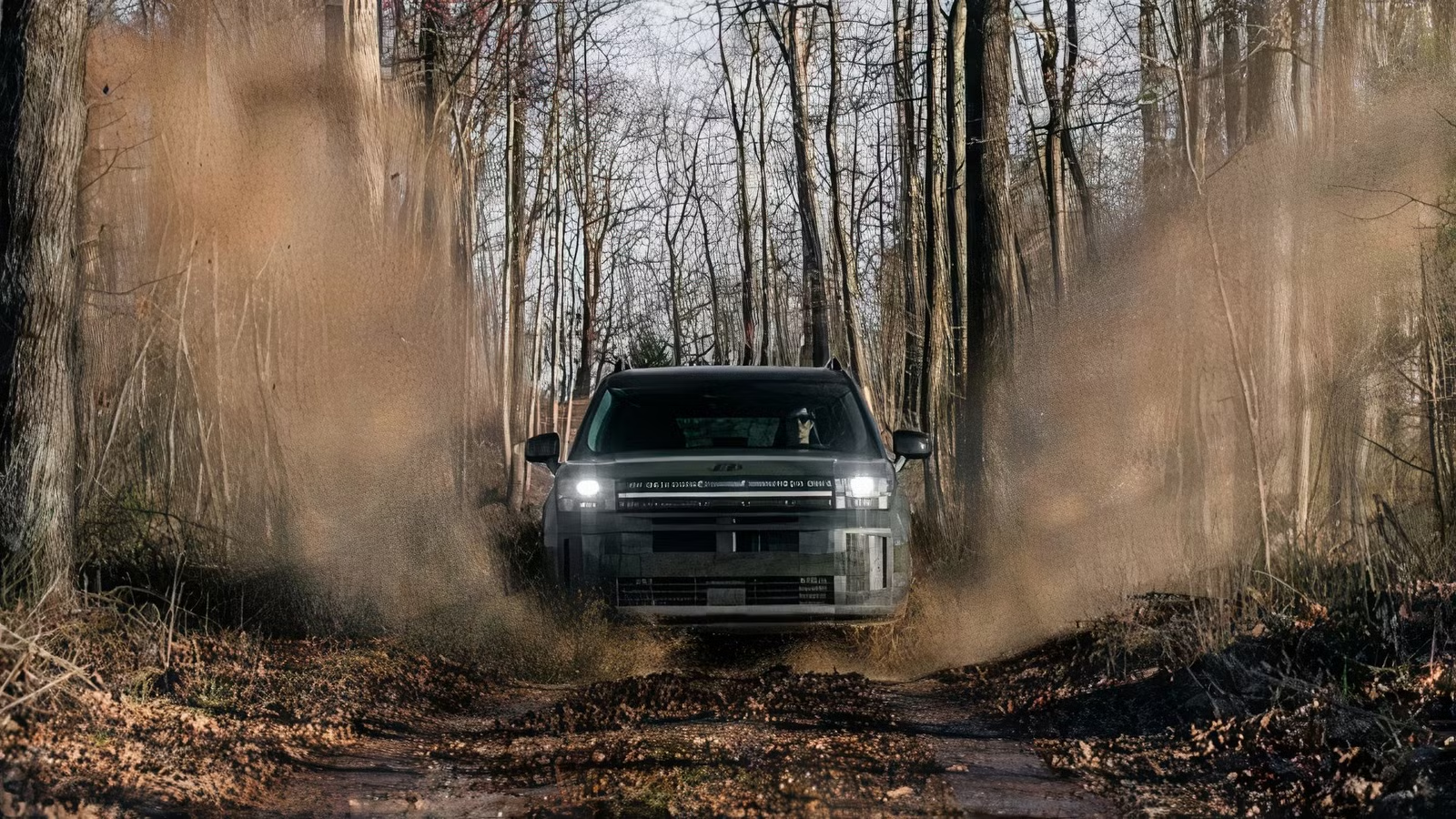
Front 3/4 action shot of 2026 Hyundai Santa Fe Hybrid driving on roadHyundai
It is not all just about fuel efficiency and space, though; the new Santa Fe Hybrid is a proper all-around family SUV. It is rated 82 out of 100 overall on J.D. Power, while owners on Kelley Blue Book rate it 4 out of 5 overall, with 77 percent of owners (at the time of writing) saying they’d recommend buying one.
Long-Term Reliability And A Long Lifespan
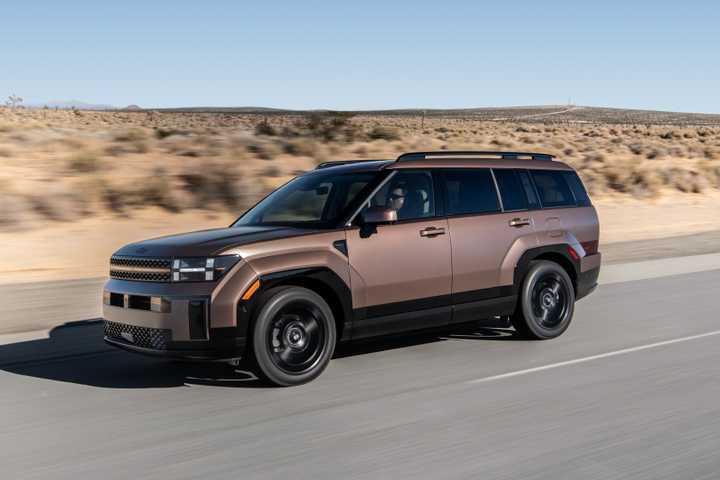
Rear 3/4 action shot of 2026 Hyundai Santa Fe Hybrid driving on roadHyundai
According to iSeeCars, with proper maintenance and repairs, the Santa Fe Hybrid has an average lifespan of 136,064 miles and around 9.6 years. They also say that it has a 10.2 percent chance of reaching 200,000 miles. According to reviews on J.D. Power, the new Santa Fe has a reliability rating of 81 out of 100, while owners on Kelley Blue Book rate it 3.8 out of 5 for reliability.
Ownership Costs That Are Sensible
Rear 3/4 action shot of 2026 Hyundai Santa Fe Hybrid driving on roadHyundai
Per year, RepairPal says that it will cost you $515 a year to maintain, and it has a reliability rating of 4 out of 5, which makes it better than the market average of 3.5 out of 5. The annual repair bill is also cheaper than the $572 a year to maintain other SUVs in its class and cheaper than the market average of $652.
According to data on Kelley Blue Book, average combined five-year depreciation and out-of-pocket expenses total $66,685. This includes $21,240 in depreciation, $11,443 for fuel, $15,300 for insurance, $4,908 for financing, $5,812 in state fees, $7,241 for maintenance, and $741 for repairs.
The Technology And Cabin That Make It Easy To Live With
Shot of 2026 Hyundai Santa Fe Hybrid interior showing front cabinHyundai
Hyundai has also avoided turning the Santa Fe Hybrid into the sort of rolling touchscreen showroom that has become so popular in the SUV market today. Every grade gets a 12.3-inch touchscreen, wireless Apple CarPlay and Android Auto, HD Radio, Sirius XM, Bluelink+, and a fully digital 12.3-inch gauge cluster on the upper trims.
Everything looks modern and cleanly designed, but you don’t have to hunt through touchscreen menus for every function. You still get physical controls for climate control, while the column-mounted shift-by-wire selector keeps the center console relatively uncluttered.
Close-up shot of 2026 Hyundai Santa Fe Hybrid center consoleHyundai
The SE gets a hands-free smart liftgate with adjustable opening height, push-button start, and a leather-wrapped steering wheel, so you aren’t punished for choosing the most affordable option. The SEL adds an eight-way power driver’s seat, two-way lumbar adjustment, heated front seats, wireless phone charging, and Hyundai Digital Key 2 Premium.
The Limited brings a six-way passenger seat, four-way driver’s lumbar, memory settings, ventilated front seats, navigation, Dynamic Voice Recognition, Remote Parking Assist, and a 12-speaker Bose audio rig. Right at the top is the Calligraphy, which brings true luxury SUV features in the shape of Nappa leather, a dual-pane sunroof, rear sunshades, and more ambient lighting.
What To Know Before Buying A Santa Fe Hybrid In 2026
Front 3/4 shot of 2026 Hyundai Santa Fe Hybrid parkedHyundai
There are many reasons why the Santa Fe Hybrid is the best family SUV. Technically, the FWD Kia Sorento Hybrid can achieve 37 combined mpg, one more mpg than the Santa Fe Hybrid, but it has slightly less maximum cargo capacity (75.5 cubic feet), so you could argue that the Santa Fe Hybrid strikes a better balance.
Likewise, the new Grand Highlander Hybrid is a great family SUV, and it can achieve up to 36 combined mpg and carries more, but with a starting price of $45,610, it is somewhat more expensive than the Santa Fe Hybrid base trim. The Santa Fe Hybrid makes the most sense when you stop looking at it like a spreadsheet exercise. Yes, some SUVs will beat it on specific points, but as the all-rounder, most efficient family vehicle you can buy in 2026, it takes some beating.
Profile shot of 2026 Hyundai Santa Fe Limited interior showing front cabinHyundai
The 36-mpg FWD rating and huge gas tank range are good enough to make fuel stops noticeably infrequent, while the three-row layout, manageable size, comfortable cabin, and generous cargo space mean you don’t need to move to a much larger SUV to get everything you need.
The SEL could be seen as the most sensible option because you get a power driver’s seat, heated seats, and wireless charging, but you don’t need to spend luxury SUV money for it. The Calligraphy is for you if you want something that feels like a luxury SUV without the price tag.
Side profile of a 2026 Hyundai Santa Fe Hybrid Calligraphy parkedIsaac Atienza | TopSpeed
There is an important caveat, though: buy the FWD version if maximum fuel economy is the priority. HTRAC AWD costs a couple of mpg, but it does make more sense if you live in an area that gets wet weather often or is prone to potholed roads. We wouldn’t suggest attempting serious off-roading with it, but it does improve wet-road traction.
Ultimately, the 2026 Santa Fe Hybrid is among some tough competition this year, and while it doesn’t outdo every other SUV in every category, its exceptional fuel efficiency combined with the very few things it gets wrong makes it an ideal family SUV. A recent TopSpeed review of the Hyundai Santa Fe Hybrid sums it up nicely.
The Santa Fe Hybrid and Highlander Hybrid are pretty much ideal competitors that should serve customers very well. The Toyota is a little quicker and offers a bit more cargo space, but the Hyundai offers more room for passengers and has extra-comfortable front seats. Additionally, the Santa Fe is more stylish than the Highlander, and it has a nicer interior.
Base Trim Engine
1.6L Smartstream I4 Hybrid
Base Trim Transmission
6-speed automatic
Base Trim Drivetrain
Front-Wheel Drive
Base Trim Horsepower
178 HP @5500 RPM
Base Trim Torque
195 lb.-ft. @ 1500 RPM
Base Trim Battery Type
Lithium ion (Li-ion)
Make
Hyundai
Model
Santa Fe Hybrid
Segment
Midsize SUV
Sources: Hyundai, J.D. Power, Kelley Blue Book, FuelEconomy.gov, and iSeeCars.














No Comments