
Here’s What Camry Money Would Have Bought You In 1969
Around $35,000 buys a very complete new car in 2026. It buys quiet cruising, impressive fuel economy, screens, airbags, climate control, a warranty, and enough speed to make an old sports sedan sweat. Roll that spending power back to 1969, though, and the priorities change fast. The same broad slice of a household budget could buy something built with far less concern for silence, fuel bills, or digital convenience.
$35,000 Means Something Very Different Today

The 2026 Toyota Camry makes a useful benchmark because it shows just how much modern car buyers expect from ordinary transportation. The Camry LE starts at $29,600, while the sportier XSE starts at $36,000. Adding all-wheel drive to the XSE pushes the base price to $37,525. Toyota has now turned the entire Camry range into hybrids, with front-drive models making 225 net horsepower and AWD versions making 232.
The numbers get stranger when performance enters the picture. The efficiency-focused LE can reach an EPA-estimated 51 mpg combined, yet the Camry no longer feels painfully slow in exchange for that thrift. Tests often record around a 6.8-second run from zero to 60 mph in an XSE AWD. That would have counted as serious performance in plenty of earlier eras. The remarkable part is that the Camry can do it without demanding that its owner learn the personality of three carburetors, warm the engine like a campfire, or carry a mechanic named Earl in the trunk.

That is where modern car money goes. A Camry buyer gets four usable doors, seating for five, automatic climate control, an infotainment system, an airbag system, and a long list of electronic safety aids. Toyota Safety Sense 3.0 includes systems such as automatic emergency braking, radar cruise control, and lane-departure assistance, while blind-spot monitoring and rear cross-traffic alert also come standard. There is a 36,000-mile basic warranty, a 60,000-mile powertrain warranty, and, for the hybrid battery, coverage lasting 10 years or 150,000 miles. Modern buyers pay for a car expected to start every morning, survive traffic, sip fuel, and protect its occupants when things go wrong.

1969 Was Peak Bang for Your Buck

The same spending equation looked wild in 1969. Using the Bureau of Labor Statistics’ CPI figures, $3,500 in 1969 works out to roughly $32,000 in August 2026 purchasing power. A buyer shopping around the $3,500 mark in 1969 had real money to spend, but American automakers offered some astonishing ways to spend it.
Detroit had also chosen violence, at least where engine displacement was concerned. The muscle-car fight had turned horsepower into showroom bait. Big V8s went into midsize coupes because acceleration sold cars, racing sold cars, and a nasty exhaust note could apparently solve several problems that market researchers had not yet named. Manufacturers did not need every performance model to carry adaptive dampers, configurable drive modes, digital dashboards, radar sensors, giant touchscreens or ten speakers. They could sell speed with a large engine, a strong transmission, aggressive rear gearing and enough tire to make a serious attempt at turning gasoline into black stripes.
Cars of the era were also far simpler. Federal safety and emissions rules had already started to change the industry, so 1969 was not some lawless mechanical Wild West. Still, the amount of engineering devoted to emissions control, crash management, sound deadening, electronics and software remained tiny compared with a modern car. That left performance versions with an almost comic focus on hardware. A manufacturer could take a fairly basic coupe, spend heavily on the engine and driveline, leave plenty of comfort items on the options sheet, and send the result to a showroom. One particular Plymouth pushed that idea close to its logical limit.
Camry Money Bought You a Plymouth Road Runner in the Late 1960s

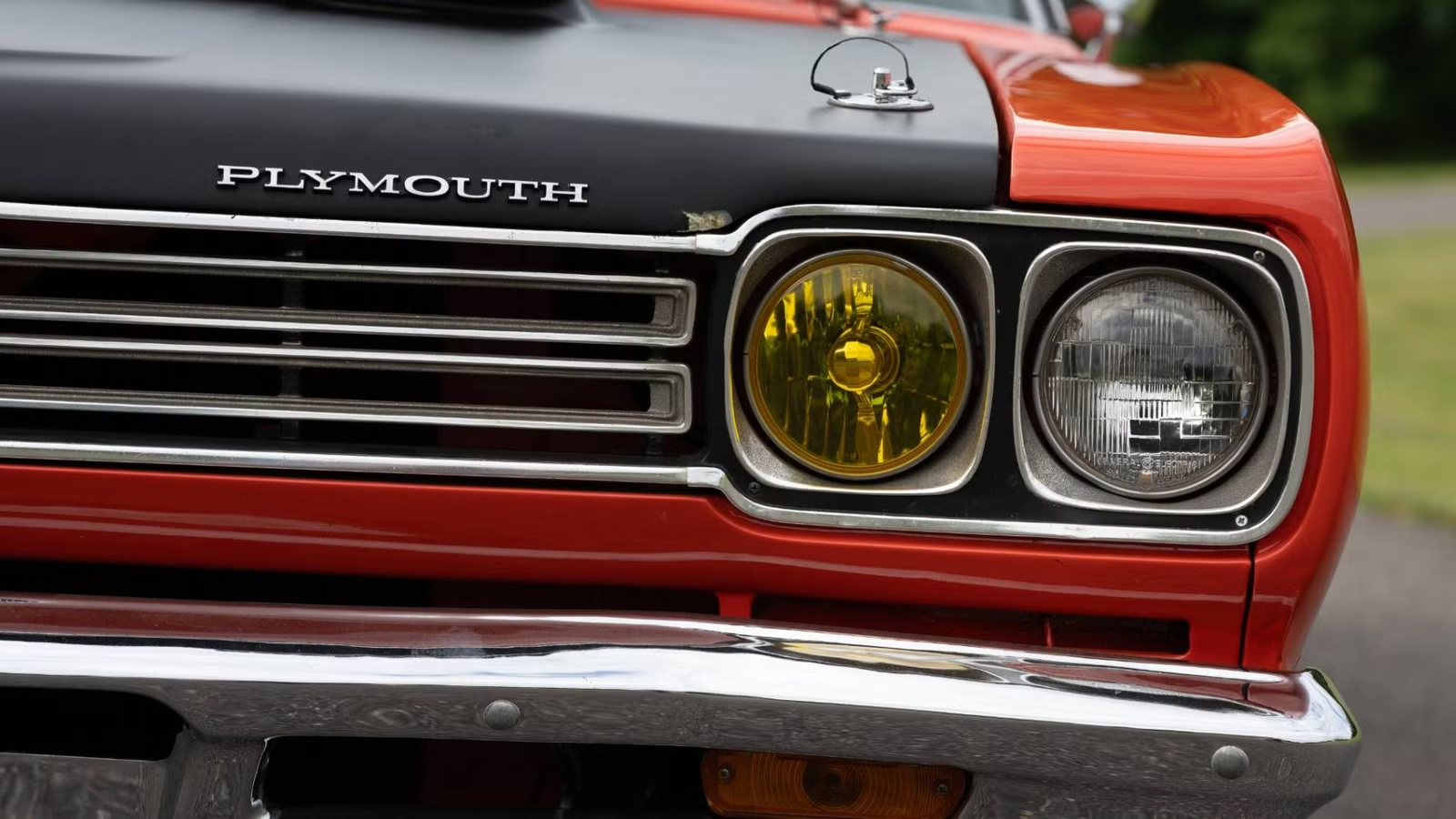
That car was the 1969½ Plymouth Road Runner with the A12 package and its 440 Six-Barrel V8. The regular Road Runner already existed as Plymouth’s low-cost answer to muscle cars that had grown expensive and fancy. The formula was simple and proven: start with a midsize Plymouth, keep the trim modest, give it serious power, and even pay Warner Bros. to let the car borrow the Road Runner cartoon identity.
The A12 package bought a 440-cubic-inch V8 breathing through three Holley two-barrel carburetors. Plymouth rated it at 390 horsepower and 490 lb-ft of torque. The transmission could be Chrysler’s tough A833 four-speed manual or a 727 TorqueFlite automatic. Behind that sat a Dana 60 rear axle with a 4.10:1 Sure Grip differential. Heavy-duty springs and shocks supported the car, 11-inch drum brakes handled stopping, and G70-15 bias-ply tires wrapped plain 15-inch steel wheels. Hubcaps did not make the cut, and neither did a normal hinged hood. Instead, the A12 wore a fiberglass hood that lifted completely off after the driver pulled four retaining pins. It was basically the automotive version of buying work boots and discovering someone had stuffed a sledgehammer inside the box.

Even the hood has a good story. The lightweight panel looks today like an exotic factory weight-saving trick, but period history suggests speed of production and cost helped drive the decision. Chrysler needed to get the A12 package to market quickly, so a fiberglass piece made more sense than developing a new stamped-steel hood. The lower weight became a useful bonus. The engine had its own bit of theater, too: under gentler driving, the center carburetor handled much of the work, but push harder, and the outer carburetors joined the party. The result delivered the kind of mechanical sequence modern drive modes try to imitate with software: more throttle brought more noise, more fuel, and quite a lot more trouble for the rear tires.
1969 Performance Vs. 2026 Performance

Put the A12 beside a 2026 Camry and the meaning of “performance” splits in two. The Camry may actually be the more impressive engineering achievement. An XSE AWD can hit 60 mph in 6.8 seconds, while another Camry configuration can return about 50 mpg. It can crawl through rush-hour traffic with the climate control running, stream music from a phone, watch the lane markings, warn about nearby traffic, and carry a family without requiring anyone to smell like unburned hydrocarbons afterward. The Road Runner answers with 7.2 liters of V8, three carburetors, short gearing, bias-ply tires, and a driveline designed with drag-strip launches clearly in mind.
None of that makes the Plymouth objectively better or worse. A 2026 Camry has vastly stronger crash protection, far shorter expectations for stopping drama, far better wet-weather manners, much better fuel economy and emissions, and a level of day-to-day dependability that would seem almost supernatural to many 1969 motorists. The Road Runner also asks its owner to accept carburetor tuning, old tire technology, old brake technology, and the possibility that a cold morning may require negotiation. What makes the A12 special is its focus, and a startling share of its selling price went toward the parts enthusiasts could feel: engine, induction, axle, gearing, suspension, and tires. Plymouth spent the money on pulse rate and trusted the buyer to forgive the rest.
There Were Plenty of Exciting Alternatives for the Money

The Plymouth also was not a freak pricing accident. Dodge sold the 1969 Charger R/T for a base price of $3,592, about forty-six bucks more than the A12 Road Runner. The Charger brought a completely different personality: it was longer, more stylish, and more substantial, with one of the most famous shapes to come out of Detroit. Better yet, the R/T came standard with Dodge’s 440 Magnum V8, rated at 375 horsepower. Heavy-duty suspension and brakes were part of the R/T treatment.
Then there was the 1969 AMC AMX. Its $3,297 factory price made it one of the stranger values of the period because AMC did not simply build another midsize four- or five-seat muscle coupe. The AMX had two seats and a short wheelbase. Its shipping weight sat at just 3,097 pounds, and buyers could pair that small body with AMC’s 390-cubic-inch V8. The 390 was rated at 315 horsepower in regular production form. That gave the AMX a very different pitch: less family-car baggage, less mass, and the layout of a genuine two-seat performance machine.

Ford made the same budget still more dangerous to anyone with poor impulse control. A 1969 Mustang Mach 1 started at $3,122. Its standard 351 Windsor V8 made 250 horsepower, but Ford’s option sheet let buyers climb rapidly from there. A four-barrel 351 cost only another $26 in a Mach 1, while a 390 and several versions of the 428 Cobra Jet sat further up the menu. The Mach 1 mixed speed with a more dressed-up cabin and one of the era’s defining fastback profiles.
We Got a Much Better Car, But Did We Get a Better Deal?

A modern Camry makes the progress since 1969 impossible to miss. It turns fuel into motion with far greater efficiency, protects passengers with crumple zones, airbags, and active safety systems, and starts without a carburetor ritual. It can even deliver acceleration that once belonged to genuine performance machinery.
So the useful lesson is not that cars were better in 1969—they were not. Modern tires alone have moved the goalposts. Brakes, structural engineering, emissions control, rust protection, climate systems, manufacturing tolerances, and electronic engine management have changed what owners can reasonably demand from a car. A 2026 Camry can cover a long highway trip quietly, return excellent mileage, sit in freezing weather overnight, and probably greet its driver the next morning with the same calm little startup chime.

An A12 Road Runner offers no such promise of serenity. Serenity, to be fair, was never printed anywhere near the job description.
What changed most was where the buyer’s money went. In 1969, roughly $3,500 could fund 440 cubic inches, six carburetor barrels, a Dana 60, 4.10 gears, and enough torque to make skinny rear tires reconsider their career choices. The cabin, brakes, noise levels, and daily manners could sort themselves out later.
Source: Toyota, Plymouth, Dodge, AMC, Ford

Related posts

Latest Post


No Comments