
The 500-HP Mustang That Changed American Muscle
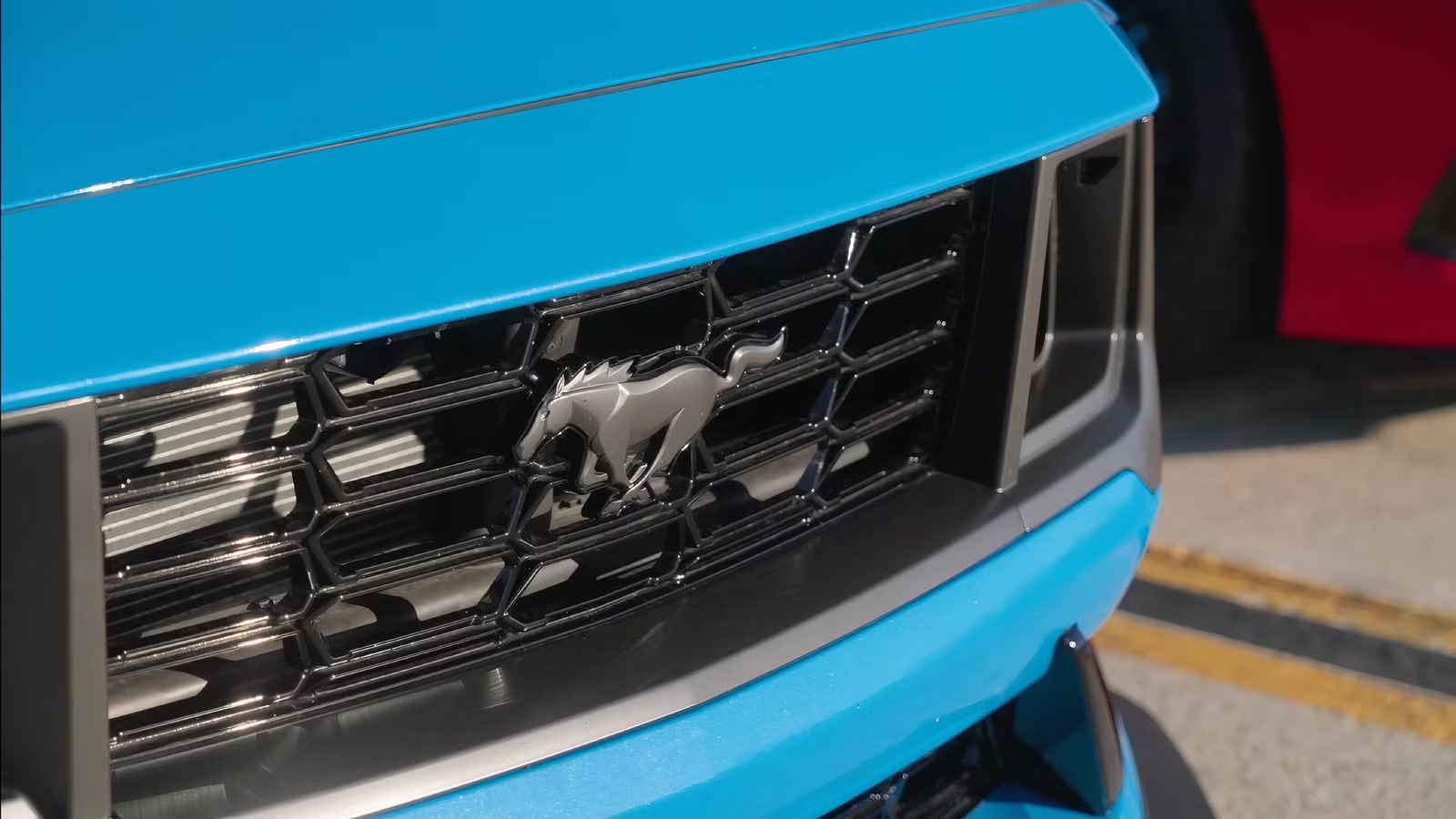
Muscle cars have always been about brutish power and straight-line speed, but as power became less of a differentiator, manufacturers needed to find new ways to stand out from the rest. Ford turned to its Mustang to prove that power alone wasn’t what makes a car fast and, in doing so, created what would become the benchmark that every other American muscle car had to meet.
American Muscle Entered A New Horsepower War In The 2000s

The closing years of the S550 Mustang era, which ran from 2015 to 2023, were some of the most competitive in American automotive history as Ford, Chevrolet and Dodge were locked in a horsepower battle. Numbers were continually increasing, as each wanted to release the most exciting V8 muscle car that drivers could take off the showroom floor.
Ford had been diversifying its Mustang offerings, with the GT350 being the naturally aspirated, track-ready version, the GT500 being a supercharged machine, and the Mach 1 combining elements of the two. Meanwhile, Chevrolet’s Camaro ZL1 paired supercar-level handling with a 650 hp output, and Dodge continued its development of the Hellcat, pushing it to 807 hp in Last Call models like the Black Ghost.
As horsepower figures climbed into increasingly impractical territory, Ford was facing a new challenge. It needed to create something that could truly compete and, hopefully, silence the other two brands. Rather than rely solely on Shelby for another model, Ford chose to create a new in-house performance flagship developed by Ford Performance.

Top 10 Fastest Mustangs Ranked
We’ve ranked the top 10 fastest Mustangs ever built, from track-focused beasts to supercharged street demons hitting over 200 mph.
Ford Wanted A New Kind Of Performance Mustang

As the market shifted, simply adding more power wasn’t enough to stand out. Both the ZL1 and the Hellcat had more power than the Mustang in their biggest trims, and it was reaching a point of diminishing returns as numbers climbed higher. Ford’s burgeoning Ford Performance department had grown into a fully-fledged performance division, and was after a flagship halo car that could sit above the Mustang GT. With cars already producing more power than any normal person could fully use, Ford Performance started looking elsewhere for improvements in speed rather than purely power. And one area that had been relatively under-explored in muscle cars was handling.
Muscle cars had traditionally prioritized straight-line acceleration over cornering ability, but the market was starting to demand more track handling and durability. Across the performance market, buyers were placing increasing value on sharp handling and driver engagement, as evidenced by the increase in Nürburgring development. Cars didn’t need to produce 700 hp to be enjoyable — they simply needed to inspire confidence through the corners. And while the Mustang had spent much of its life on tracks, Chevrolet was starting to sniff around the circuits, too. The ZL1 (or a highly-modified car bearing its name) had made a surprise entrance into the 2023 24 Hours of Le Mans in the experimental Garage 56 entry, and would line up on the NASCAR grid in 2024. It was a statement of intent, and one that Ford needed to answer.
The Ford Mustang Dark Horse Became Its Newest 500 HP Performance Benchmark

|
Engine |
Power |
Torque |
0–60 MPH |
Top Speed |
1/4 Mile |
|
5.0-Liter Coyote V8 |
500 HP |
418 lb-ft |
3.7 seconds automatic / 4.1 seconds manual |
166 MPH |
12.7 seconds @ 117 MPH |
Ford’s answer to the growing demand for muscle cars that could corner was 2024’s Dark Horse. The first new nameplate in 21 years, the Mustang Dark Horse was a dedicated performance car that would sit between the GT and any future Shelby variants. It would also form the core of Ford’s global motorsport program, taking on not just one, but two disciplines.
That’s because while Chevrolet opted to enter its ZL1 solely in the NASCAR Cup Series in 2024, Ford targeted both NASCAR and GT3 racing. This was a very clear and deliberate message from Ford: not only did they think the Dark Horse was good around a track, but that it was a complete all-rounder. A car that could legitimately hang with the big boys on the ovals and street circuits of NASCAR, and at the same time compete with GT3 cars from the likes of Ferrari, Lamborghini, and McLaren on the GT circuits of the world.
It would do this by utilizing Ford’s fourth-generation 5.0-liter Coyote V8 engine, which made 500 hp and 418 lb-ft of torque. Sure, these numbers weren’t exactly going to beat either of its main competitors in the ZL1 or the Hellcat, but Ford was more interested in how it used that power.

For a start, the V8 engine was naturally aspirated. This was in stark contrast to the ZL1 and Hellcat, and helped to give the car its unapologetic engine growl and throttle response. Of course, the massive power created by that engine meant that the car had to borrow the conrods, camshafts, and crankshaft from the Shelby GT500 to help tame the Dark Horse, while the carbon fiber wheels were an optional extra.
These parts helped the Dark Horse to squeeze out an extra 20 hp compared to the “regular” Mustang GT, despite both using the same Coyote engine. There were other changes, like the two cars having different six-speed gearboxes and different brakes (though both used Brembo), but the main difference was in the handling. The Dark Horse improved handling by being overall stiffer than the GT, running wider tires, using upgraded dampers, and incorporating aerodynamic changes like a different grille and a front splitter. Together, these changes made the Dark Horse feel far more composed than the standard GT, allowing drivers to more aggressively exploit performance around a circuit.
These combined into one of Ford’s most exciting Mustangs ever. Its GT racing endeavors showed immediate promise, with the Mustang GT3 scoring podiums in both the IMSA and FIA World Endurance Championships, and Mustangs scoring 12 wins in the NASCAR Cup. This may have put it second, just 34 points behind the Chevrolet, but it didn’t matter. Ford had unleashed the Dark Horse, and it had rewritten what a modern muscle car was capable of.
The Dark Horse Reset Expectations For Modern American Muscle

Prior to the Dark Horse, muscle cars were judged more on power than on performance. That both the ZL1 and Hellcat had upwards of 650 hp for what were, realistically, road cars showed that the marketing was centered around headline horsepower figures. By having a comparatively modest 500 hp and changing the conversation to how well it performed as a sports car, Ford rewrote what a muscle car was capable of.
This shift towards being a sports car was helped by Ford’s entry into the GT series of the world. It put the car on the world stage, against cars like the Porsche 911 GT3 R and Ferrari 296 GT3, and showed that muscle cars were not only able to compete with them, but that they should. That it did so with a naturally aspirated V8 only furthered Ford’s statement of intent, almost asking the question of why Chevrolet and Dodge couldn’t build cars that powerful without forced induction.
The Highest Horsepower Muscle Car With A Manual Transmission Ever
Think the ’60s had the most powerful manual muscle cars? This modern monster will make you think again.
Why The Dark Horse Is The Benchmark Every American Muscle Car Now Has To Beat

Having already established the Dark Horse as a performance machine, in 2026 Ford released the Dark Horse SC—SC standing for supercharged. It added almost 300 extra horsepower to the car, increased displacement from 5.0 liters to 5.2 liters, and acted as a bridge between the Dark Horse and Ford’s 815 hp Mustang GTD. Though not on the road at the time of writing, it represents another step in Ford’s evolving performance philosophy.
|
Ford Mustang |
Ford Mustang Dark Horse |
Ford Mustang Dark Horse SC |
Ford Mustang GTD |
|
|
Engine |
2.3-Liter EcoBoost |
5.0-Liter Coyote V8 |
5.2-Liter Supercharged V8 |
5.2-Liter Supercharged V8 |
|
Power |
315 HP |
500 HP |
795 HP |
815 HP |
|
Torque |
350 lb-ft |
418 lb-ft |
660 lb-ft |
664 lb-ft |
|
Starting Price |
$30,658 |
$58,630 |
$106,090 |
$325,000 |
This philosophy is ultimately what defines the Dark Horse’s legacy. Rather than chasing headline horsepower figures, Ford proved that a muscle car could be judged by how effectively it put its performance to use. The Dark Horse showed that outright speed, precise handling, and everyday usability didn’t have to exist separately, creating one of the most complete American performance cars of its generation. In doing so, it changed the benchmark from who could build the most powerful muscle car to who could build the best one.
Sources: Cars.com, LMR.com, Auto Express, Lorenzo Ford, Ford

Related posts



Latest Post


No Comments