
Harley-Davidson Nearly Built A V4 Muscle Bike Decades Before The Ducati Diavel
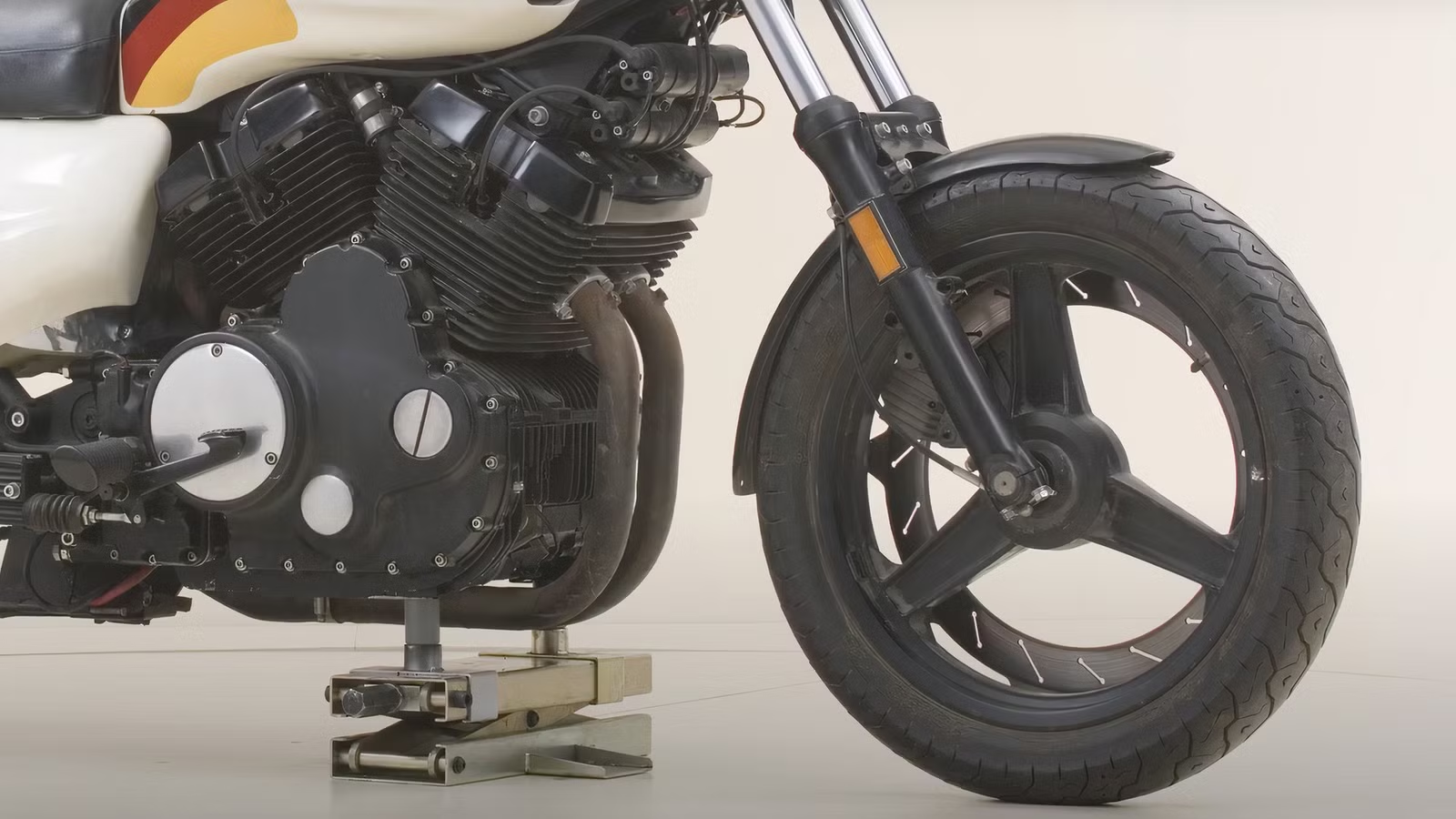
Long before modern power cruisers like the Ducati Diavel dominated the muscle cruiser segment with its aggressive chassis geometry and powerful V4 engine, an iconic American bikemaker secretly planned a massive performance revolution. During the late 1970s and early 80s, Harley-Davidson secretly worked on a high-revving muscle cruiser platform designed to kill foreign competition. The concept abandoned every lazy stereotypical design element associated with Harley’s heavyweight cruisers, opting instead for liquid cooling, overhead camshafts, and a stiff chassis layout. It was a bold move, unlike anything Harley-Davidson had previously attempted, and completely opposite to what it stood for.
The Secret 1980s Harley-Davidson Engineering Gambit

In 1976, executives over at Harley-Davidson’s parent company, American Machinery and Foundry (AMF), realized that air-cooled engine architecture was reaching its limits against the onslaught of high-output Japanese multi-cylinder motorcycles. To retain market relevance and attract a new generation of performance-minded riders, Harley-Davidson initiated a clean-sheet development effort. The secret project set out to develop a modular liquid-cooled engine family spanning multiple displacements and cylinder counts — from mid-size models to heavyweight muscle bikes.
Rather than building everything in-house, Harley-Davidson partnered with Porsche to handle engine engineering and casting design. The collaboration gave birth to a modular 60-degree V-engine platform that used a short 58mm stroke, allowing the engine to rev higher and operate completely opposite to Harley’s traditional long-stroke engines. Harley’s engineering team built functioning prototypes, logging tens of thousands of test miles to ensure durability.
The Harley-Davidson Nova: Porsche Tech, Modular Displacements, And High-RPM Capabilities


At the center of Harley-Davidson’s clandestine operation was the Nova, a prototype motorcycle powered by a liquid-cooled 60-degree V4 engine designed to decimate quarter-mile times. Built in 800cc and 1,000cc displacements, the DOHC 800cc variant produced 80 horsepower at 9,500 rpm, while the high-spec 1,000cc versions were developed to put out an astonishing 135 horsepower.
The modular engine architecture was remarkable. By sharing standard piston and cylinder dimensions, the bikemaker planned to offer 400cc and 500cc V-twins, 800cc and 1,000cc V4s, and even massive 1,200cc or 1,500cc V6 engines for tourers. Power was delivered through a 5-speed gearbox with a low-maintenance toothed belt final drive.
The chassis and bodywork solutions were decades ahead of their time. The cooling radiator was placed horizontally under the rider’s seat under the direction of Harley’s Styling Director, Willie G. Davidson, who wanted to hide the clunky and ugly-looking radiator from view. The conventional-looking fuel tank was actually a hollow airbox fed by dual air scoops upfront. The fuel cell was placed below the seat. Paired with a rigid pressed steel backbone frame using the engine as a stressed member, early prototype testing revealed that the motorcycle could comfortably cross 120 mph and corner as well as European tourers of the time.
The $10 Million Buyout Dilemma: Why the Evolution V-Twin Killed Off The Nova Program

By 1981, Project Nova was almost production-ready, with $10 million already sunk into development costs, tooling dies, and roughly two dozen running prototypes. However, a major corporate shift changed everything. Harley-Davidson broke free of parent company AMF, but the resultant buyout brought massive debt and limited capital.
Faced with a cash crunch, leadership realized they could not afford to manufacture both the radical liquid-cooled V4 and the newly designed air-cooled Evolution V-twin simultaneously. The former was a high-risk, high-cost bet that would require new tooling, while the other was a less risky traditional one that would require low capital cost. They chose the safer financial route, pooling their remaining resources into the traditional Evo motor to preserve their core customer base. The gamble worked, saving the company from bankruptcy, but the fallout was that the Nova program was shelved indefinitely.
V-Rod to Pan America: The Lasting Legacy of Harley’s Nova V4

Although the Harley-Davidson Nova never saw the light of production, its underlying engineering DNA lived on. The close partnership with Porsche laid the groundwork for the 2002 VRSC V-Rod. The V-Rod was a muscle cruiser heavily influenced by the Nova concept, featuring liquid cooling, double overhead cams, a perimeter frame, dummy top fuel tank housing the airbox, and a fuel cell below the seat.
Today, the high-performance liquid-cooled DNA lives in Milwaukee’s modern lineup through the Revolution Max engine series powering motorcycles like the Pan America 1250 and Sportster S. While muscle bike enthusiasts will always wonder how the market would have reacted to a high-revving 135 horsepower Harley V4 back in 1981, the bold experiment proves that American engineers were working on a muscle cruiser decades before the Ducati Diavel.

Related posts
Latest Post


No Comments