
10 Junkyard V8s That Can Make Big Power On A Small Budget
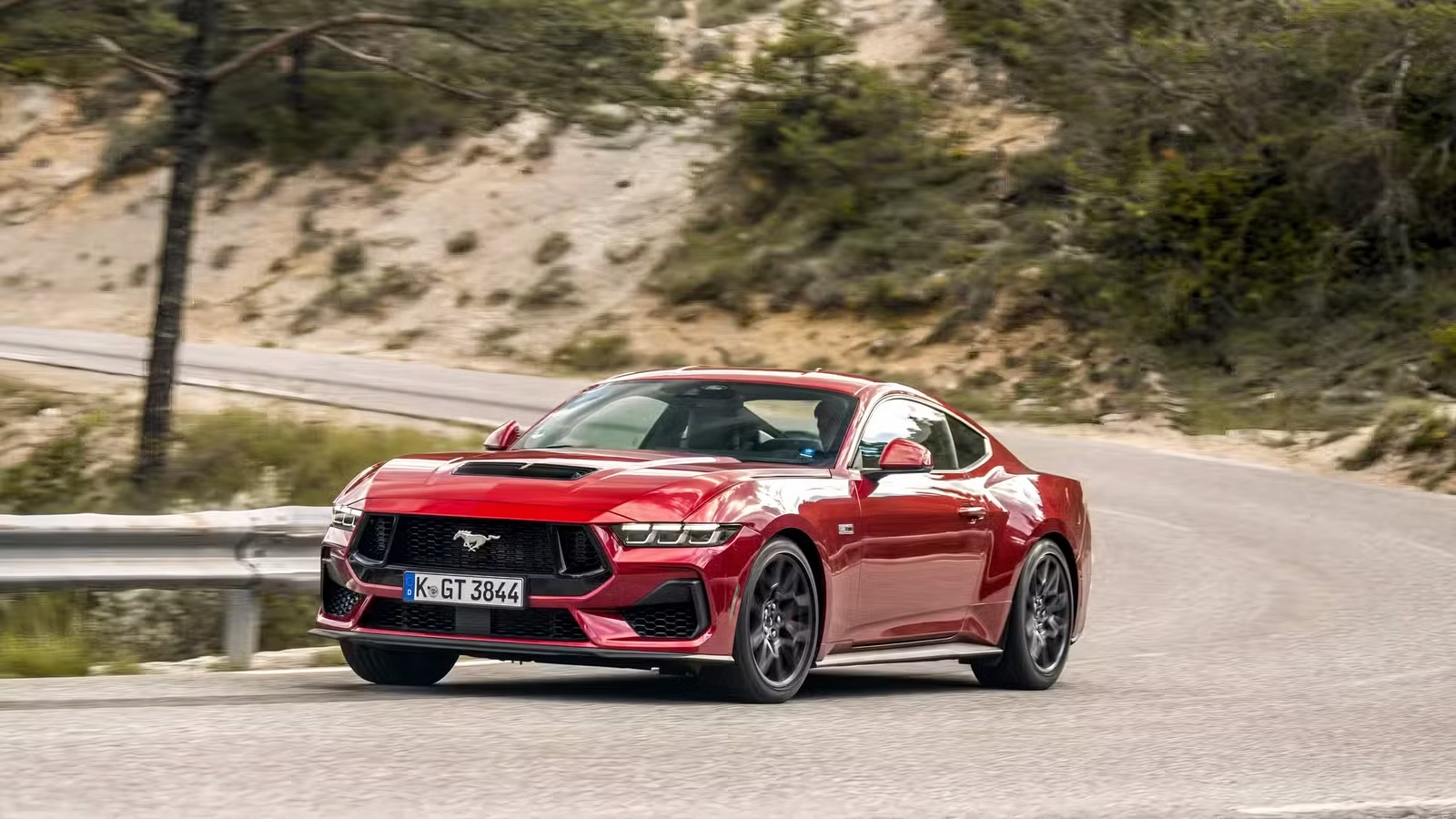
Cheap horsepower has become harder to find, but the junkyard still offers an alternative to spending five figures on a crate engine. The catch is that not every inexpensive V8 is actually a bargain. Some arrive with impressive factory output but carry high replacement prices, while others cost almost nothing and require extensive modifications just to feel powerful. The best choices strike a balance between availability, purchase price, stock performance, and the strength to handle more. From overlooked 4.8-liter truck engines to modern Hemis and Coyotes, these 10 junkyard V8s prove that big power is still possible on a small budget, provided you start with the right foundation.

Note: These engines are ranked using a price-to-performance methodology. Emphasis is placed on initial affordability (40 percent), stock output (30 percent), realistic power potential (20 percent), and availability and supporting costs (10 percent). Potential horsepower figures are estimates and not a guarantee of actual power.
1
Ford 5.0-Liter Coyote
Typical Used Price: $2,000–$4,500 | Stock Output: 360–460 Horsepower
The Coyote is the most expensive engine here, but it is also the most powerful before modification. Early F-150 versions produced around 360 horsepower, while Mustang GT engines ranged from 412 horsepower in the first generation to 460 horsepower in later models within this price range. Prices depend heavily on generation, donor, mileage, and completeness. An inexpensive truck long block may not include the wiring, ECU, accessory drive, intake, or controls needed for a swap. Current advertised F-150 engine listings show prices ranging from roughly $1,500 for an early, high-mileage unit to more than $3,000 for later engines.
Potential Output: 450–500 Horsepower N/A | 650–750 Horsepower Boosted

Long-tube headers, a Mustang-style intake manifold, a cold-air intake, and calibration can substantially improve an early-truck Coyote. Camshafts, cylinder-head work, and higher-rpm intake components can bring a naturally aspirated combination toward 500 crank horsepower, although the cost rises quickly.

A supercharger or twin-turbo system can put a healthy Coyote in the 650–750 horsepower range without sacrificing normal street behavior. The build requires sufficient injectors, fuel-pump capacity, intercooling, spark control, and an experienced tuner. The engine’s breathing makes the power relatively easy to achieve; paying for the engine, controls, swap hardware, and drivetrain is what prevents the Coyote from ranking higher in a small-budget comparison.
2
Toyota/Lexus 4.0-Liter 1UZ-FE
Typical Used Price: $600–$1,500 | Stock Output: 250–300 Horsepower

Toyota’s aluminum 1UZ-FE powered the Lexus LS 400, SC 400, and GS 400. Early versions generally produced around 250 horsepower, while later VVT-i engines approached 290–300 horsepower. The 1UZ is smooth, compact, and exceptionally well-engineered, but the purchase price does not tell the entire story. Transmission adapters, engine management, exhaust fabrication, and front- or rear-sump oil-pan requirements can increase the total cost of the swap.
Potential Output: 325–375 Horsepower N/A | 450–550 Horsepower Boosted

Naturally aspirated gains require headers, freer-flowing intake and exhaust systems, camshafts, higher compression, and programmable engine management. Those components can move a later engine toward 350 horsepower, but the cost per horsepower is usually higher than it is with an LS.
A supercharger or turbocharger can generate approximately 450–550 horsepower. Early non-VVT-i engines are often favored for straightforward boosted projects, but fuel delivery, intercooling, engine management, and precise tuning remain mandatory. Forged internal components are advisable when high boost or sustained track use is planned.
3
Ford 5.0-Liter Explorer V8
Typical Used Price: $400–$900 | Stock Output: 210–215 Horsepower

The 1996–2001 Explorer and Mercury Mountaineer 5.0 produces only about 210–215 horsepower, but horsepower alone does not explain its popularity. These engines came with useful GT40 or GT40P-style cylinder heads, a capable factory intake, a roller camshaft block, and compact pushrod architecture. They are attractive to owners building older Mustangs, hot rods, and compact trucks because the donor provides several desirable small-block Ford components in one package. GT40P heads can create spark plug and header clearance complications, however.
Potential Output: 300–350 Horsepower Naturally Aspirated

A more aggressive hydraulic-roller camshaft, upgraded valve springs, headers, improved exhaust, intake work, and ECU or carburetor tuning can move the Explorer engine toward 300 horsepower. Aftermarket cylinder heads and additional compression can push it closer to 350.
The factory block becomes a concern at much higher output levels, particularly under detonation or at heavy boost. The Explorer 5.0 makes the most sense as a responsive 300-horsepower street engine rather than a foundation for chasing four-digit dyno numbers.
4
Dodge 5.9-Liter Magnum
Typical Used Price: $400–$1,000 | Stock Output: 230–250 Horsepower

The 5.9 Magnum appeared in Ram pickups, Dodge Durangos, Dakota R/Ts, and full-size vans. Its 230-to-250-horsepower rating appears unimpressive, but the engine compensates with displacement, low-speed torque, traditional pushrod construction, and relatively simple electronics. A pre-purchase inspection should include the intake plenum gasket and the cylinder heads. Failed plenum gaskets can cause oil consumption and detonation, while cracked cast-iron heads are sufficiently common that a cheap takeout engine should not automatically be considered usable.
Potential Output: 350–425 Horsepower Naturally Aspirated

The Magnum responds to a performance camshaft, upgraded valve springs, corrected intake manifold, headers, higher-flow cylinder heads, and proper fuel and ignition tuning. Approximately 350 horsepower is realistic with a moderate combination, but reaching 400–425 horsepower generally requires serious cylinder-head work, more compression, and a carefully selected cam and intake.
Forced induction is possible, but it is less attractive for a budget build because the pistons, tuning ecosystem, and aftermarket support are not as boost-friendly as an LS platform. For that reason, its stated potential focuses on a conventional naturally aspirated build.
5
Ford 4.6-Liter Two-Valve Modular
Typical Used Price: $300–$800 | Stock Output: 215–260 Horsepower

Ford installed the two-valve 4.6 in Crown Victorias, Grand Marquis, Town Cars, Mustang GTs, F-150s, Expeditions, and other high-volume models. That makes it one of the easiest V8s to find at a self-service salvage yard. Output varies significantly by application. Full-size sedans generally sit near the bottom of the 215-to-260-horsepower range, while later Mustang GT versions benefit from Performance Improved cylinder heads and intake components. Buyers should confirm whether an engine has PI or earlier non-PI heads before planning the build.
Potential Output: 300–330 Horsepower N/A | 400–450 Horsepower Boosted

Reaching 300 horsepower naturally aspirated generally requires PI heads and intake, aftermarket camshafts, headers, a better exhaust, and tuning. The relatively small displacement and restrictive two-valve heads make additional naturally aspirated gains expensive.
A centrifugal supercharger or turbocharger offers a more direct route to 400–450 horsepower. The build needs larger injectors, a higher-capacity fuel pump, intercooling, and conservative tuning. Stock powdered-metal connecting rods become a concern as torque and boost rise, so this should be treated as a moderate-power combination rather than an inexpensive 600-horsepower foundation.
6
Nissan 5.6-Liter VK56DE
Typical Used Price: $600–$1,400 | Stock Output: 305–320 Horsepower

The VK56DE is an underappreciated aluminum V8 found in early Nissan Titan, Armada, Pathfinder, and Infiniti QX56 models. The original Titan version produced 305 horsepower and 379 pound-feet of torque, giving it a stronger starting point than many similarly priced American truck engines. Its drawback is not the engine itself but the smaller swap ecosystem. Transmission adapters, wiring solutions, headers, oil-pan conversions, and tuning support are less plentiful than equivalent LS components.
Potential Output: 375–425 Horsepower N/A | 500–600 Horsepower Boosted

Headers, freer-flowing intake and exhaust systems, camshafts, valve springs, and ECU tuning can move the VK56DE toward 400 crank horsepower. Kelford offers VK56DE camshafts designed to strengthen midrange or high-rpm output, demonstrating that meaningful valvetrain support exists even if it is not as extensive as LS-level.
Moderate turbocharging can produce 500 to 600 horsepower. Reaching that level requires custom fabrication, intercooling, fuel-system upgrades, engine management, and a tuner familiar with the VKplatform. The additional fabrication expense can eliminate the savings created by the engine’s low purchase price.
7
Chrysler 5.7-Liter Gen III Hemi
Typical Used Price: $900–$2,000 | Stock Output: 335–395 Horsepower

The 5.7-liter Hemi offers considerably more factory output than most older junkyard V8s. Early Ram versions produced 345 horsepower, while output varies across later Ram, Charger, Challenger, Chrysler 300, Magnum, Durango, and Jeep applications. Later Eagle engines introduced improved cylinder heads, variable valve timing, and outputs approaching 395 horsepower. The original 345-horsepower rating is documented in Stellantis’ history of the modern Hemi. Before buying one, the owner should inspect for valvetrain noise, damaged lifters, worn cam lobes, broken exhaust-manifold bolts, and differences between MDS and non-MDS applications.
Potential Output: 425–475 Horsepower N/A | 550–650 Horsepower Boosted

A camshaft, upgraded valve springs, long-tube headers, intake work, and custom tuning can move a 5.7 Hemi beyond 400 horsepower. Eagle cylinder heads provide a better starting point, while early engines may need additional head work to approach 475 horsepower.
A supercharger or turbocharger can produce approximately 550 to 650 horsepower, but the factory pistons and ring lands place practical limits on aggressive boost. Larger injectors, an upgraded fuel system, intercooling, colder plugs, and conservative ignition timing are essential. Forged pistons and connecting rods are sensible investments when the owner regularly wants to use the upper end of the range.
8
GM 6.0-Liter LQ4/LQ9
Typical Used Price: $800–$1,800 | Stock Output: 300–345 Horsepower

The LQ4 and higher-output LQ9 combine an iron block with six liters of displacement. Common donors include Chevrolet and GMC heavy-duty pickups, Express and Savana vans, Cadillac Escalades, and certain high-performance GM SUVs and trucks. Most LQ4 applications produced approximately 300–325 horsepower, while the higher-compression LQ9 produced 345 horsepower. LQ9 engines generally command higher prices due to their output, compression ratio, and availability in more desirable donor vehicles.
Potential Output: 425–475 Horsepower N/A | 700-Plus Horsepower Boosted

The 6.0 responds particularly well to a camshaft, upgraded springs, long-tube headers, intake work, and tuning. A well-matched cylinder-head and camshaft combination can generate approximately 450 crank horsepower while retaining the stock rotating assembly.
Forced induction unlocks the LQ4/LQ9’s greater advantage. A turbo system, intercooler, larger injectors, high-flow fuel pumps, head studs, and professional calibration can put one beyond 700 horsepower. The factory iron block is stout, but owners should not treat 700 horsepower as an automatic safe limit. Piston-ring clearance, detonation, engine condition, and tuning ultimately determine how long it survives.
9
GM 5.3-Liter LM7
Typical Used Price: $400–$1,000 | Stock Output: 270–295 Horsepower

The iron-block LM7 is one of the most plentiful LS-family engines in salvage yards. It powered millions of Chevrolet and GMC pickups, vans, and SUVs between the late 1990s and late 2000s. Its broad donor supply also makes wiring harnesses, computers, swap mounts, oil pans, and replacement parts relatively inexpensive. GM offered the LM7 with outputs ranging from 270 to 295 horsepower and approximately 315 to 335 pound-feet of torque. Holley identifies the LM7’s output range and major donor applications.
Potential Output: 350–400 Horsepower N/A | 550–650 Horsepower Boosted

A camshaft, valve springs, long-tube headers, intake improvements, and custom tuning can place an LM7 around 350 to 400 crank horsepower. Cylinder-head work may be necessary if the goal is near the top of that range.
A single turbo running moderate boost can move a healthy stock-bottom-end LM7 into the 550-to-650-horsepower neighborhood. That result requires larger injectors, a high-capacity fuel pump, intercooling, colder spark plugs, proper crankcase ventilation, and careful tuning. The inexpensive engine does not make the entire combination inexpensive; the fuel system, transmission, rear axle, and cooling package must survive the additional power.
10
GM 4.8-Liter LR4/LY2
Typical Used Price: $300–$800 | Stock Output: 255–295 Horsepower

The 4.8-liter truck V8 is frequently overshadowed by GM’s larger 5.3- and 6.0-liter engines. That works in a budget builder’s favor because sellers often price it below otherwise similar LS-family engines. LR4 and LY2 versions appeared primarily in Silverado, Sierra, Express, and Savana models. Depending on its year and application, factory output ranged from approximately 255 to 295 horsepower. The engine’s short 3.27-inch stroke also helps it tolerate engine speed, although the smaller displacement produces less low-end torque than a 5.3 or 6.0. Holley’s LS engine guide explains the dimensional differences among GM’s LS-based engines.
Potential Output: 325–375 Horsepower N/A | 500–600 Horsepower Boosted

Reaching approximately 350 naturally aspirated horsepower normally requires a performance camshaft, matching valve springs, long-tube headers, a freer-flowing intake, and ECU tuning. Better-flowing cylinder heads can move the result toward the upper end of the range.
A turbocharger is the more cost-effective route to 500 horsepower. The owner will need an appropriately sized turbocharger, an intercooler, larger injectors, an adequate fuel pump, stronger valve springs, and a conservative ECU calibration. Ring gap, fuel quality, oil pressure, and the condition of the original bearings become critical when boosting an unopened high-mileage engine.
Sources: Manufacturer Websites, Holley Performance Brands, Autoweek, Car and Driver, MotorTrend, 603AutoSalvage, eBay

Related posts





Latest Post


No Comments