
Gen X Needs To Accept That This Buick Station Wagon Is Cooler Than Any Corvette
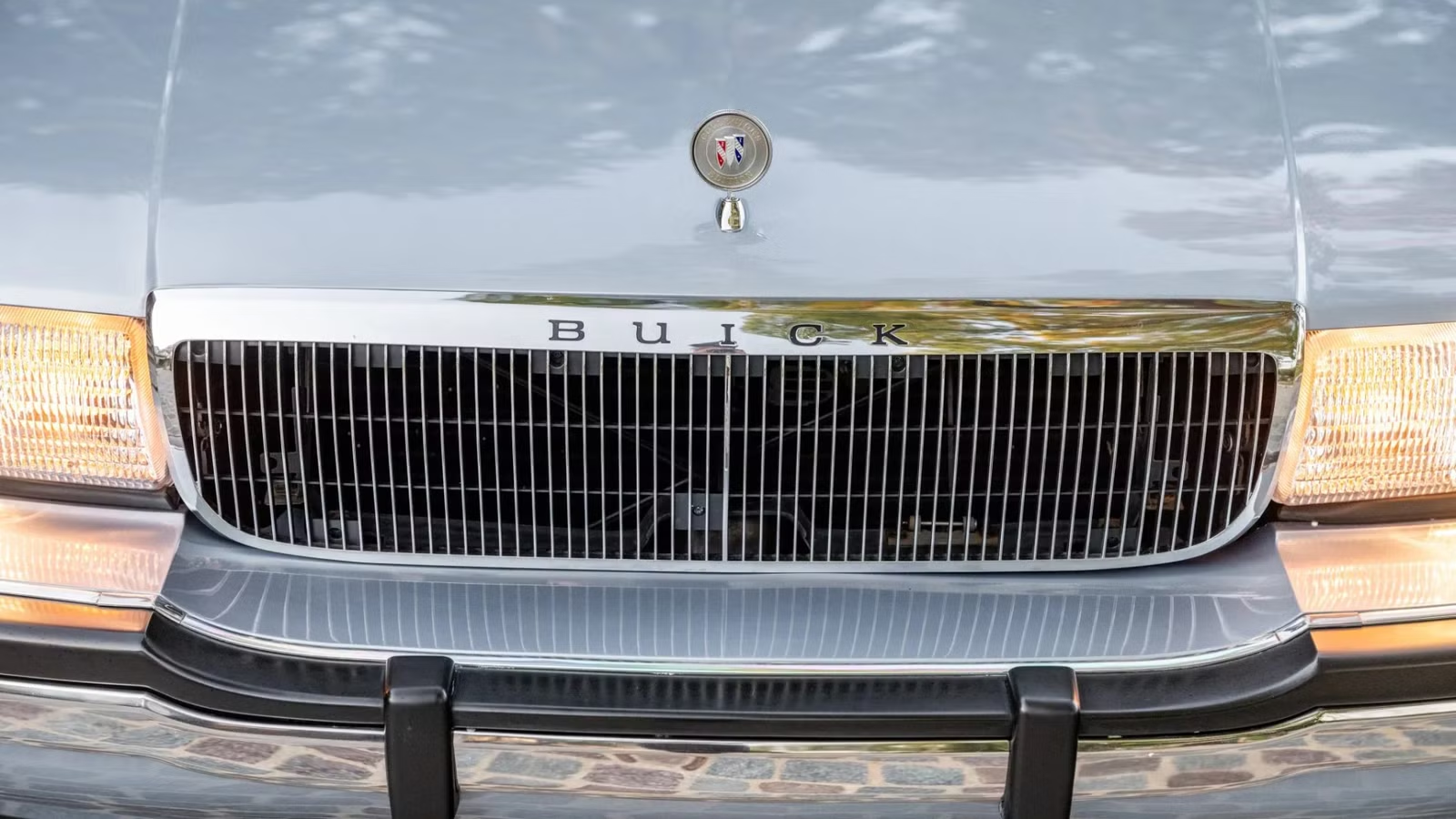
Woodgrain down the sides, a tailgate that swung two ways, and two kids in a rear-facing third row. That was what an average school run looked like in 1995. Gen X rode in these wagons and hated every mile of them.

The poster on the wall was a Corvette, but in the driveway was a station wagon. Except one of those wagons had the Corvette’s engine under the hood, and almost nobody in the family ever found out. It was the cooler car then. It is still the cooler car now, and prices are only starting to admit it.
The Overlooked Era Of The 1990s Family Station Wagon
Eight seats, a folding rear-facing third row, and more than 90 cubic feet of cargo space made the full-size wagon the default American family tool. Buick, Chevrolet, and Oldsmobile each sold one, and owners bragged about swallowing a 4×8 sheet of plywood, which these cars did better than most pickups of the era.

GM built just over 29,000 full-size wagons across three brands in 1992. Chrysler moved roughly 250,000 Plymouth Voyagers that same year, and Ford sold close to 300,000 Explorers. The long-roof was already losing, and everyone in the industry could see it.
Enthusiasts looked straight past these cars anyway. Behind the vinyl woodgrain sat a body-on-frame chassis, rear-wheel drive, a live rear axle, and a V8 under a very long hood. Every ingredient of a cheap hot rod was already bolted together at the factory.
The sleeper wagon just wore the wrong clothes. It had a luggage rack instead of a spoiler, whitewalls instead of fat rubber, and a badge that promised comfort rather than speed. Nobody at a stoplight in 1995 gave one a second look, which turned out to be the whole point.
Buick Secretly Borrowed Corvette Power For Its Family Hauler

Every 1994, 1995, and 1996 Buick Roadmaster Estate left the factory with a 5.7-liter LT1 V8, the same engine family that powered the C4 Corvette, the Camaro Z28, and the Pontiac Firebird. It wasn’t an option, special order, or some skunkworks performance trim sold under the table. It was simply the engine that it came with.
The LT1 made 260 hp, a major improvement from 180 hp from the engine it replaced. The move from multiport to sequential-port fuel injection accounted for the entire 80 hp gain. A wagon that had been merely adequate could suddenly keep up with traffic in a way no Buick buyer had asked for.

Buick could pull this off because the old 5.7-liter V8 could not meet upcoming emissions rules. Reaching into the Corvette parts bin allowed GM engineers to keep a big engine in the lineup without spending serious development money. The most interesting engine swap of the decade was, in part, an accounting decision.
Buick’s 1994 full-line brochure bragged about it, calling the new 260 hp V8 enough to make the Roadmaster the most powerful American car of its kind. Coming from a brand that sold cushioned, isolated interiors, that is strange.

The wagon’s LT1 was not entirely a Corvette engine in every detail though. Buick, Caprice, Cadillac, and Impala SS versions used cast-iron cylinder heads where the Corvette, Camaro, and Firebird got lighter aluminum heads. Only the Corvette block received four-bolt main caps, and the wagon’s camshaft was milder.
Everything else carried straight over. Same block casting, reverse-flow cooling, sequential port injection, and even the factory dual exhaust. The Corvette engine’s performance is more than most sleeper legends manage once you start checking part numbers.
How Heavy-Duty Towing Specs Created An Accidental Sleeper

The LT1 in the Roadmaster Estate made 260 hp at 5,000 rpm and 330 lb-ft of torque. Power went to the rear wheels through a 4L60E four-speed electronic automatic, which arrived for 1994 alongside the engine and a stainless-steel dual exhaust system.
Rear axle gearing is where these wagons split into two very different cars. Standard cars ran a tall 2.56 ratio. The trailer towing package brought a 2.93 ratio, a limited-slip differential, upgraded engine cooling, air shocks, and a 5,000-pound tow rating.
Those towing-package parts worked just as well on a drag strip. The shorter gearing and a locking differential are exactly what a heavy rear-drive car needs to launch. Buick sold the option to people hauling boats, and it quietly turned out to be the performance package.

The 40 hp the Buick gave up to the Corvette is the wrong number to focus on. The Roadmaster’s camshaft was re-profiled specifically for low-end torque, which is the opposite of a compromise in a car this heavy. The Corvette needed revs to feel fast; the wagon needed shove at 30 mph with a trailer behind it, and that is what Buick built.
Published figures put the Estate Wagon at 7.8 seconds to 60 mph and 15.5 seconds in the quarter mile. Owner timeslips back that up, with one 1995 wagon running 15.19 seconds at 91 mph. That is respectable for something carrying more than 4,500 pounds, eight people, and a full set of groceries.

A 1995 Mustang GT made 215 hp and 285 lb-ft. The SVT Cobra managed 240 hp, and the Camaro Z28 made 275 hp and 325 lb-ft. The Buick wagon out-torqued the Mustang GT, sat 15 hp behind a Z28, and stickered at $26,110 with vinyl wood on the doors and a luggage rack on the roof.
Why GM Killed Long-Roofs To Build High-Profit SUVs

The B-body line at Arlington Assembly built its last car in December 1996. Fewer than 23,000 Roadmasters found buyers in that final year, and the nameplate has not returned since. GM had already made its choice about what the plant would build next.
It was the last GM plant still building B-bodies when the company decided to consolidate, and it converted to assemble trucks in 1997. The building is still running today, assembling the Chevrolet Tahoe and Suburban, GMC Yukon, and Cadillac Escalade.
SUVs commanded higher prices, resulted in better profit margins, faced looser fuel economy rules, and sold in volumes wagons could not touch. Giving that floor space to trucks was the obvious call for the bottom line.

Roadmaster sales had already fallen off a cliff, dropping from more than 85,000 in 1992 to roughly a quarter of that by 1996. Just over 200,000 were built across the entire 1991 to 1996 run, which is a small number for a full-size car sold over six model years.
The wagon did not lose to the minivan or the Explorer. It lost its own factory floor to its own replacement, and thirty years later that same building is still shipping Escalades to dealers by the thousands.
How To Find A Clean LT1 Wagon

Clean LT1 Roadmaster wagons have been trading between roughly $9,000 and $18,000. Recent tracked sales include $17,600 in July 2026, $16,500 and $12,100 in late June, and $9,450.
The eighth digit of the VIN is the fastest way to confirm the engine: P means LT1, W means the 4.3-liter L99. Factory dual exhaust is the quick visual check, since L99 cars ran a single pipe. Every 1994 to 1996 wagon came with the LT1, so a mismatch means someone has been under the hood.
It is best to pay up for a rust-free car under 75,000 miles rather than chase a cheap runner. The OptiSpark distributor is the known weak spot on any LT1 of this era.

Those cast-iron heads are the first thing to change if you want more. Corvette or F-body aluminum heads are a direct swap, and a tune alone is advertised at 15 to 20 hp.
A 1991 to 1993 wagon has the older L05 or the 5.0-liter V8 and none of the appeal; buyers confuse the two constantly. The trailer towing package is the option to hunt for, because of the 2.93 gearing and limited-slip differential. The Limited trim adds leather, the Vista Roof, and the full equipment list. The 1996 Collector’s Edition badge sounds special, but every 1996 Roadmaster wore one.
A decent C4 Corvette from the same years costs about the same money today. The difference is that everyone at the show already knows what the Corvette is, and nobody has ever been surprised by one.
Sources: Chevrolet, Classic.com

Related posts



Latest Post


No Comments