
This Lambo Minivan Could Have Changed The Way We Look At Supercars
We are used to cars doing everything nowadays. EV that can crush a supercar? No problem. Off-roader that you can take to a track day? Of course. But back in the ’80s, things were different. You had a hatchback if you wanted to drive around town or pop to the supermarket, and you had a supercar if you wanted to wear mirrored sunglasses and drive 10 miles on a Sunday morning. But before all the genres got mashed together, one company dared to do something different — but did it work?
Supercars Were Out Of Control In The ’80s

The term supercar had arrived with the Lamborghini Miura, a car created by a tractor manufacturer because he allegedly had a dispute with Ferrari. This V12 mid-engined machine hit 170 mph with ease and was driven by rock stars, sporting eyelashes over its headlights and a tendency to (allegedly) take off at a certain speed. But if you thought that supercars were unhinged in the ’70s, it was nothing compared to the ’80s.
The Ferrari Testarossa looked like it had Wolverine’s Weapon X bolted onto the doors, and the Lamborghini Countach had a rear window so small it could double as a speakeasy door slot. Supercars were designed to be wild, temperamental, and hard to live with — people didn’t want them because they were practical and user-friendly. Nothing made sense in the ’80s, a period when shoulder pads were so big that you walked through a door sideways. But times were changing.
Customers Needed Something Different

While stockbrokers were buying supercars during their lunch break in the mid-’80s, by the end of the decade it was all starting to come crashing down. The Black Monday crash of 1987 sent shock waves through the yuppie elite, and many high-end carmakers started to struggle. Flaunting excess wealth suddenly went out of fashion. If you were a company owner who had to lay off a few staff, you’d be far better off driving one of the new stealthy sleeper sedans, such as the E28 BMW M5 (equipped with an M1 supercar engine), as it would attract a lot less attention to how deep your pockets were.

At the same time, a new kind of car was becoming popular: the MPV. The Chrysler Voyager and Dodge Caravan in the US, and Renault Espace in Europe, were proving that you could have essentially a plush van with car manners; a perfect device for the busy growing family. Maybe there was an opportunity for something completely new.
The Bertone Genesis Was A Completely New Type Of Supercar

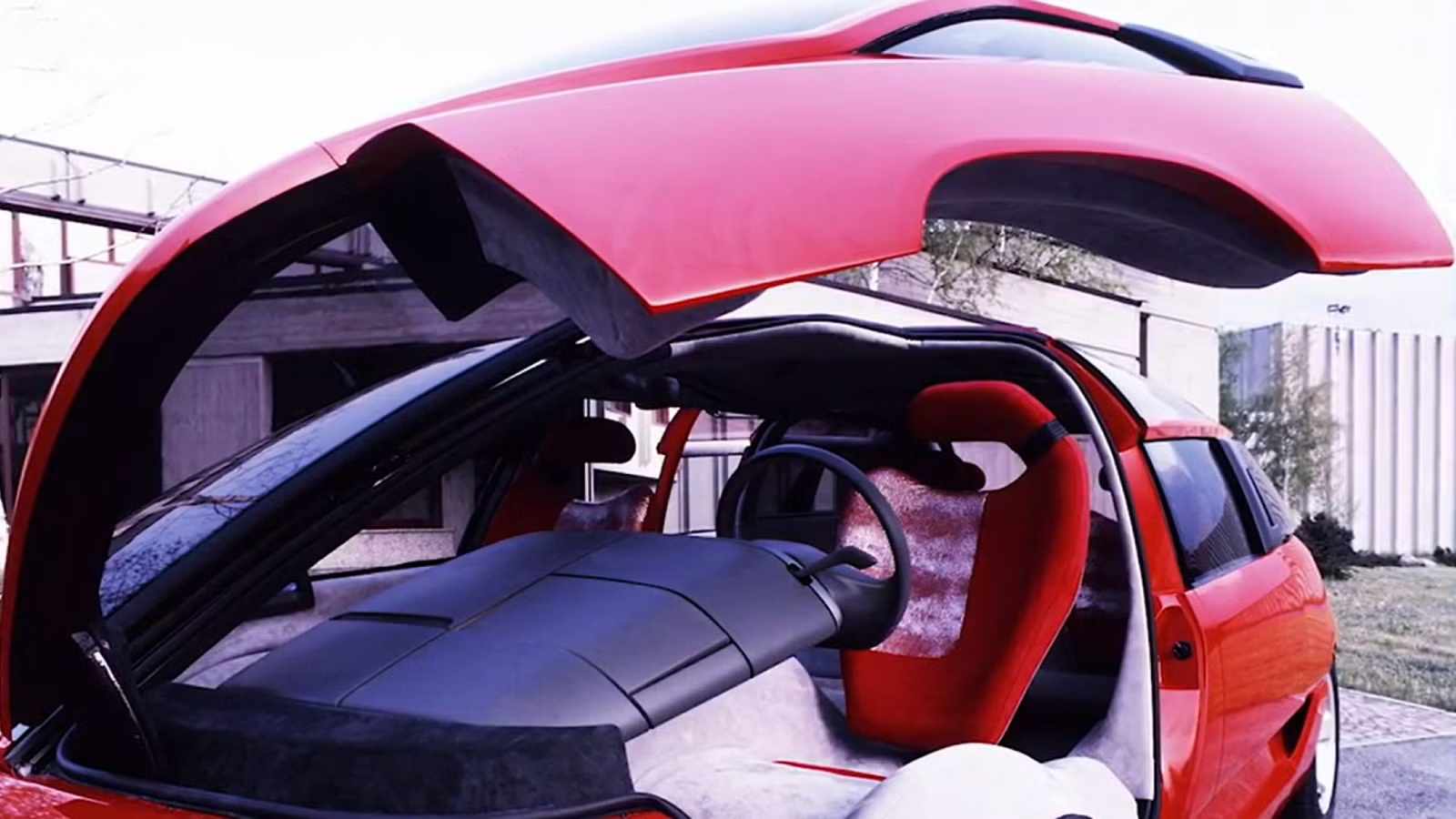
The Bertone Genesis essentially combined every hot car genre of the late ’80s into one extraordinary vehicle. Bertone was reportedly worried that its relationship with Lamborghini was under threat, so the legendary Italian car styling and coachbuilding company decided to fit an MPV with a Countach V12 engine. Even so, wrapping it in a one-box design certainly would have appealed to those interested in sleeper cars and family machines at the time. The work of Marc Deschamps, the Genesis was launched at the 1988 Turin Motor Show. At 14 ft 8 in long and 6 ft 9 in wide, and five feet tall, it had the footprint of a sports car rather than a large people carrier, and could, curiously, only seat four people (five with a small jump seat).
If you weren’t impressed by the twelve-cylinder powerplant, you certainly would have been by the supercar-style beetle-wing doors that hinged in the middle of the windshield. Once inside, the seats were reclined, but you still had a commanding view of the road. In a world where cars still tended to focus on one ability, the Genesis attempted to roll everything you needed into one vehicle. Well, perhaps you didn’t strictly need a Countach V12.
The Genesis Matched Lambo Power With Chrysler Transmission

The front occupants sat nearly on top of a 48-valve V12 from a Countach, sensibly linked to a three-speed Chrysler TorqueFlite automatic transmission to calm things down. This 5000 QV (Quattrovalvole) unit came in at 5.2 liters and produced 455 horsepower and 369 lb-ft. It could be argued that it might be a bit much in a vehicle where your legs were hanging out over the front axle.
But then there was the weight. It is estimated that the Genesis somehow weighed in around two tonnes, which, combined with the long ratios in the gearbox, probably meant that it wouldn’t get off the line quite like Lamborghini’s iconic supercar. But a lot of it made sense. The swiveling front seat, the sliding doors — they were all clever nods to the functionality needs of the family. Plus, the Swiss Army Knife concept was groundbreaking — but more on that in a moment.
Here’s What Happened To The Bertone Genesis

The Genesis, as you probably realized, never went into production. Many of its details seemed frivolous, and were certainly more motor-show spectacle than anything else, but with proper development it had potential. Lamborghini went back to what it did best — having also dabbled with a Countach-powered SUV in the form of the Rambo Lambo LM002 — and created the Diablo for the ’90s. The Genesis concept then went on to be shown at the Museo Volandia in Somma Lombardo, Italy, before it was returned, along with the rest of the ASI Bertone Collection, to Stellantis’ new Heritage Hub. It now resides alongside a Lamborghini Espada (1970), Lancia Stratos (1975), Suzuki Go (1970), and Citroën Camargue (1972).
The Genesis Seemed Like A Failure — But Did It Predict The Future?
This is the point where we could easily say the Genesis was a failure and move on. But in many ways it was just too far ahead of its time for its own good. There are a lot of similarities with the production Renault Avantime, a futuristic sports MPV with a 207 hp V6 engine. The very concept of an upmarket model from a supercar manufacturer, with the power of a mid-engined exotic, was taken up by Lamborghini much later — in the form of the Urus. The Ferrari Purosangue is a V12-powered kind of SUV that blurs the lines between genres. Nuccio Bertone is quoted in the Genesis press release as saying: “Genesis represents a vision of a possible GT car for coming decades which incorporates the mobility and comfort requirements of the near future.” Looking at the kinds of cars that are popular today, he wasn’t far wrong.
Nuccio also said: “I’m convinced that — in the near future — reliability will be so good that we will not have the need to reach the engine compartment easily anymore. A car will be like a fridge; it will work for years and years without the need for maintenance”. It is no stretch of the imagination that a modern EV is edging closer to a tech appliance than to a collection of moving parts. The Genesis MPV may not have come to fruition, but a supercar for the whole family is something we are very much in favor of.
Sources: Hagerty, Bertone, Lamborghini

Related posts





Latest Post


No Comments